International Finance: Exchange Rates, Trade, and Balance of Payments
Exchange rates are prices in a system of accounts. Read how the balance of payments constrains them and why a rate series has a revision history.
Currency movements are usually reported as a story about a country getting stronger or weaker, and that framing is misleading in a specific way. An exchange rate is a relative price, and relative prices are determined by the interaction of trade, capital flows, and policy — inside a system of accounts that must balance. You cannot understand the price without the accounts.
Direct answer: A bilateral exchange rate is the price of one currency in terms of another; an effective exchange rate is a weighted average against a basket of trading partners, and it is the better measure of a currency's overall movement. The balance of payments records a country's transactions with the rest of the world and must balance, so a current-account deficit is matched by a capital-account surplus. The Federal Reserve publishes both the bilateral series and "Summary Measures of the Foreign Exchange Value of the Dollar" in its H.10 release, including a documented change to the indexation of its dollar indexes effective 24 June 2019 — which is a reminder that even the benchmark series have construction histories.
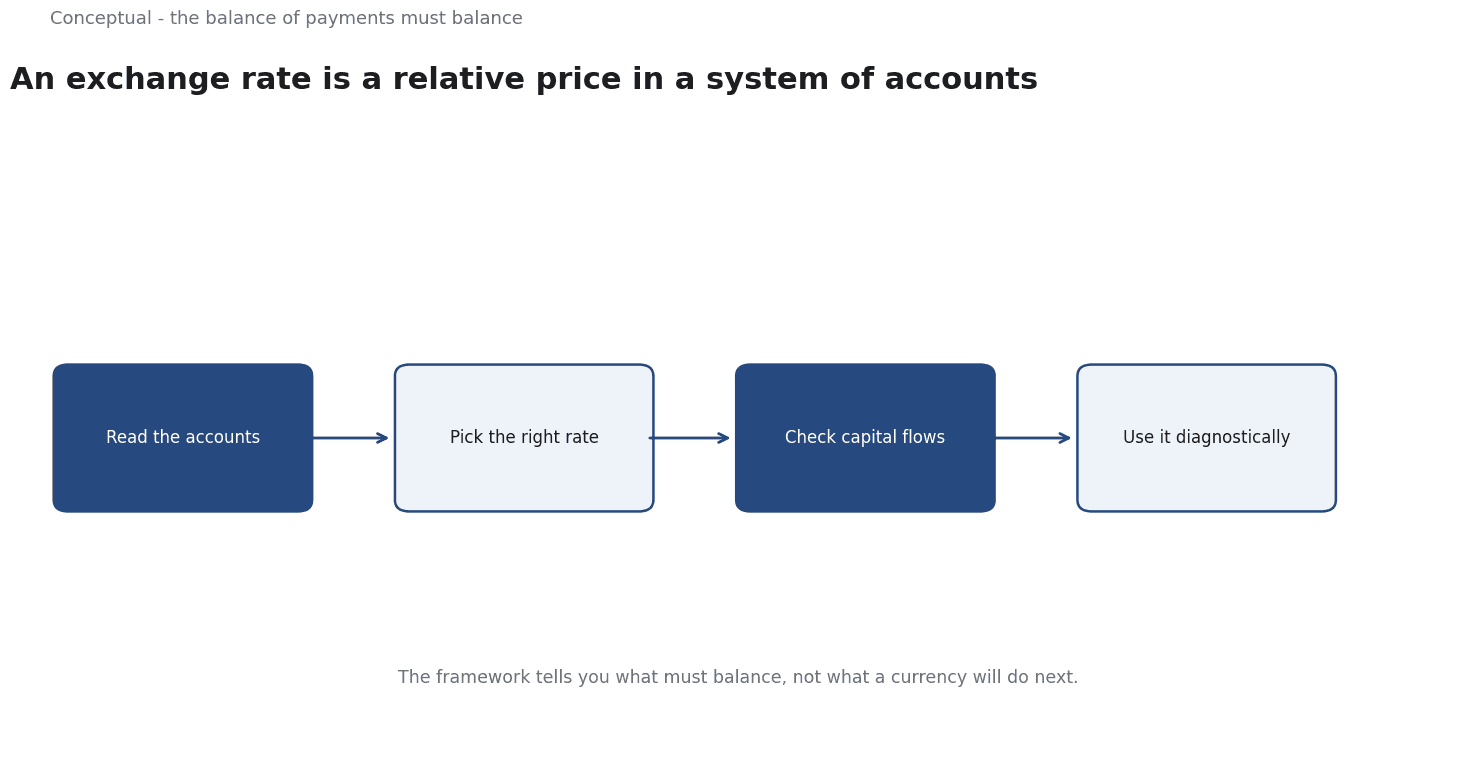
The accounts come first
The balance of payments is a set of double-entry accounts. Every transaction between a country and the rest of the world appears twice: a good exported is matched by a claim on the buyer, a purchase of a foreign asset is matched by a payment.
The current account records trade in goods and services, income from investments, and transfers. A deficit means the country is consuming more from the rest of the world than it is selling, and is therefore borrowing or selling assets to finance the difference.
The capital and financial account records the corresponding flows of assets. A surplus means the rest of the world is acquiring claims on the country — through direct investment, portfolio purchases, or lending.
The crucial implication is that a current-account deficit is not automatically a sign of weakness. It can reflect productive investment funded by foreign capital, or it can reflect consumption funded by borrowing. The accounts tell you the magnitude and the financing, not the quality; the quality is a question about what the money was used for.
For a business, this matters because the currency you face depends on both flows. A country running a large current surplus may see its currency strengthen through trade demand, while a country attracting portfolio capital may see it strengthen through the capital account. The two mechanisms respond to different events.
Bilateral rates and effective rates
A headline rate — euros per dollar, yen per dollar — tells you about one pair. A business with customers and suppliers in ten countries does not care primarily about one pair; it cares about the trade-weighted movement of its cost and revenue currencies.
Effective exchange rates solve that. The Fed's H.10 release publishes summary measures of the foreign exchange value of the dollar, including broad and narrower baskets, and its notes record that "effective June 24, 2019, the Federal Reserve Board staff will make a change to the indexation of the daily Broad, AFE, and EME dollar indexes". That is a construction change, not a market event, and any long time series that spans it is comparing two slightly different indices unless adjusted.
The practical discipline is the same one used elsewhere in this publication: record the vintage and the construction of any external series, and read the release notes before drawing a conclusion from a long chart.
What moves a rate
The standard framing divides the drivers into three channels:
Trade flows. Demand for a country's exports creates demand for its currency. A shift in what the world buys changes the demand for the producing country's currency.
Interest-rate differentials. Capital moves toward higher expected risk-adjusted returns, so a change in relative policy rates can move currencies. The ECB describes its policy rates as influencing "financing conditions and economic developments", and those conditions affect capital flows as well as domestic demand.
Expectations and risk. Currencies are assets, and their prices move on expectations of future policy, growth, and political risk. This is the channel that makes short-term movements hard to attribute to any single observable.
The channels interact. A higher rate may attract capital and strengthen a currency, which makes exports more expensive, which changes the current account, which changes the flow that supports the currency. There is no single-direction causal story, and a forecast built on one channel alone will be fragile.
Purchasing power and what it cannot tell you
Purchasing power parity says that identical goods should cost the same in different countries once converted at the exchange rate. As a long-run anchor it is useful; as a short-run predictor it is poor, because goods are not perfectly tradable, prices are sticky, and capital flows dominate many currency movements.
The practical use is narrower and more honest: PPP is a benchmark for asking whether a currency looks very cheap or very expensive relative to long-run relationships, not a claim that it will return to that level on any useful timeline. A currency can remain far from PPP for years.
A worked example of an effective-rate exposure
Consider a company that sells 40% of its revenue in euros, 30% in yen, and 30% in its domestic currency, while buying 50% of its costs in dollars and the rest domestically. A headline "the dollar strengthened" is almost useless to this business, because what matters is the weighted movement across its specific cash flows.
If the euro and yen both weaken 10% against the domestic currency while the dollar strengthens 10%, the revenue side falls by roughly 7% in domestic terms (0.4 × 10% + 0.3 × 10%) while the cost side rises by roughly 5% (0.5 × 10%). The margin compresses by about 12 percentage points of the original revenue and cost base — not because any single currency moved unusually, but because the weighted mix moved against the company on both sides.
That is the effective-rate logic applied to a firm rather than a country. Three consequences follow:
- The company's relevant index is not the Fed's broad dollar index. It is the weighted basket implied by its own cash flows, with the same weights updated as the business changes.
- Correlation between currencies matters. If the euro and yen move together, the exposure is concentrated; if they offset, it is diversified. A single-currency hedge can make the residual exposure worse if it ignores the correlation.
- Timing matters. Revenue and costs do not settle on the same date, so a hedge that matches annual averages can leave large quarter-to-quarter mismatches.
The practical artefact is a small table — currency, share of revenue, share of cost, typical settlement lag — that is reviewed on the same cadence as the forecast. Without it, the finance team is responding to headlines rather than to exposure.
Where the accounts stop being useful
The balance-of-payments framing is powerful, and it has limits worth stating:
Data arrives late and is revised. Current-account figures are published with a lag and revised as better information arrives, so a claim about this quarter's financing is often a claim about a preliminary estimate. Record the vintage.
The aggregate hides composition. A current-account surplus can reflect a healthy export sector or suppressed domestic demand. The account records the arithmetic, not the welfare.
Services and intangibles are measured differently from goods. A company's cross-border revenue may appear in services, in intellectual-property flows, or not at all in the headline trade balance. A business comparing its exposure to the official trade story will often find the two describe different things.
Financial flows can dominate for long periods. Capital moves faster and in larger volumes than trade, so a currency can be driven by portfolio decisions that the trade-based narrative does not mention.
The honest use of the framework is therefore diagnostic: it tells you what must balance and where to look, not what a currency will do next.
Hedging is a cost, not a prediction
A company with foreign-currency revenue or costs faces a choice: accept the exposure or pay to reduce it. Forward contracts, options, and natural hedging — matching currency revenues with currency costs — are the usual instruments.
The decision should start with the exposure, not with a view on the currency. A business that locks in a rate and then sees the market move favourably has not made a mistake; it has paid for certainty. A business that leaves an exposure unhedged because it expects a favourable move has made a forecast, and it should record that forecast so the outcome can be evaluated honestly.
The OCC's guidance on options applies to currency options too: "Options involve risk and are not suitable for all investors", and the official risk document exists because leverage and asymmetry are hard to intuit. A corporate hedger is not exempt from that.
A sequence for a business
- Map the actual currency exposures — which cash flows are in which currencies, and when.
- Use an effective rate, not a single bilateral pair, where the exposure is diversified.
- Record the series construction and check release notes for rebasing or indexation changes.
- Separate trade-driven from capital-driven movements when explaining a change.
- Treat PPP as a long-run benchmark, not a forecast.
- Hedge the exposure, not the view. State the cost of certainty explicitly.
- Review the hedge against the exposure on a schedule, because both change as the business changes.
For the policy side, see Central Banking; for the instrument mechanics, see Derivatives and Options.
A counterargument
A fair critic would argue that the article's maxim mistakes an identity for an explanation. The balance of payments must balance by construction, so a current-account deficit matched by a capital-account surplus describes the bookkeeping rather than why the rate moved; the article's own limits section concedes that the accounts record arithmetic, not causation. The cited sources (FRED, the ECB's strategy review, and Investor.gov) provide data and regulator guidance but no theory tying the identity to a forecast, which is why the article calls the framework diagnostic.
If capital flows dominate and the data is revised, 'accounts first' organises exposure without saying what a currency will do next.
References & Further Reading
- Federal Reserve Bank of St. Louis, 2026. FRED economic data — The primary time-series database used for macro indicators.
- European Central Bank, 2026. Evaluating our strategy — Primary material on the inflation-targeting framework.
- U.S. Securities and Exchange Commission (Investor.gov), 2026. Introduction to Investing — Primary regulator guidance on market mechanics and investor protection.