Inventory Accuracy Mistakes to Avoid
A system that thinks it has stock it does not has no reliable plan. Read the mistakes, a worked count, and why a periodic adjustment hides the cause.
Inventory accuracy is often treated as a warehouse problem, which misses that every downstream decision depends on it: purchasing, fulfilment, and cash. The inventory entry describes stock in operations and accounting, as the inventory-control entry covers the systems used to track it, as the supply-chain article treats service level, as Inventory Management: Balancing Stock and Cash Flow requires for the cash tied up, as the data-governance article requires provenance for relied-upon records.
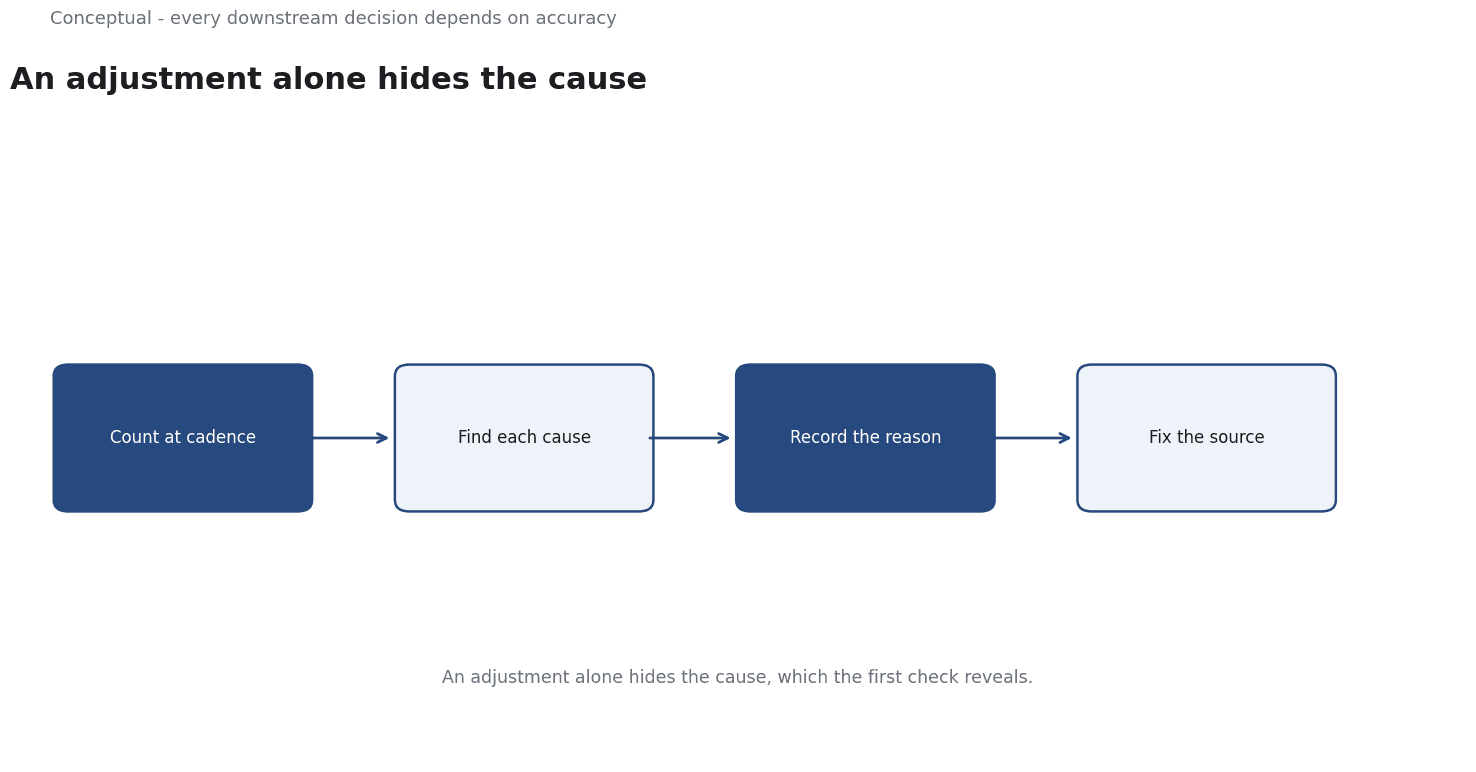
Direct answer: Keep inventory accurate by finding the cause of each discrepancy, counting at a defined cadence, and recording the adjustment with a reason. Wikipedia's inventory entry provides the context, and inventory control covers the mechanisms. The boundary: a periodic adjustment cannot recover the decisions already made on wrong data, which the root-cause article warns, as the publication standard forbids guaranteed outcomes, as the risk-assessment article requires residual risk.
The mistakes
Adjusting without a cause.
Counting only on a schedule. A periodic count misses what happened between counts, which the inventory-control entry describes, as the monitoring article advises for review, as the time-series article warns about non-stationarity, as the risk article requires residual risk.
Ignoring returns and substitutions. Stock moves back and is substituted, which the reverse-logistics entry describes, as Inventory Management: Balancing Stock and Cash Flow treats stock and cash, as the data-governance article requires for records, as the dashboard article argues for metrics tied to decisions.
Trusting one figure. A single stock number without a location or a date is hard to act on, which the data-governance article requires, as the comparables article requires consistent definitions, as the rubric article requires for concrete criteria, as the observability article treats signals as evidence.
Three consequences follow. The cause should be found, as the root-cause article advises, as How to Get Inventory Accuracy Right recommends, as the decision-memo article requires. The cadence should match the risk, as the inventory-control entry advises, as the monitoring article advises, as the risk article requires. And the adjustment should be recorded, as data governance requires, as the decision-memo article requires, as Inventory Management: Balancing Stock and Cash Flow requires for cash.
A worked count
The following is hypothetical and illustrative. A system shows 100 units of an item, but a count finds 92.
Three checks decide the response. First, what happened between the last count and this one, as the inventory-accuracy and root-cause articles ask, with a record, as data governance requires? Second, were returns or substitutions involved, as the reverse-logistics and inventory-management articles advise, with the cash treated, as Inventory Management: Balancing Stock and Cash Flow requires? Third, what decision was made on the wrong figure, as the dashboard and decision-memo articles require, with residual risk, as the risk article requires?
Three conclusions follow.
An adjustment alone hides the cause, which the first check reveals.
Returns can explain part of the gap, as the reverse-logistics article advises. And the decision should be recorded with the cause, as the decision-memo and data-governance articles require.
What inventory accuracy cannot do
It cannot recover decisions made on wrong data, which the root-cause and decision-memo articles advise, as the publication standard forbids guaranteed outcomes. It does not remove the need for monitoring, which the observability article treats as evidence, as the monitoring article advises, as the risk article requires residual risk. And it cannot fix a supply problem, which the supply-chain article treats as a service-level question, as the demand-forecasting article advises for metric choice.
The counterargument that a periodic count is enough is fair for low-risk items and incomplete where a gap changes purchasing or fulfilment, which the worked count shows, as the inventory-control entry and risk article advise.
A decision test
- Define the count cadence by risk, as the inventory-control entry advises.
- Find the cause of each discrepancy, as the root-cause article requires.
- Record adjustments with a reason, as data governance requires.
- Account for returns and substitutions, as the reverse-logistics article advises.
- Treat the figure as cash, as Inventory Management: Balancing Stock and Cash Flow requires.
- Check decisions made on wrong data, as the decision-memo article requires.
- State residual risk, as the risk article requires.
For the method, see How to Get Inventory Accuracy Right; for the stock and cash, see Inventory Management.
References & Further Reading
- Wikipedia contributors, 2026. Inventory - Wikipedia — The role of stock in operations and accounting.
- Wikipedia contributors, 2026. Inventory control - Wikipedia — Systems for tracking and managing stock accuracy.