Jobs-to-be-done Explained
Jobs-to-be-done reframes demand around the task a customer hires a product for. See how value propositions and conjoint analysis inform it, plus where the framing stops.
Product and marketing teams often describe customers by demographic segment or by the features a product contains, then wonder why a well-specced offering fails to sell. The problem is that a feature list and an age bracket do not say what the customer was trying to accomplish when they made the purchase. Jobs-to-be-done starts from that accomplishment instead of from the product.
Direct answer: Jobs-to-be-done is a framing that treats a purchase as the customer hiring a product to perform a specific job in a specific context. The value proposition then states how the product gets that job done better than the alternatives, and conjoint analysis can quantify which job-relevant attributes buyers actually weight. Together they turn a vague claim about customer value into a testable statement about demand.
Delta: This article adds a decision framing beyond the sources: it maps the jobs-to-be-done lens to a concrete build-and-message decision, with claim status explicit.
The mechanism
The starting idea behind jobs-to-be-done is that people do not buy products; they hire them to get something done.
A purchase is a solution chosen in a particular context to accomplish a task they care about. That shifts the unit of analysis from the buyer's demographic category or the product's feature list to the circumstance that triggered the search. The value proposition is the natural companion to this view: it is a statement of the value an offering promises to deliver and communicate, and it is strongest when it names the outcome the customer is after rather than listing specifications. Read together, the two constructs say that demand is best described by the job and that the proposition should explain how the product performs it.
A value proposition, in this framing, is more than a tagline. It is a promise of value to be delivered and acknowledged, and it works by connecting what the product does to what the customer values. When it is written from the job outward, it answers three things at once: what the customer is trying to accomplish, why the current approach falls short, and how this product closes the gap. That makes the proposition falsifiable. If a team cannot state the job in the customer's context, the proposition is probably describing the product rather than the demand, and no amount of wording polish will fix it.
Conjoint analysis supplies a way to test part of that claim. It is a survey-based statistical technique used in market research to determine how people value the different attributes that make up a product or service. Respondents are shown sets of alternative offerings and asked to choose or rank them; from those trade-offs, the analysis infers the relative weight, or part-worth utility, that each attribute carries. This is useful precisely because it forces trade-offs instead of asking buyers to rate every feature as important. Attribute weights that survive a conjoint design are a stronger signal than a list of features everyone claims to want.
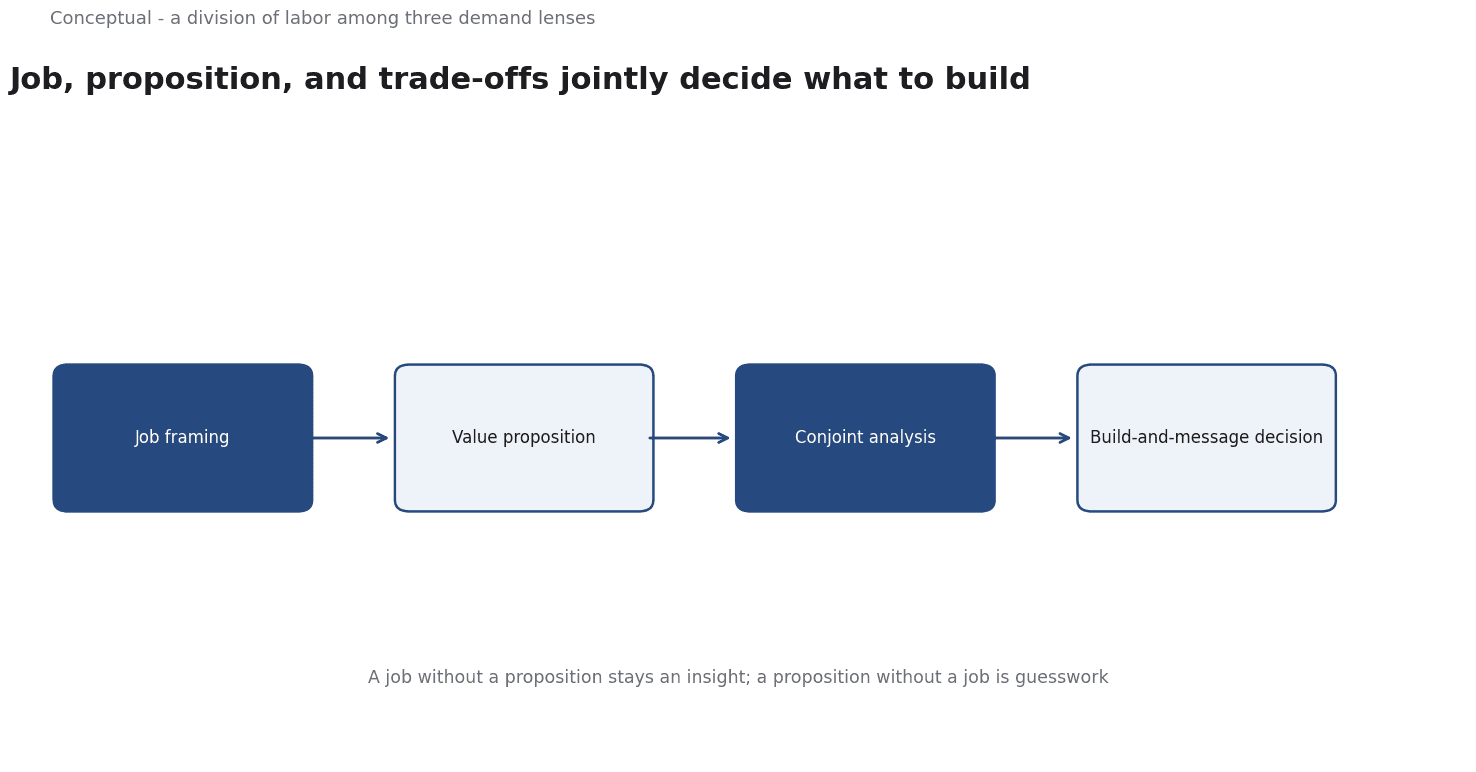
The practical consequence is a division of labor among the three ideas. The job framing defines what demand is and gives the team a unit of analysis. The value proposition turns that job into a clear, external statement of benefit that can guide messaging and positioning. Conjoint analysis then tests which attributes actually drive choice, so the team knows which parts of the job to invest in. None of them works alone: a job without a proposition stays an insight, a proposition without a job is guesswork, and a conjoint study without a clear job measures attributes that may not matter. The decision they jointly support is what to build and what to say.
A worked example
The following is hypothetical and illustrative. A team selling a scheduling tool assumed the job was saving time on administrative work and built a value proposition around speed. They ran three checks. First, a job-framing exercise restated the purchase in context and found the customer was trying to avoid double-booking across shared calendars, not simply move faster. Second, they rewrote the proposition around that outcome so the promise named the problem solved rather than a feature. Third, a conjoint survey varied attributes such as calendar sync, conflict detection, and setup effort to see which buyers weighted most heavily. The outcome was a reprioritized roadmap that put conflict detection ahead of raw speed, and a message that described the job rather than the tool. No figure here is measured data; the example only shows how the three checks connect.
Evidence status
| Claim | Status | Source | Verified | Recheck when |
|---|---|---|---|---|
| Job framing views a purchase as hiring a product to do a task | source-reported | Wikipedia: Value proposition | 2026-11-18 | Framing definition changes |
| Conjoint analysis infers attribute values from choices | source-reported | Wikipedia: Conjoint analysis | 2026-11-18 | Method standards change |
| Combining the three sharpens a build-and-message decision | inferred | Derived from the sources | 2026-11-18 | Evidence on method pairing changes |
The source-reported rows establish the two building blocks the sources actually provide: a value-centered view of what a product promises and a survey technique for valuing attributes. Neither source sets out a full jobs-to-be-done method. The inferred row is this article's synthesis that combining the three sharpens a build-and-message decision, not a finding the sources state. Recheck it if research on stated versus revealed preference changes how much weight a conjoint result should carry.
What it cannot do
The most immediate limit is that these two sources do not, on their own, constitute a complete method. They describe a value proposition and a survey technique; the broader jobs-to-be-done body of work, with its own interview protocols and definitions, is not supplied here. Anyone treating this framing as a turnkey procedure would be overreading the material. The sources support a way of asking better questions, not a guaranteed answer, and the burden of defining the job still falls on the team.
The hidden cost is research effort. Defining a job in its real context takes interviews and observation, and a well-designed conjoint study needs careful attribute selection, sensible levels, and enough respondents to produce stable part-worth estimates. These are not cheap or fast, and a rushed version produces confident-looking numbers built on poorly chosen attributes. There is also an opportunity cost: time spent mapping jobs is time not spent shipping, and for small teams that trade-off is real.
A team can rewrite its value proposition in job language and run a conjoint study while continuing to build the same roadmap, treating the exercise as a messaging refresh. Another failure is confirmation bias in the job definition: if the team already knows what it wants to build, it will hear only the interview evidence that supports that plan. Conjoint analysis has its own weakness, because it captures stated preferences within a designed choice set, not what buyers do when real money and habit are on the line.
The boundary is the kind of purchase being examined. The framing earns its keep for considered, higher-involvement decisions where context and trade-offs matter. For low-involvement or habitual buys, or where the job is essentially identical across every customer, the elaborate machinery adds cost without adding insight. Context is also a boundary: the same product can be hired for different jobs on different occasions, so a single job statement may not describe the whole customer relationship.
Finally, jobs and attribute weights drift. Competitors appear, contexts shift, and what was a decisive attribute becomes table stakes. A job definition and a conjoint model are snapshots, not permanent truths, so they need a review trigger. Revisit them when win and loss reasons change or when a competitor alters the choice set. Without that, the team keeps optimizing against a job that no longer exists.
The counterargument that this is just qualitative research with a survey bolted on is fair for simple, stable products where features and segments already predict demand, and incomplete for markets where the real competition is the customer's current workaround.
A decision test
- State the purchase context. Describe when and why a customer starts looking, in their terms.
- Define the job. Write the task and the circumstance, not a feature or a segment.
- Draft the proposition. Say how the product gets that job done better than the current alternative.
- Choose attributes for testing. Pick the job-relevant dimensions and realistic levels for a conjoint design.
- Run the trade-off test. Use the choices to estimate which attributes carry the most weight.
- Commit to a decision. Translate the result into a roadmap priority and a message.
- Set a review trigger. Revisit the job and weights when win and loss reasons or the choice set change.
Jobs-to-be-done is a lens for demand, not a substitute for evidence.
The sources offer a value-proposition view and a way to value attributes; the team's job is to connect them to a real build-and-message decision. State the job, test the trade-offs, and record the choice so the reasoning can be challenged later.
For further reading, see Voice of Customer: Turning Feedback into Decisions.
References & Further Reading
- Wikipedia contributors, 2026. Value proposition - Wikipedia — The value a product promises to a buyer.
- Wikipedia contributors, 2026. Conjoint analysis - Wikipedia — Measuring preferences across product attributes.