Jobs-to-be-Done as a Product and Marketing Tool
Customers hire products to get a job done. Read how to frame a job, a worked example, and where the method stops being useful.
Jobs-to-be-done reframes a purchase as a hire: the customer has a problem in a context and brings something in to solve it. The frame is useful because it shifts attention from product features to the situation that creates demand. It is less useful when treated as a template for writing fake customer quotes.
Direct answer: A job is a problem or goal a customer has in a specific context, with a functional, emotional, and social dimension. Demand-generation principles explain the decision a job relates to, and Porter's strategy argument supports grounding the frame in a defensible position. The boundary: a job statement is a hypothesis until tested with real customers, which AAPOR's standards and the startup-validation article require, and it cannot replace a strategy, as Brand Positioning: Why Being Different Is More Important Than Being Better argues.
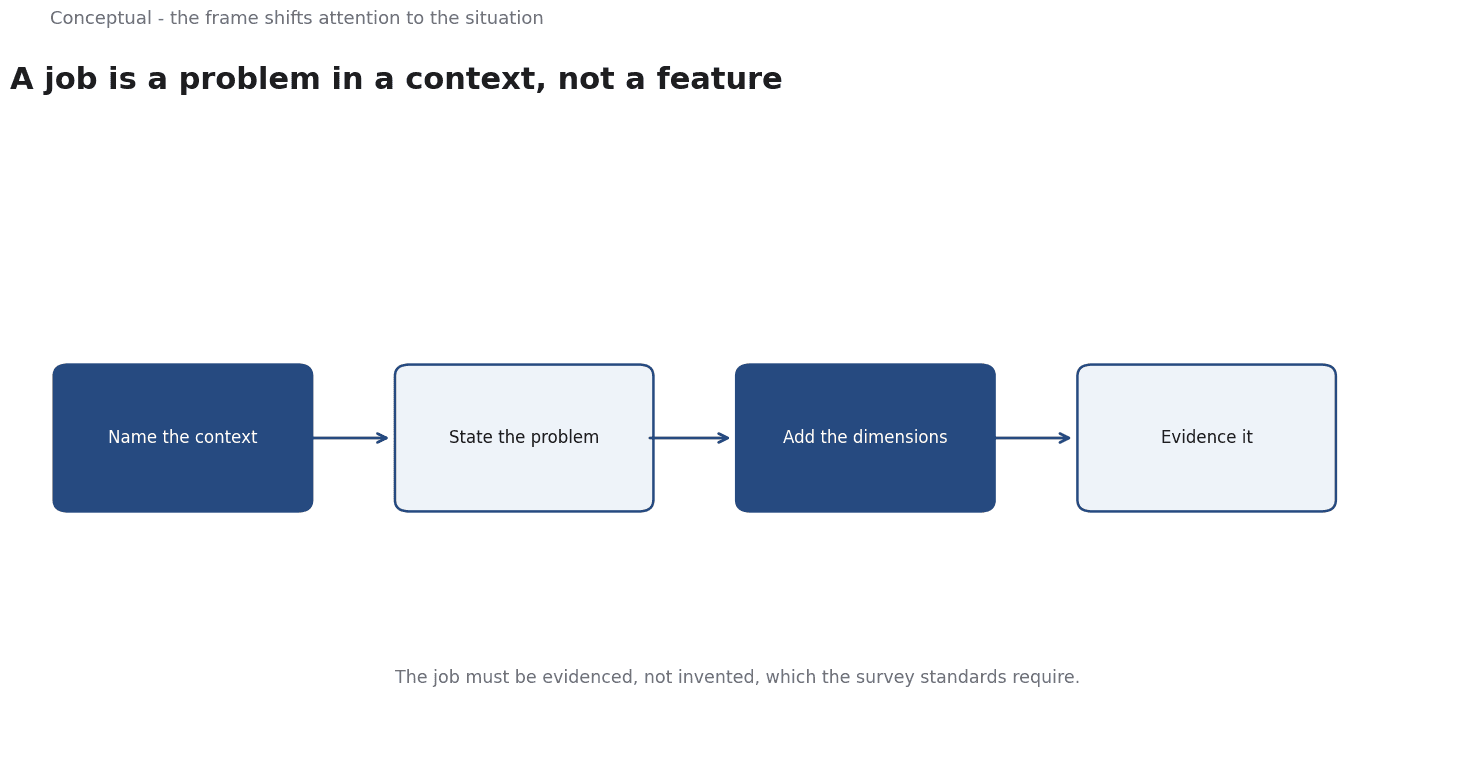
What a job contains
A context. When the need arises — a situation, not a demographic. The customer-segmentation article argues for real differences in situation over cosmetic categories.
A goal. What the customer is trying to accomplish, stated in their language, which the value-proposition article recommends as the basis for a clear promise.
A constraint. What gets in the way — time, skill, risk — which the design-brief article treats as a real boundary on a solution.
A hiring criterion. What would make them choose one solution over another, which the competitive-positioning workshop recommends testing.
A worked example
The following is hypothetical and illustrative.
A company makes meal-planning software. A feature-focused brief says "add a recipe database". A jobs-focused brief asks what job a customer hires for in a specific context:
- Context: a weeknight, after work, with little time and a fridge partially full.
- Goal: get a reasonable dinner on the table without a long decision.
- Constraint: limited ingredients and low willingness to plan far ahead.
- Criterion: a suggestion that uses what is available, in under 30 minutes.
Three checks decide whether the job is real:
- Evidence from customers. Interview a defined sample with AAPOR-style wording and ask about the last time the situation occurred, as Voice of Customer: Turning Feedback into Decisions recommends for concrete evidence.
- Behaviour. Do usage logs show short, evening sessions with the available-ingredients filter, as the product-analytics article argues for observed signals?
- Solution fit. Does a recipe database alone serve the job, or is the constraint the real problem, as the build-versus-buy article asks when choosing a capability?
Three conclusions follow:
- The job reveals the constraint that a feature list hid, which the value-proposition article treats as the real problem to solve.
- The frame is tested, not asserted, as the survey standards require.
- Marketing and product share the frame, which the demand-generation article treats as a consistent decision stage.
Using the frame in marketing and product
The same job statement can serve both teams if it is kept concrete. Three uses:
Product: define the constraint the solution must respect, which the design-brief article treats as a boundary on a specification.
Messaging: state the situation before the product, as the value-proposition article recommends for copy a buyer recognises.
Prioritisation: choose which jobs to serve by their frequency and the value of the outcome, which the strategy article frames as a choice among competing needs.
These uses share one requirement: the job must be evidenced, not invented, which the survey standards require for any customer-derived claim.
Distinguishing jobs from features
Three questions separate them:
Does it describe a situation? A job names when and why a need arises; a feature names what the product does, which the value-proposition article distinguishes clearly.
Would it exist without your product? A job the customer had before your product existed is likely real; one invented to justify a roadmap item is not, which the positioning workshop article treats as a test of a defensible claim.
Can it be evidenced? Behaviour and interviews should support the job, as AAPOR's standards and the product-analytics article require for any customer claim.
These questions keep the frame grounded, which the editorial standard requires for all material claims.
What jobs-to-be-done cannot do
It cannot replace strategy. A job describes a need; choosing which to serve and why is a strategic decision, as Brand Positioning: Why Being Different Is More Important Than Being Better argues.
It is not a quoting machine. Invented "job stories" presented as customer evidence are fabrication, which the standard editorial rules prohibit.
It goes stale. Contexts change with products and habits, which the monitoring article treats as a change trigger.
The counterargument — that customers cannot articulate jobs — is sometimes true and misses the method: observe behaviour and ask about specific past situations rather than asking people to imagine preferences, as the customer-journey article recommends.
A decision test
- State the context as a situation, not a demographic, as the segmentation article advises.
- Use the customer's language for the goal, as the value-proposition article recommends.
- Name the constraint that the solution must respect, as the design-brief article requires.
- Test with real customers using AAPOR-style wording, as the survey standards require.
- Check behaviour against the stated job, as the product-analytics article argues.
- Share the frame across product and marketing, as the demand-generation article recommends.
- Revisit on change, as the monitoring article advises.
For the framing, see Brand Positioning; for the evidence, see Voice of Customer.
References & Further Reading
- Wikipedia contributors, 2026. Demand generation - Wikipedia — An overview of demand generation as a marketing discipline distinct from lead generation; secondary reference used with the lead-generation entry.
- Michael E. Porter, 1996. What Is Strategy? — The differentiation-versus-cost argument behind competitive-advantage analysis.