Leadership Checklist
A leadership checklist turns broad management advice into observable checks. Read the mechanism, a worked example, and the limits of any checklist.
Leadership advice tends to arrive as virtues - be decisive, be supportive, build trust - that are hard to observe and harder to verify. The difficulty is not agreement with the advice but translating it into checks that can be applied consistently. O*NET OnLine describes what management roles involve, and Google re:Work sets out management practices, but neither is itself a checklist a manager can run.
Direct answer: A leadership checklist is a short set of observable checks tied to the tasks and behaviours that management roles and practices describe, used before or after a decision rather than as a scorecard of character. O*NET OnLine supplies the occupational tasks and skills; Google re:Work supplies the practice behaviours. The boundary: a checklist prompts attention, it does not certify good leadership.
Delta: This article adds a decision framing beyond the sources: it maps occupational tasks and practice behaviours to the specific question of which checks a manager should run before a people decision, with claim status explicit.
The mechanism
O*NET OnLine is a descriptive occupational database from the U.S. Department of Labor. It catalogues tasks, work activities, skills and work contexts for occupations, including management roles. For leadership it tells you what the job contains: supervising, planning, allocating resources and handling interpersonal matters. The practical consequence is that the first draft of a checklist should come from the described tasks of the role, not from personality adjectives. A check tied to a real task, such as whether the person who will do the work was consulted, is observable; an instruction to be visionary is not.
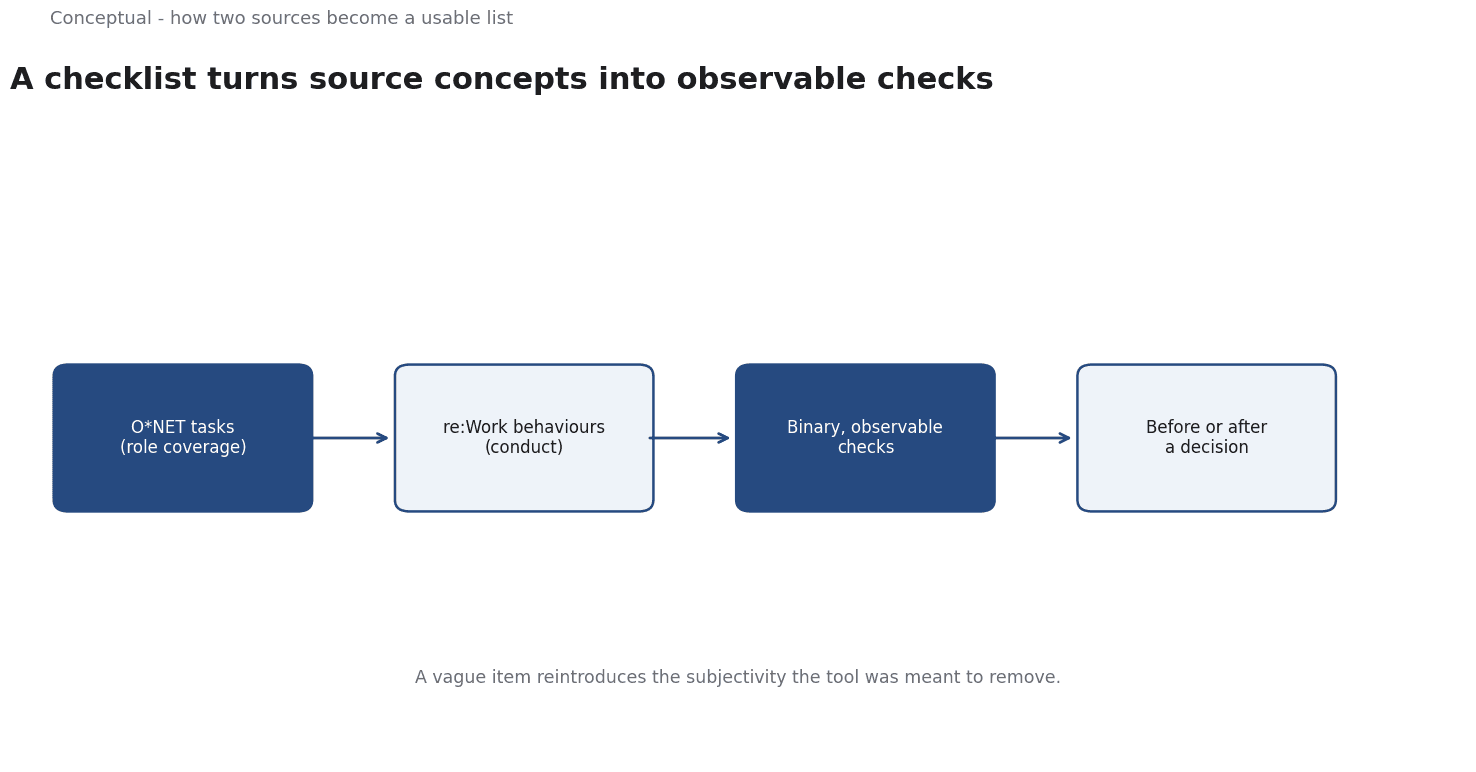
Google re:Work's management practice material describes behaviours drawn from the organisation's work on effective management. These are claims about conduct, such as coaching, setting clear expectations and avoiding over-direction. The practical consequence is that behaviours can become checks about actions rather than traits. Where O*NET answers what the role involves, re:Work answers what managers do. Combining them gives a checklist with both coverage, from tasks, and conduct, from behaviours. Neither source ranks which items matter most; that ranking is local judgement.
A checklist works by externalising the checks, reducing reliance on memory and mood.
For that to help, each item must be answerable in a binary, evidence-based way: either the expectation was stated, or it was not. Vague items that need interpretation reintroduce the subjectivity the tool was meant to remove. So each item should be phrased so that two people looking at the same situation would answer it the same way. An item that depends on a feeling is not a check; it is a reminder dressed as one.
The final mechanism is timing and scope. The same list used as a before-decision prompt and as an after-action review serves different ends. Before, it prevents omission; after, it supports learning. The practical consequence is that the list must be short enough to run under time pressure and specific enough to one role that it is not a generic set of platitudes. A checklist that cannot be completed in a few minutes will be skipped when the decision arrives.
A worked example
The following is hypothetical and illustrative. A team lead is about to reassign a project owner and uses a short checklist before the conversation. Three checks decide. First, task coverage: does the list include the supervisory tasks the role actually contains, such as setting expectations and allocating work, rather than only personality traits? Second, behavioural evidence: for each behaviour item, can the lead point to an observed action rather than an impression? Third, observability: would a second manager answer each item the same way from the same facts? The outcome is a revised list of six binary questions and one deferred item: a question that could not be answered consistently is removed and replaced with one about a documented expectation. The scenario is hypothetical; the mapping from source concepts to checks is the contribution.
Evidence status
| Claim | Status | Source | Verified | Recheck when |
|---|---|---|---|---|
| O*NET OnLine catalogues tasks, skills and work contexts for occupations, including management roles | source-reported | O*NET OnLine (U.S. Department of Labor) | 2026-11-18 | Occupational data or taxonomy is revised |
| Google re:Work publishes management practices drawn from its work on effective management | source-reported | Google re:Work - Management practices | 2026-11-18 | Guidance or underlying research is updated |
| Observable, binary checks reduce subjective judgement in people decisions | inferred | Derived from the sources | 2026-11-18 | New evidence on structured management decisions appears |
The two descriptive claims are reported directly from the references and are stable as descriptions of what each resource offers. The claim about observability is an inference from combining them, so it should be revisited if the occupational data changes or if guidance on structured decisions shifts. The distinction keeps source material separate from local judgement.
What it cannot do
A checklist cannot resolve a decision that depends on facts it does not contain. It can confirm that expectations were stated, that a person was consulted and that a behaviour was observed. It cannot tell you which of two candidates deserves a promotion, because that requires judgement about performance and context that no list encodes. Used as a verdict rather than a prompt, it lends a false sense of procedural correctness to a decision that still rests on human assessment.
The honest limit is that a checklist structures attention; it does not make the decision.
The hidden cost is compliance theatre. Once a checklist exists there is pressure to complete it and file it, which shifts effort from the conversation to the artefact. A manager who ticks six boxes and moves on has satisfied the form while missing the substance. There is also a cost in false precision: items that look objective invite the belief that the decision is objective. The more polished the checklist, the easier it is to skip the judgement it was meant to support, and the harder it becomes to say which part of the decision the list actually informed.
Checklists grow because every reviewer adds an item that mattered in a recent difficult case, until the tool is too long to use under pressure. When that happens it is abandoned or completed carelessly, which is worse than none because it produces a record of diligence that did not occur. Another failure is decorating the list with traits nobody can observe, reintroducing exactly the subjectivity the tool was meant to remove. Both failures share a cause: items are added for completeness rather than for their ability to be answered consistently.
There are settings where a checklist should not drive the decision. Novel situations, genuine ethical conflicts and irreversible choices need deliberation and, often, a second person, not a form. A checklist can prepare that deliberation but cannot replace it. Its proper boundary is routine, repeatable people decisions where omission is the main risk. Outside that boundary the list is at best a memory aid and at worst a distraction that narrows attention to what is easy to tick.
Finally, a checklist needs scheduled review because roles and practices drift. Occupational data is revised, management guidance changes and the tasks in a role evolve with the team. A list that fit last year can encode assumptions that no longer hold. The practical requirement is to re-derive items from the two sources on a fixed cadence, to record which decision relied on which version and to delete items nobody can answer consistently. Without that discipline the checklist becomes a habit rather than a tool.
The counterargument that a checklist is too mechanical for leadership is fair for novel, high-stakes or value-laden decisions and incomplete for routine people decisions, where the dominant risk is forgetting a basic step rather than misjudging a hard one.
A decision test
- Name the specific people decision the checklist is meant to inform.
- Draft items from the tasks O*NET OnLine associates with the role.
- Add behaviour items from Google re:Work's management practices.
- Rewrite each item so two people would answer it the same way from the same facts.
- Cut any item that cannot be answered with a yes or no.
- Keep the list short enough to run under time pressure.
- Set a review date and record which version supported which decision.
These steps do not require new research; they require discipline about what a check is and where it came from. The test is passed when a reader can trace each item to a task or a practice and can see which decision it supports, and failed when the list reads like a set of virtues. For further reading, see Decision Memos That Survive Review.
References & Further Reading
- U.S. Department of Labor, 2026. O*NET OnLine — The standard occupational taxonomy used to compare roles across industries.
- Google, 2026. Google re:Work — A large company's published people practices, including hiring and growth frameworks.