Learning Strategies Explained
Six evidence-informed learning strategies, mapped to the study decision each one supports, with limits and a worked example.
Most people study by rereading notes and highlighting text, because those activities feel productive and produce a sense of fluency. The problem is that familiarity is not the same as durable learning, and the methods that feel easiest often leave the weakest long-term memory. The Learning Scientists set out a set of strategies that separate activities which build memory from activities that only create the feeling of knowing.
Direct answer: The Learning Scientists describe six evidence-informed strategies: retrieval practice, spacing, interleaving, elaboration, concrete examples, and dual coding. The practical point is that a learning activity should be chosen by what it does to memory, not by how comfortable it feels. Their downloadable materials turn these strategies into classroom and self-study formats.
Delta: This article adds a strategy-to-outcome map beyond the sources. It maps each strategy to the study decision it supports, with claim status explicit.
The mechanism
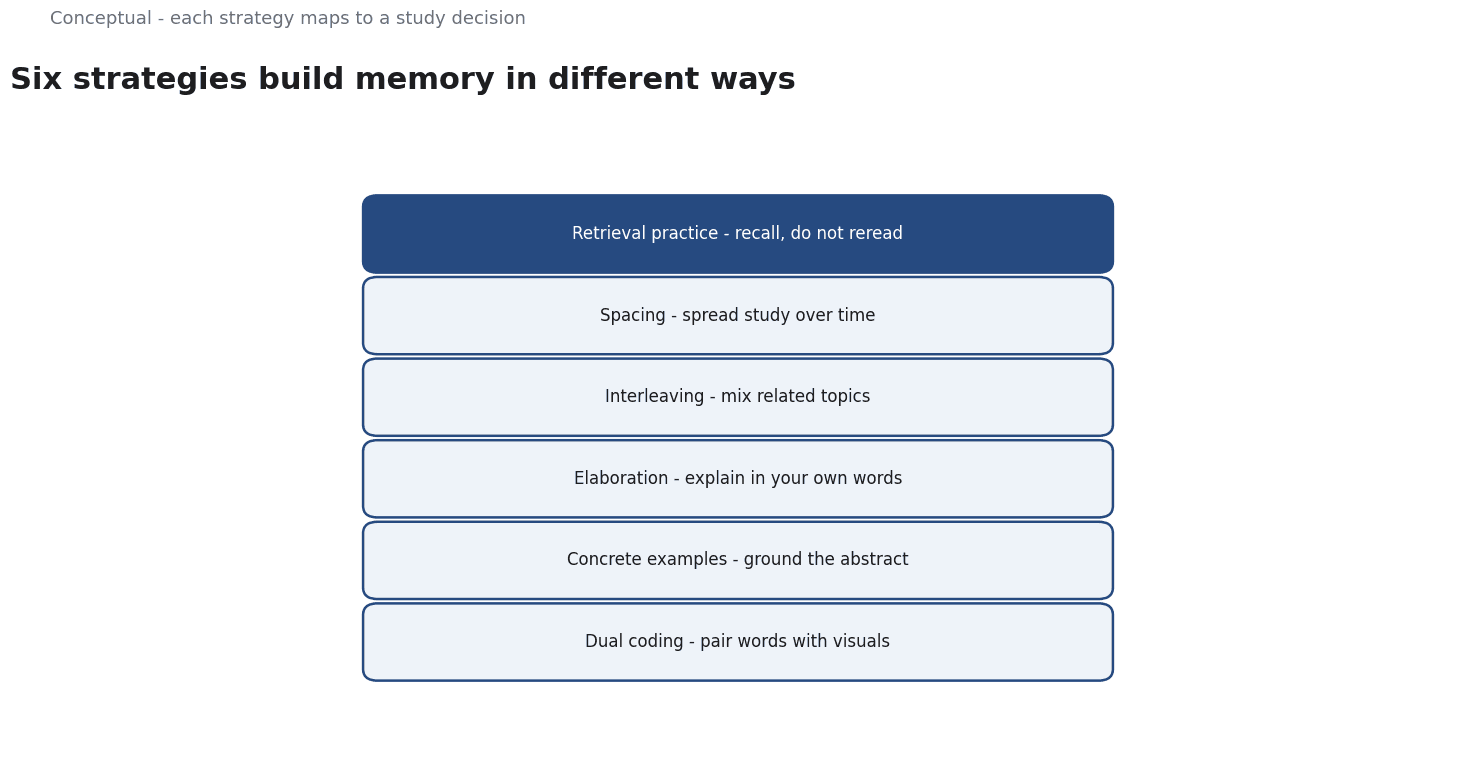
The Learning Scientists present six strategies, each targeting a different part of how memory is built. Retrieval practice means recalling information from memory rather than reviewing it. Spacing means spreading study over time instead of massing it into one session. Interleaving means mixing related but distinct topics. Elaboration means explaining ideas in your own words and connecting them to what is already known. Concrete examples ground abstract ideas, and dual coding combines words with visuals. The six are complementary, not competing.
The practical consequence is that the activities which feel easiest are often the least effective.
Rereading and highlighting tend to create familiarity without strong retrieval paths. Retrieval practice strengthens access to memory because the act of pulling information out is itself the practice. Spacing prevents the rapid decay that follows massed repetition. Interleaving improves discrimination between similar concepts, because the learner has to choose which rule applies. The uncomfortable feeling of a hard quiz or a delayed review is a feature of these methods, not a flaw.
A workable study plan uses several strategies together. After first exposure to a topic, the learner closes the material and recalls the key points from memory. That recall is scheduled again days later rather than in the same sitting. Related topics are mixed in one session so that the learner practises choosing between them. Ideas are restated in plain language, paired with a concrete case, and tied to a diagram or visual where the structure matters. None of these steps requires special tools; they require a decision to trade short-term comfort for retention.
The Learning Scientists also provide downloadable materials that translate the research into classroom activities, guidance sheets, and study resources. These are implementation aids that reduce the gap between knowing a strategy and actually running it. A learner or instructor can adopt a tested format rather than design one from scratch, which lowers the chance of applying the idea superficially. The practical consequence is that the strategies become behaviours rather than vocabulary.
A worked example
The following is hypothetical and illustrative. A learner is preparing for a certification exam and had planned to reread a guide three times. The plan is changed in three ways. First, the second reread is replaced with a blank-page recall of the main concepts, which makes gaps visible immediately. Second, review sessions are moved to successive days rather than one long evening, so that each return happens after some forgetting. Third, practice questions from different topics are mixed instead of blocked, forcing the learner to choose the right approach. The outcome: the first recall session feels worse and scores lower than rereading did, but a delayed check a week later shows stronger retention. The learner keeps the harder method because the evidence, not the feeling, supports it.
Evidence status
| Claim | Status | Source | Verified | Recheck when |
|---|---|---|---|---|
| The Learning Scientists describe six strategies: retrieval, spacing, interleaving, elaboration, concrete examples and dual coding | source-reported | The Learning Scientists | 2026-11-18 | The site updates its strategy list |
| Downloadable classroom and study materials are available from The Learning Scientists | source-reported | Learning Scientists Materials | 2026-11-18 | The downloads page changes |
| Choosing a strategy by the desired outcome rather than by habit improves retention | inferred | Derived from the sources | 2026-11-18 | Delayed-retention data contradicts the choice |
The first two rows restate material published by the source and stay stable until that material changes. The third row is an inference about how a learner should decide, not a statement the source makes verbatim. It is the row to revisit when measured retention no longer matches the strategy chosen. The table should be read as a dated snapshot, not as a permanent verdict on any method.
What it cannot do
These strategies strengthen learning of what is actually practised. A learner cannot retrieve material they never encountered, and no strategy substitutes for the content itself or for understanding what that content means. Retrieval practice on shallow notes produces shallow recall. The methods improve the encoding and strengthening of knowledge; they do not supply the knowledge. Treating them as a replacement for good material is a category error.
There is a hidden cost in how these methods feel. Retrieval practice produces errors, spacing delays the sense of completion, and interleaving feels chaotic compared with working one topic at a time. Because rereading feels smoother, learners often conclude that it is more efficient and abandon the harder methods. The cost is short-term discomfort and slower apparent coverage.
A learner who judges a session by how good it felt will reliably choose the less effective option.
Writing quiz questions whose answers are already visible is not retrieval practice. Spacing without any cumulative review lets early topics decay while later ones are revisited. Elaboration that merely restates the same words adds little. Dual coding with decorative images that do not map to the concept can distract rather than help. In each case the label is present but the mechanism is absent, so the expected benefit does not follow.
The strategies are also bounded by context. They do not fix poor source material, the absence of feedback, or insufficient time. Different content favours different methods: dual coding suits spatial or structural material, elaboration suits conceptual material, and retrieval practice suits factual and procedural recall. A single method applied to everything will underperform matching the method to the task. The downloadable materials help here because they show a strategy in a specific format rather than as an abstraction.
Finally, strategy choice needs calibration and review. A learner should check what is retained after a delay, not what felt easy during the session, and adjust the plan when the goal or the material changes. What works for exam recall may not work for acquiring a physical skill or writing fluently. The strategies are tools with conditions of use, not universal laws.
Counterargument: the claim that these strategies are just common sense is fair for the labels, which sound obvious, and incomplete for the implementation, because disciplined retrieval and spacing differ sharply from casual review.
A decision test
- State the learning goal and the material to be learned.
- Choose retrieval practice over rereading for recall-heavy material.
- Schedule spaced returns rather than one long session.
- Interleave related topics to improve discrimination between them.
- Add elaboration by explaining ideas in your own words.
- Pair concrete examples and visuals with abstract text.
- Check retention with a delayed test and adjust the plan accordingly.
A strategy set earns its place when it changes what a learner does on an ordinary week, not just what they know about learning. The test above is meant to convert six research-backed ideas into choices that survive a busy schedule. The measure that matters is delayed retention, not how smooth the session felt. If the plan cannot be kept, it will not help, so the most useful strategy is the one that gets repeated.
For further reading, see Decision Memos.
References & Further Reading
- Learning Scientists, 2026. The Learning Scientists — Research summaries on retrieval practice, spacing, and durable learning.
- The Learning Scientists, 2026. Downloadable Materials — The Learning Scientists — The Six Strategies for Effective Learning resource and the researchers' explicit caution that success cannot be guaranteed.