Leverage Ratios Metrics that Matter
Leverage measures obligations, not just ambition. Read the ratios, a worked example, and why a low ratio can hide maturity risk.
Leverage ratios are often read as a single measure of caution, which hides the structure of debt. The Wikipedia entry describes leverage and the ratios used to measure it, and the balance-sheet entry structures the figures. The same ratio can look safe while the maturity profile is dangerous.
Direct answer: Read leverage with the denominator, the accounting basis, and the maturity schedule, then state what would change the assessment. The sources define the terms; the reading rule is a synthesis.
Delta: This article adds a claim-status table and a worked comparison, separating the documented definition from the local judgements in interpretation.
The mechanism
Three distinctions matter:
- Denominator choice. Debt relative to equity and debt relative to assets answer different questions. The leverage entry describes the use of debt; the choice of ratio is local.
- Accounting basis. Leases and off-balance-sheet obligations change what the denominator contains. The balance-sheet entry structures reported figures.
- Maturity. A low ratio with near-term refinancing is riskier than a higher ratio with long-dated debt. Interest-rate sensitivity matters here.
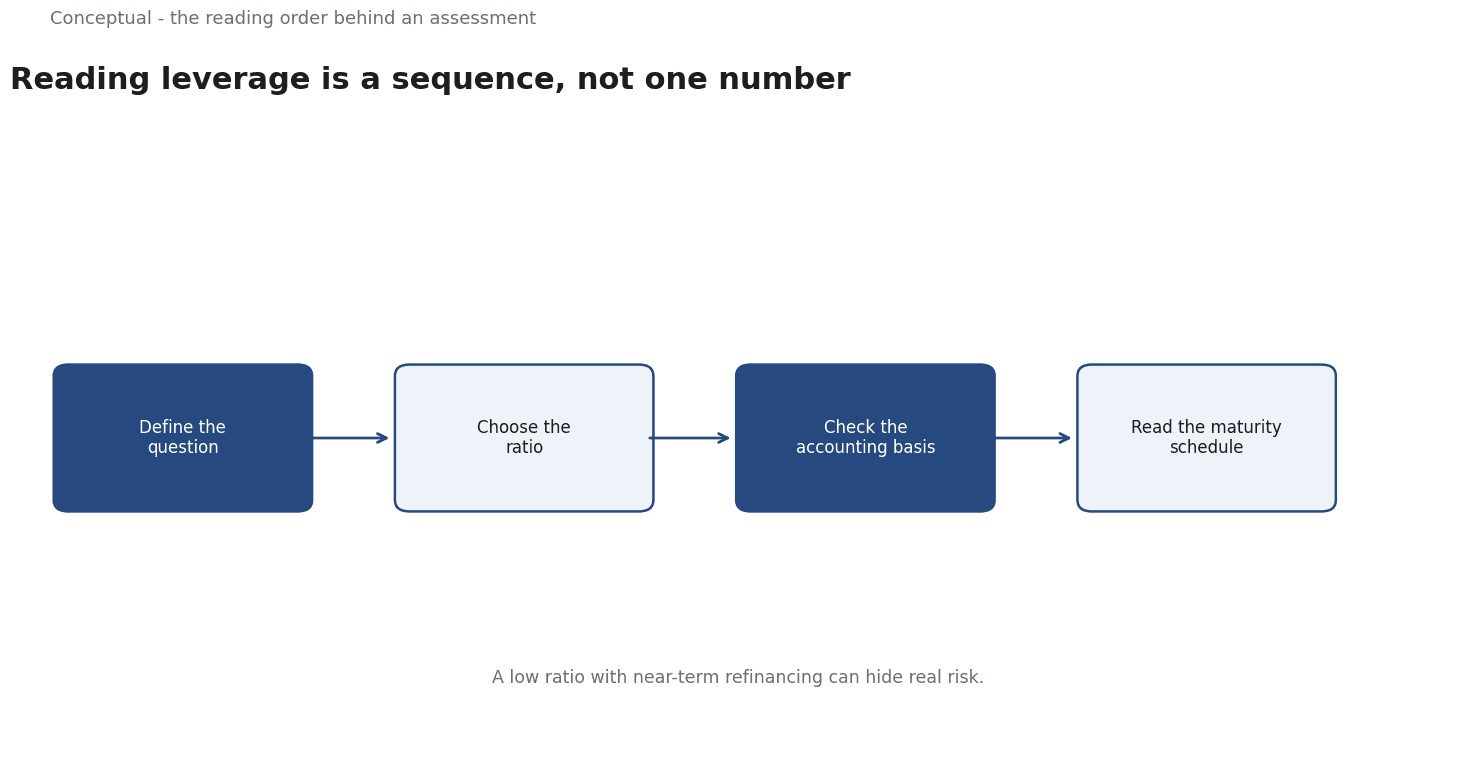
The sequence is: define the question, choose the ratio, check the basis, then read the maturity schedule. Choosing the question is judgement, so it is inferred; the definitions are source-reported.
A worked example
Illustrative. Two companies report the same debt-to-equity ratio.
Three checks decide. First, do they use the same definition of debt, including leases and other obligations? Second, how much of each company's debt refinances within two years? Third, what happens to interest cost if rates rise, given the fixed and floating mix?
The outcome is a qualified comparison, not a ranking by ratio. The numbers are hypothetical; the disclosure method is the contribution.
Why the denominator is a choice
A leverage ratio compares debt with a base, and the base determines the question being asked. Debt against equity describes how much of the ownership value is financed by borrowing. Debt against assets describes how much of the asset base is claimed by lenders. Neither is wrong, but they answer different questions and can move in opposite directions.
The accounting basis is the second choice. A ratio that excludes lease obligations is not comparable with one that includes them, even when both are labelled the same way. The balance-sheet entry describes what is reported; deciding what belongs in the numerator is an analytical judgement that should be stated.
Maturity is where the risk actually sits.
A modest ratio with a large refinancing due next year exposes the company to conditions it does not control. A higher ratio with long-dated fixed-rate debt may be more stable. Reading the ratio without the maturity schedule removes that distinction, which is why it can be reassuring for the wrong reason.
What belongs in the record
A defensible assessment states the ratio used, the definition of debt, the reporting date, the maturity profile, and the interest-rate mix. It also states what would change the assessment — a refinancing, a covenant breach, or a change in the denominator. That record turns a snapshot into something that can be revisited, which is more useful than a single number presented as a verdict.
Evidence status
| Claim | Status | Source | Verified | Recheck when |
|---|---|---|---|---|
| Leverage describes the use of debt | source-reported | Wikipedia, Leverage (finance) | 2026-11-18 | Definition revised |
| Balance sheets structure reported assets and liabilities | source-reported | Wikipedia, Balance sheet | 2026-11-18 | Standards change |
| Read maturity and basis alongside the ratio | inferred | Derived from the definitions | 2026-11-18 | Capital structure changes |
Why the ratio is not the risk
A ratio is a snapshot of a balance sheet. Risk also lives in timing. A company with modest debt due next year faces a refinancing question that a higher-leverage company with decade-long maturities does not.
Definitions matter for the same reason. Two firms can report the same number while including different obligations. Without a reconciliation, the comparison measures accounting policy as much as financial structure.
A final point concerns comparison. A ratio is meaningful relative to peers using the same definitions and operating in the same capital structure. Comparing across industries, or across accounting regimes, can produce a ranking that reflects the measurement rather than the risk. Stating the comparison set is therefore part of the analysis, not a stylistic detail.
What it cannot do
It cannot predict default. It does not replace a cash-flow analysis, because obligations must be serviced with cash. And it cannot remove interest-rate risk.
The counterargument that lower leverage is always safer is fair on average and incomplete when maturity and cash generation are ignored.
A decision test
- Define the question.
- Choose the ratio.
- Check the accounting basis.
- Read the maturity schedule.
- Check the fixed and floating mix.
- Use dated figures.
- Record the assessment and its limits.
For the accounting basis, see Reading Financial Statements.
References & Further Reading
- Wikipedia contributors, 2026. Leverage (finance) - Wikipedia — The use of debt and the ratios used to measure it.
- Wikipedia contributors, 2026. Balance sheet - Wikipedia — The structure of assets, liabilities and equity, and the accounting equation that must balance.