Loss Prevention for Small Teams
Loss prevention is a set of controls, not suspicion. Read where loss comes from, a worked review, and why a tighter policy can cost more than it saves.
Loss prevention is often treated as catching theft, which ignores the larger category: errors, damage, and process gaps that quietly reduce stock. The shrinkage entry describes inventory loss and its causes, as the inventory entry treats stock as cash, as Retail Fraud Pitfalls warns about incentives and controls, as the risk article requires residual risk, as the publication standard forbids guaranteed outcomes.
Direct answer: Wikipedia's shrinkage entry provides the categories, and the inventory entry covers stock as cash. The boundary: a control that costs more than the loss it prevents is a bad trade, which the unit-economics article requires for contribution, as the risk article requires residual risk.
Prevent loss by identifying where stock actually disappears, applying proportionate controls, and measuring the result.
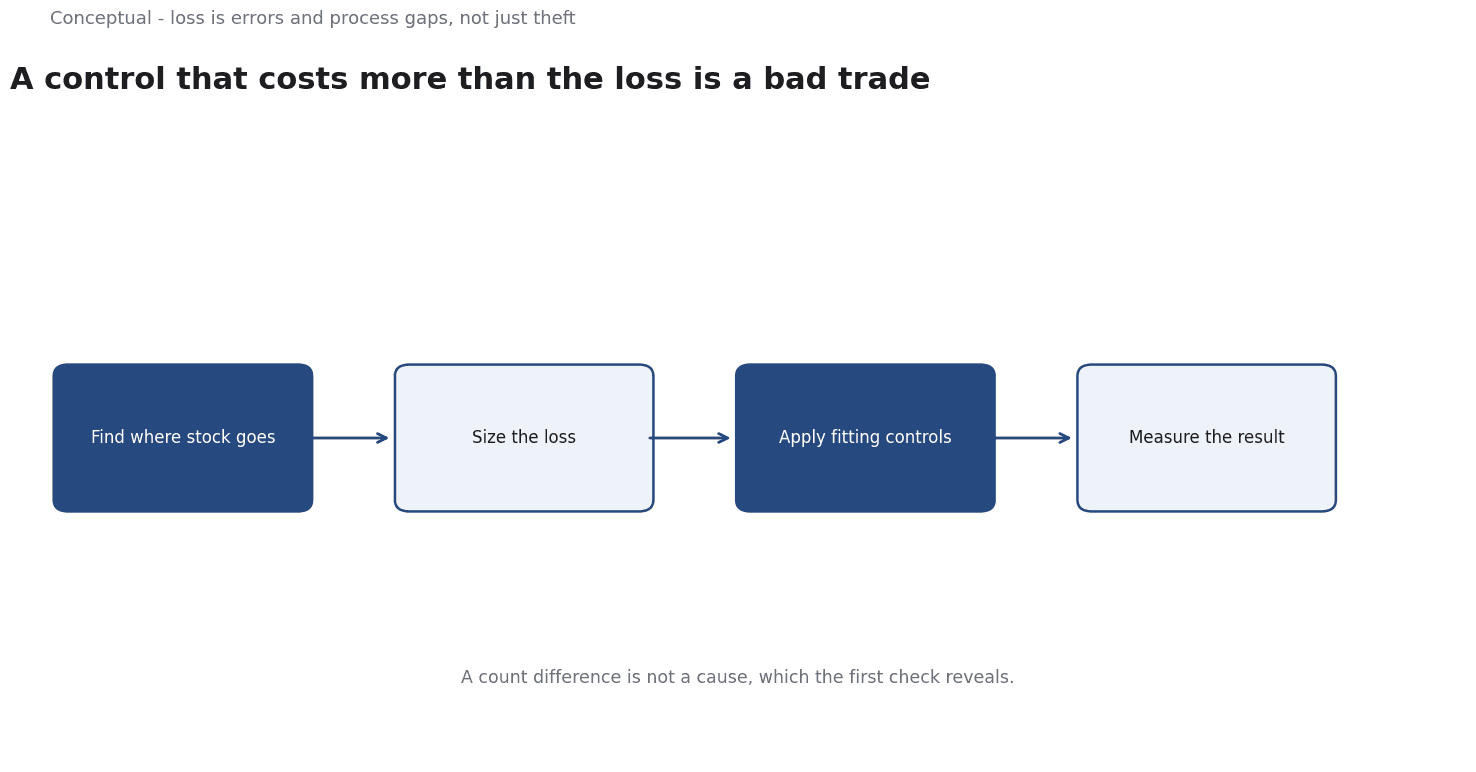
The categories
Shrinkage from error. Counting mistakes, misposted stock, and damage, which the shrinkage entry describes, as Inventory Accuracy without the Hype advises, as the data-governance article requires provenance, as the root-cause article distinguishes cause, as the risk article requires residual risk, as the decision-memo article requires for a record.
External theft. Loss to people outside the business, which the shrinkage entry treats, as Retail Fraud Pitfalls warns about incentives, as the security-checklist article treats per-tool controls, as the threat-modeling article treats boundaries, as the data-governance article requires records, as the risk article requires residual risk.
Internal error and fraud. Loss from within, which the shrinkage entry describes, as Retail Fraud Pitfalls treats incentives, as the HR-screening article treats formal duties, as the privacy article makes obligations jurisdiction-specific, as the governance checklist requires an owner, as the decision-memo article requires for a record, as the risk article requires residual risk.
Process gaps. Weak handoffs and missing checks, which the shrinkage entry implies, as the inventory-control entry describes, as the operations article treats execution, as the monitoring article advises for review, as the root-cause article advises, as the rubric article requires concrete criteria, as the risk article requires residual risk.
Three consequences follow. The category comes before the control, as the shrinkage and root-cause articles advise, as the rubric article requires criteria, as Inventory Accuracy without the Hype advises, as the data-governance article requires provenance, as Retail Fraud Pitfalls warns, as the security and threat-modeling articles treat boundaries, as the HR-screening and privacy articles require formal duties, as the governance checklist requires an owner, as the inventory-control and operations articles treat execution, as the monitoring article advises for review, as the risk article requires residual risk, as the decision-memo article requires for a record.
A worked review
The following is hypothetical and illustrative. A small shop counts 5% of stock missing at year end.
Three checks decide. First, how much is counting error versus physical loss, as the shrinkage and inventory-accuracy articles advise, with provenance, as data governance requires? Second, where in the process did it occur, as the root-cause and inventory-control articles advise, with a criterion, as the rubric article requires? Third, do proposed controls cost less than the loss, as the unit-economics and cash-flow articles require, with residual risk, as the risk article requires, as the decision-memo article requires for a record?
Three conclusions follow.
Process gaps matter, as the inventory-control and root-cause articles advise. And the decision should be recorded, as the decision-memo article requires.
What loss prevention cannot do
It cannot eliminate loss, which the publication standard forbids claiming, as the risk article requires residual risk. It does not replace accurate records, which the inventory-accuracy and data-governance articles require, as the root-cause article advises, as the rubric article requires criteria, as the monitoring article advises for review. And it cannot justify a control that costs more than it saves, which the unit-economics and cash-flow articles require, as the risk article requires residual risk, as the decision-memo article requires a judgement.
The counterargument that stricter controls always help is fair for high-loss environments and incomplete when the control costs more than the loss, which the worked review shows, as the unit-economics and cash-flow articles advise, as the risk article requires residual risk.
A decision test
- Categorise the loss, as the shrinkage entry advises.
- Check record accuracy, as Inventory Accuracy without the Hype advises.
- Find the process gap, as the root-cause article advises.
- Apply proportionate controls, as the fraud and security articles advise.
- Check cost, as the unit-economics article requires.
- Use dated figures, as data governance requires.
- Record the decision and residual risk, as the decision-memo and risk articles require.
For the controls, see Retail Fraud Pitfalls; for the records, see Inventory Accuracy.
References & Further Reading
- Wikipedia contributors, 2026. Shrinkage (accounting) - Wikipedia — Inventory loss and its causes in retail.
- Wikipedia contributors, 2026. Inventory - Wikipedia — The role of stock in operations and accounting.