Loyalty Mechanics Best Practices
Loyalty is a measurement and incentive system, not a points balance. See how promoter scores and referrals interact, a worked example, and a test.
Loyalty programs are often reduced to a points balance, which makes them easy to launch and hard to evaluate. The deeper problem is that advocacy has two separate jobs: it has to be measured and it has to be converted into acquisition. A score and a referral reward are not the same thing, yet teams routinely treat them as one.
Direct answer: Loyalty mechanics are the rules that measure customer advocacy and the incentives that convert it into referrals. Net promoter score is a stated-intent metric based on how likely a customer is to recommend, while referral marketing is an acquisition channel built on customer-to-customer recommendations.
Use the score to ask a question and the referral program to test a behavior, never as substitutes for each other.
Delta: This article adds a decision framing beyond the sources: it maps the score and the referral channel to the specific choice of whether to invest in measurement, incentives, or both, with claim status explicit.
The mechanism
The measurement concept is net promoter score, which sorts respondents by how likely they are to recommend a product or company and reports the share of promoters minus the share of detractors. Its value is that it turns a fuzzy idea, advocacy, into a single comparable number that can be tracked over time. The practical consequence is that it captures stated intent, not observed behavior. A high score means customers say they would recommend; it does not by itself mean that any recommendation happened, which is why the score should be read as a question asked consistently rather than as proof of loyalty.
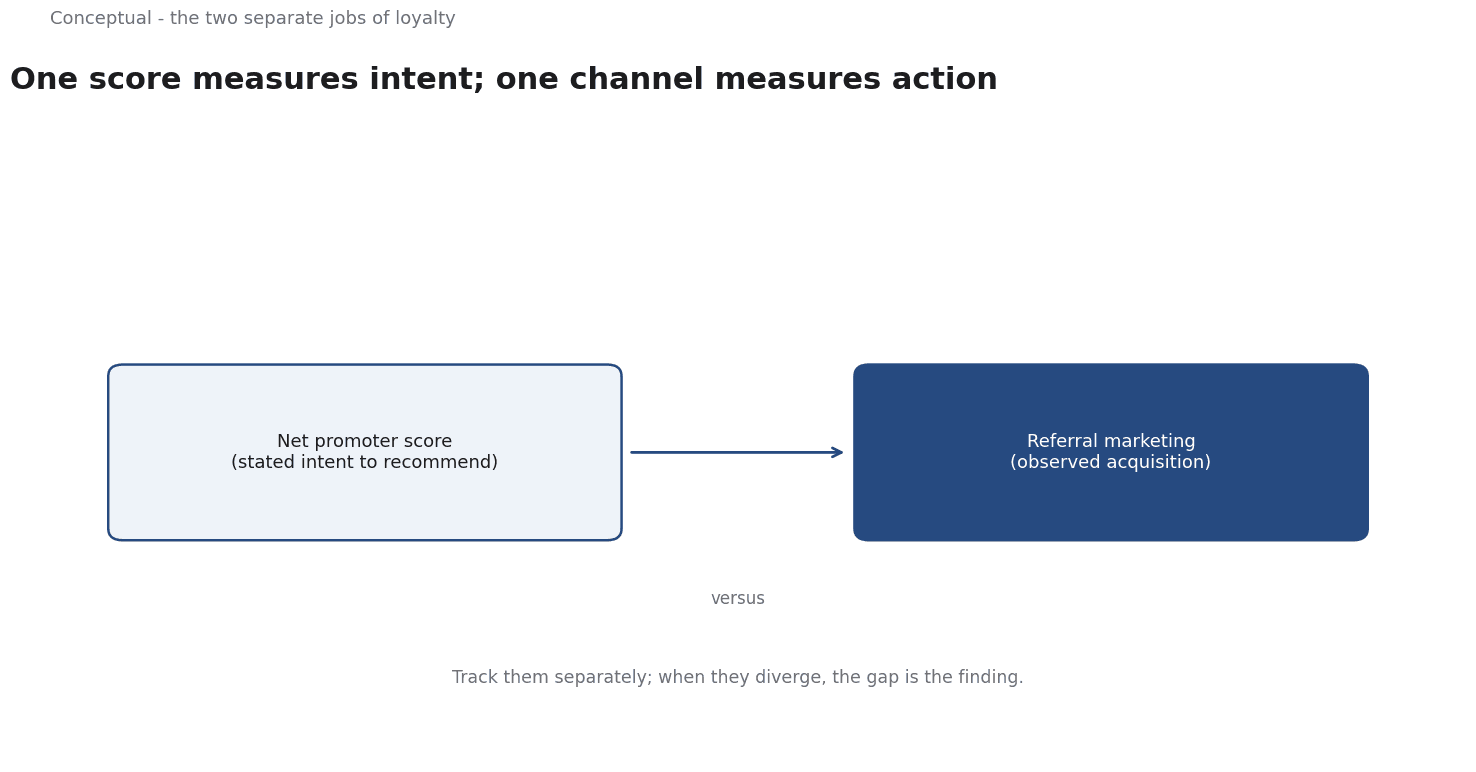
Referral marketing is the acquisition side. It uses existing customers to bring in new ones, commonly with an incentive for the referrer, the recipient, or both. Its value is that it makes word of mouth trackable: a referral can be attributed, measured, and compared with other acquisition channels. The practical consequence is that the channel converts advocacy into an observable outcome, but it also introduces costs and a fraud surface that a survey does not have. Rewards must be earned, attributed correctly, and paid, all of which require rules.
The two concepts interact in a way that is easy to miss. A score can move without any change in referrals, because intentions change faster than actions. A referral program can grow without any change in the score, because incentives can motivate recommendations from customers who would not rate the company highly. The practical consequence is that the two signals should be tracked separately and checked against each other. When they move together, the measurement is corroborated; when they diverge, the gap itself is the finding, and it usually points to a problem with one of the two instruments.
The final part of the mechanism is incentive design. Extrinsic rewards can displace the intrinsic reasons people recommend, and they attract gaming: self-referrals, duplicate accounts, or recommendations made purely for the reward. The practical consequence is that the rules around eligibility, timing, and reward size determine whether the channel measures genuine advocacy or simply purchases transactions. A program that pays too generously can look successful while attracting customers who stay only for the next reward, so the design choice is part of the mechanic, not an afterthought to be tuned later.
A worked example
The following is hypothetical and illustrative. A subscription business sees a strong promoter score but flat referral volume and is considering raising its referral reward. Three checks decide the response. First, the intent-to-action check: are satisfied customers actually being asked to refer at a moment when they can do it easily? Second, the attribution check: are referred customers being counted correctly, and how many referrals come from existing customers rather than duplicate accounts? Third, the retention check: do referred customers stay at a similar rate to other customers, or do they churn once the reward is used? The outcome is a decision rule rather than a verdict. If the gap is a missing prompt or broken attribution, fixing those beats raising the reward. If referred customers retain poorly, a larger incentive would buy more low-quality acquisitions rather than solve the problem.
Evidence status
| Claim | Status | Source | Verified | Recheck when |
|---|---|---|---|---|
| Net promoter score measures stated likelihood to recommend on a zero to ten scale | source-reported | Net promoter score - Wikipedia | 2026-11-18 | Metric definition or published critique changes |
| Referral marketing uses customer recommendations, often with incentives | source-reported | Referral marketing - Wikipedia | 2026-11-18 | Common program practices change in the source |
| A score and an incentive measure different things and should be tracked separately | inferred | Derived from the sources | 2026-11-18 | New evidence on loyalty-metric validity |
The two reported claims are descriptions taken directly from the reference entries and can be relied on as stated. The separation claim is an inference drawn from the difference between a stated-intent measure and an acquisition channel, and it is the step that carries the decision. It should be revisited if new evidence appears about how well either signal predicts actual customer behaviour.
What it cannot do
A promoter score is a measure of stated intent, and intent is not behavior. A customer can answer generously in a survey and never mention the product to anyone, or answer modestly and refer a colleague the same week. The limit is not that the score is badly collected; it is that the question it asks is narrower than the loyalty it is often used to represent. A team that treats the score as a direct measure of advocacy will overestimate the pipeline it has and underestimate the work needed to turn satisfaction into action.
The score is a signal to investigate, not a result to bank.
The hidden cost is the economics of the incentive. Referral rewards are a real expense, and their cost rises as the program grows, including when growth comes from customers who would have referred anyway. That is the subsidy problem: paying for behavior that was already going to happen. There is also the operational cost of attribution, fraud checks, and reward fulfilment, none of which appears in a headline count of referrals. A program that looks cheap per referral can be expensive once the full cost is counted, especially when the rewarded customers were already low-cost to acquire.
A common failure mode is gaming.
The same failure appears when a team rewards a single action, such as an account signup, rather than a retained customer, because the metric can be moved cheaply without improving the business. The mechanism fails when the reward becomes the reason for the referral rather than a thank-you for it. Preventing this requires eligibility rules and delayed payouts, which add friction that must be balanced against the fraud they prevent.
There are boundaries where these mechanics fit poorly. Low-frequency purchases, private or sensitive categories, and products with very long consideration cycles do not produce the steady referral flow the channel assumes. In some markets, recommending a brand carries social risk that no reward offsets, so both the score and the referral count understate real satisfaction. In these settings the framework still describes the instruments, but the instruments do not describe the customer. The honest boundary is that loyalty mechanics work best where recommendations are frequent, low-risk, and easy to attribute.
Finally, the program needs scheduled review because both signals drift. Survey fatigue changes the score, reward economics change with margins, and fraud patterns adapt to the rules. A program that was sound at launch can be leaking value a year later without any visible change in the headline numbers. The practical requirement is to recheck the score's sampling, the referral attribution, and the retention of referred customers on a fixed cadence, and to record which decisions relied on which reading. Without that discipline, the program becomes a set of numbers people report rather than a system they understand.
The counterargument that loyalty mechanics reduce genuine relationships to transactions is fair when rewards dominate the program and incomplete for businesses that use a score to listen and a referral channel to make action easy.
A decision test
- State whether the decision concerns measurement, incentives, or both.
- Check that the score is collected consistently and sampled broadly.
- Test the path from a satisfied customer to an actual referral.
- Verify that referrals are attributed to real, distinct customers.
- Compare retention of referred customers with other acquisition sources.
- Count the full cost of rewards, attribution, and fulfilment.
- Record the decision, the assumptions, and a review date.
The test is passed when a reader can tell which signal was used for which decision and what would change the answer, and failed when a score is quoted as if it were a referral count. The steps keep measurement and incentives in their separate roles. For further reading, see Voice of Customer.
References & Further Reading
- Wikipedia contributors, 2026. Net promoter score - Wikipedia — A measure based on stated recommendation likelihood.
- Wikipedia contributors, 2026. Referral marketing - Wikipedia — The mechanisms and incentives of referral marketing programmes.