Market Cycles for Beginners
Markets move in cycles that are easy to narrate and hard to time. Read what a cycle describes, a worked example, and why it is not a forecast.
A market cycle is a description of how prices, credit, and confidence expand and contract over time. The patterns are visible in hindsight and notoriously difficult to use in the moment, which is why cycle narratives are more useful for understanding risk than for predicting the next move. A beginner's first task is to separate the description from the forecast.
Direct answer:
Business cycles describe phases of expansion, peak, contraction, and recovery in economic activity, which FRED's dated series make observable.
Financial cycles in credit and asset prices often lead or amplify them, as Financial Crises: Systemic Risk, Contagion, and Lessons from History explains for contagion. The boundary: a cycle is a pattern in aggregate data, not a clock, and knowing which phase you are in is usually clear only after the fact, which the causal-inference article treats as a distinction between description and prediction.
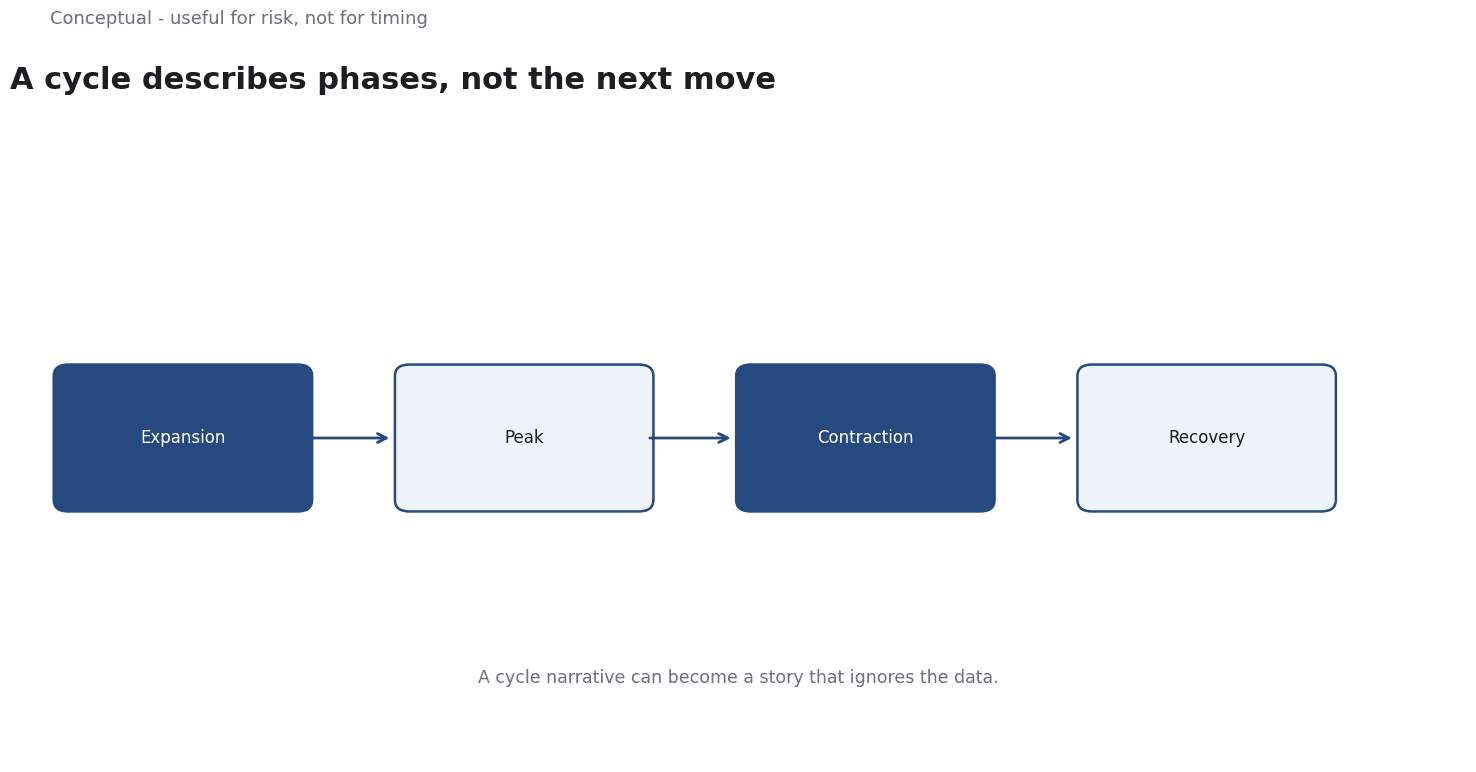
What a cycle describes
Expansion. Output and employment rise, credit grows, and asset prices often follow. The risk-taking that accompanies a long expansion is itself a seed of the next contraction, which the behavioural-finance article treats as a shift in appetite.
Peak and contraction. Growth slows, inventories build, and credit conditions tighten. The fixed-income article explains how rising risk premia and yields transmit through borrowing costs, as the credit-spreads article treats the price of risk.
Recovery. Demand stabilises and investment resumes, often unevenly across sectors, which the market-structures article treats as a question of how prices adjust.
Three consequences follow. Cycles are not symmetric or regular, which the business-cycle literature treats as an empirical finding rather than a pattern to trade mechanically. Different markets cycle on different clocks, which the international-finance article explains for countries with different policy regimes.
A worked example
The following is hypothetical and illustrative. An investor observes three signals: credit spreads have widened from 100 to 250 basis points, a leading employment series has fallen for three months, and equity volatility has doubled.
A cycle narrative says the economy is moving from expansion to contraction, which the dated FRED series supports. Three checks decide what to do. First, are the signals coincident or leading, which the business-cycle article treats as a measurement question? Spreads often move before output, so the pattern is plausible but not definitive. Second, is the investor's horizon long enough to act on a cycle, as the asset-allocation article treats horizon as the primary constraint? A twenty-year investor may rebalance rather than retreat, as the rebalancing article recommends. Third, what would falsify the reading, as the decision-memo article requires for a recorded judgement? A sustained fall in spreads and a recovery in employment would change the assessment.
Three conclusions follow. The narrative informs risk, not a prediction, as the causal-inference article advises for associations. The response should fit the investor's horizon, which the asset-allocation article treats as primary. And the decision should be recorded with the signals, as the decision-memo article requires.
What cycles cannot do
They cannot time a market, which the financial-crises article treats as a question of mechanism rather than an indicator. They cannot tell you which assets will perform, which the factor-investing article treats as a separate empirical question. And they are not a substitute for a portfolio built for your own needs, which the personal-finance article argues for starting with the investor.
The counterargument that cycles are obvious in hindsight and useless forward is too strong.
They are a framework for asking what could change, which the risk-assessment article treats as the purpose of considering scenarios.
A decision test
- Use dated series from FRED for any cycle claim.
- Distinguish leading, coincident, and lagging signals, as the business-cycle article advises.
- Treat a cycle narrative as a hypothesis, as the decision-memo article requires.
- Check that the response fits your horizon, as the asset-allocation article recommends.
- Rebalance according to a rule rather than a forecast, as the rebalancing article advises.
- State what would falsify the reading.
- Review on new data, as the monitoring article recommends.
For the policy context, see Central Banking; for systemic risk, see Financial Crises.
References & Further Reading
- Wikipedia contributors, 2026. Business cycle - Wikipedia — The phases and measurement of business cycles; a secondary reference.
- Federal Reserve Bank of St. Louis, 2026. FRED economic data — The primary time-series database used for macro indicators.