Marketing Budget Template and Allocation Rules
A budget is a set of bets with a review rule. Read a workable template, the allocation logic behind it, and what to cut first.
Marketing budgets are often built by taking last year's spend and adjusting it. That method preserves whatever happened last year, including the waste. A better approach treats the budget as a portfolio of bets with explicit sizes, review dates, and rules for what gets cut when evidence is weak.
Direct answer:
A workable budget separates committed spend, experimental spend, and measurement capacity; assigns each line to a decision and a primary metric; and sets a review rule based on evidence rather than on the calendar alone.
Geo experiments can test whether a campaign caused a change, and demand-generation principles distinguish long-horizon brand work from capture. The boundary: a template is a structure for decisions, not a formula that produces the right allocation — that depends on your margins and stage.
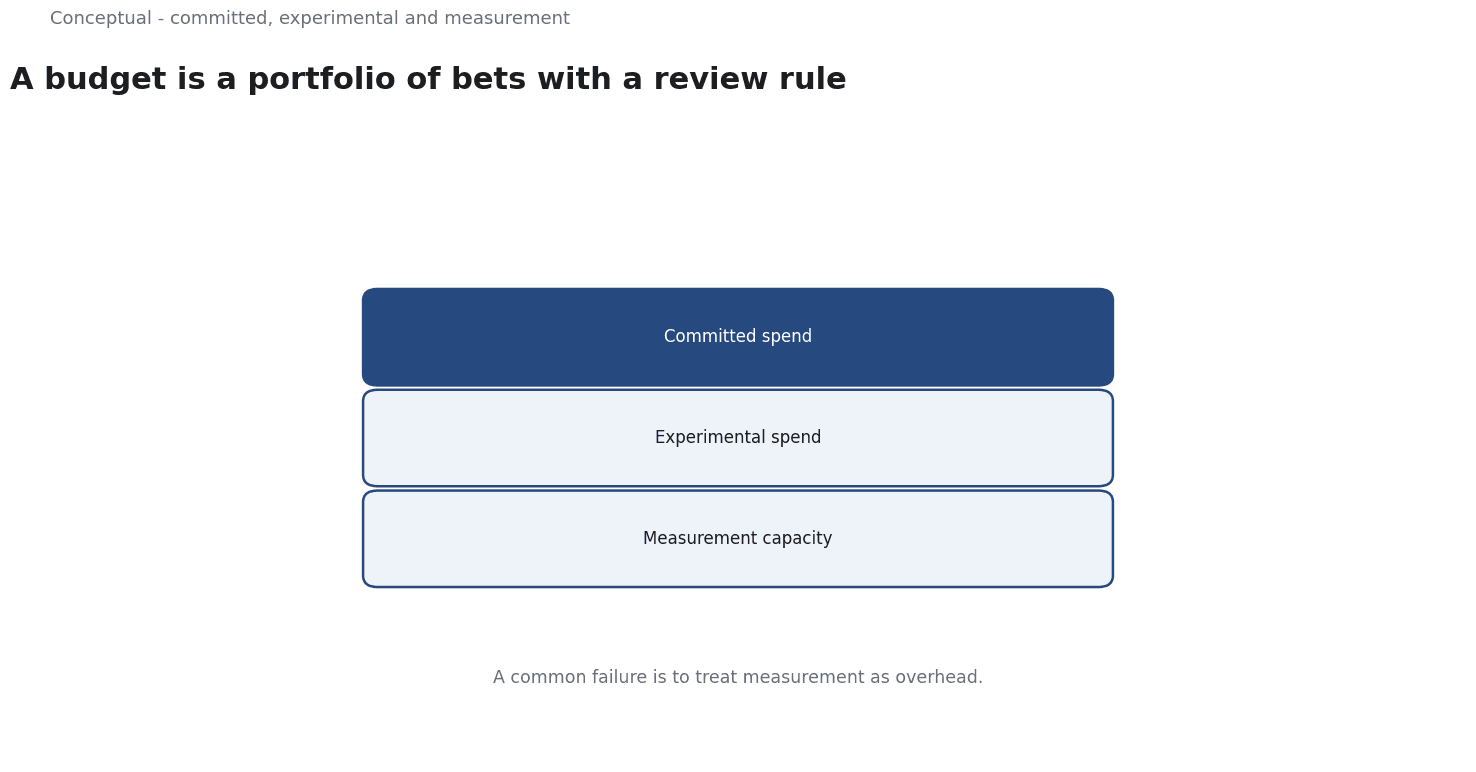
Three buckets
Committed spend. Channels with demonstrated return that you expect to continue. These are funded first, but they still need a review trigger — a change in unit economics or a material drop in performance.
Experimental spend. A bounded portion for new channels, formats, or audiences. The defining property is not the amount but the rule: each experiment has a hypothesis, a primary metric, and a stop date.
Measurement capacity. Research, surveys, testing tools, and analyst time. This line is easy to cut and expensive to rebuild. Without it, the other two buckets cannot be evaluated, which makes the whole budget a guess.
That produces activity without learning.
A worked template
The following is hypothetical and illustrative.
A company has a 1,000,000 annual marketing budget. A possible allocation:
| Bucket | Amount | Rule |
|---|---|---|
| Proven paid channels | 500,000 | Funded on measured contribution; review quarterly |
| Content and brand | 250,000 | Long-horizon; measured by a held-out geo comparison |
| Experiments | 150,000 | Ten tests of 15,000 each, with stop dates |
| Measurement | 100,000 | Survey panel, testing tools, analyst time |
Three rules make the template work:
- Experiments are capped per test, not per channel. A single large experiment that fails teaches less than ten small ones. The cap also prevents a promising-sounding idea from consuming the whole experimental budget.
- Brand spend has a comparison design. A geo holdout, as the ad-effectiveness guidance describes, separates the campaign's effect from category trends. Without it, a rising brand metric could be anything.
- Measurement is protected. If a quarter is tight, cutting the measurement line first guarantees that the next quarter's cuts will be guesses.
Three decisions follow from results:
- A proven channel whose contribution falls below the threshold moves to experimental status, not to automatic renewal.
- An experiment that wins gets promoted to committed spend at a bounded level, then re-measured.
- Brand spend is reviewed on its own horizon, not judged by the same metric as paid search.
Handling a cut
Budgets are cut more often than they are increased, and the order of cuts reveals what a team actually believes. Three rules make the process defensible:
Cut experiments before committed spend. An experiment that has not produced evidence is a cheaper loss than a proven channel whose return is known. The exception is an experiment close to a decision point — stopping it just before the result wastes the spend already incurred.
Never cut measurement first. It is tempting because it has no immediate output and no vocal advocate. But cutting measurement means the next allocation will be made on opinion, and the team will be unable to tell which of its cuts was correct. A smaller measurement line that preserves the core comparison is better than none.
Cut by evidence, not by equal percentage. A uniform 10% cut across every line treats proven performance and untested activity the same. Review each line against its metric and time horizon, then remove the weakest cases entirely.
These rules are easier to state than to follow, because budget cuts happen under pressure and the strongest channels are often the most expensive. Writing the rules down before a cut is needed is what makes them usable when it arrives.
What the allocation cannot decide
It cannot set the right total. Whether 10% or 20% of revenue belongs in marketing depends on margin, stage, and payback period — a business model question, not a template question.
It cannot remove time lags. Brand and content work pay off over quarters. A budget reviewed only monthly will cut them before the evidence arrives.
It cannot fix a weak offer. More spend on a product that does not convert produces more evidence that it does not convert. The budget should be reviewed alongside conversion and retention, not in isolation.
The counterargument — that allocation rules are too rigid for a fast-moving market — is fair.
The response is to set the rules for review, not for permanence: a quarterly reallocation with a stated reason is discipline, while a monthly reshuffle based on noise is not.
A decision test
- Separate committed, experimental and measurement spend.
- Assign a primary metric and a time horizon to each line.
- Cap experiments per test and give each a stop date.
- Use a holdout for brand and campaign claims.
- Protect measurement when cuts are needed.
- Promote winners and demote underperformers explicitly.
- Review on the bucket's horizon, not one metric for all.
For the measurement method, see Marketing Attribution; for the stage model, see Demand Generation vs Lead Generation.
References & Further Reading
- Brian Vaver and Koehler, 2011. Measuring Ad Effectiveness Using Geo Experiments — Geo experiments for incrementality, the cleanest way to attribute marketing spend.
- Wikipedia contributors, 2026. Demand generation - Wikipedia — An overview of demand generation as a marketing discipline distinct from lead generation; secondary reference used with the lead-generation entry.