Marketplaces in Practice
A marketplace matches two sides and lives or dies by trust. Read the operating mechanism, a worked example, and why liquidity is the real constraint.
A marketplace looks like a website where buyers and sellers meet, which hides the actual work: solving the chicken-and-egg problem, balancing two sides, and maintaining trust between strangers. The marketplace business-model article explains how the structure works, and the antitrust market-definition material offers a reminder that the relevant market must be defined before claiming a network effect, as Network Effects without the Hype treats the effect as a testable claim.
Direct answer:
A marketplace succeeds when enough participants on each side find value and trust the transaction, with liquidity — the ability to match quickly — as the binding constraint.
The marketplace-model article provides the structure, and O*NET's task descriptions help identify the operating roles. The boundary: a marketplace cannot manufacture trust, which the reputation article treats as a public record, and a claimed network effect must be measured, as Network Effects without the Hype argues, as the publication standard forbids guaranteed outcomes.
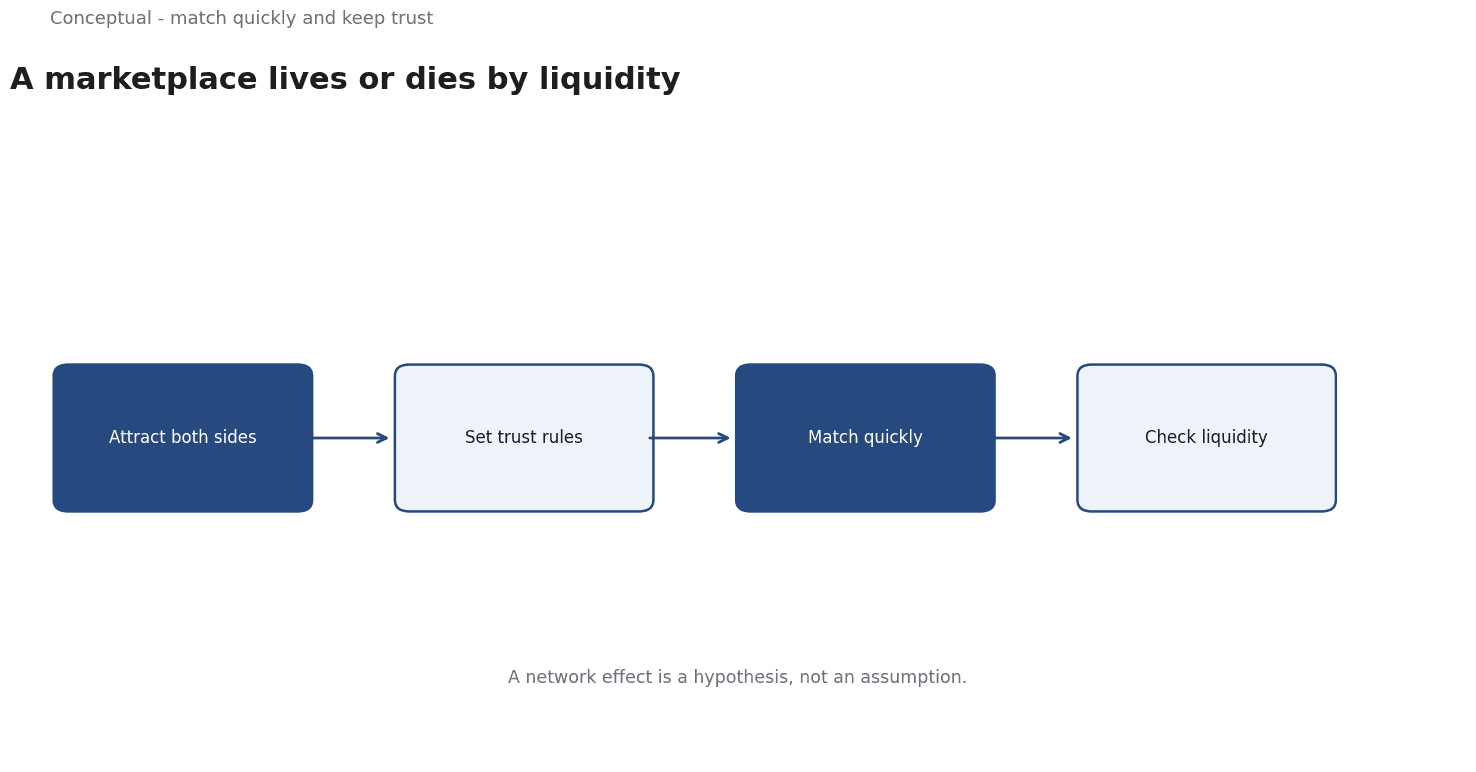
The operating problems
Cold start. A marketplace with no sellers has nothing for buyers, and vice versa, which the cold-start article treats as a problem with strategies and costs. The practical response is to seed one side deliberately, which the founder-led-sales article describes for early GTM, as the waitlist article treats interest as a stock.
Liquidity. The relevant measure is not total users but whether a participant can find a match quickly, which the network-effects article treats as the test of value, as the funnel article advises for stage measures. A large marketplace with slow matching is weaker than a small one that clears quickly, as the market-definition article warns about defining the right market.
Trust and safety. Strangers transact, which requires identity, reviews, and recourse, as the online-reviews article explains for reputation as a public record, as the fraud controls in the referral article treat abuse as a design problem.
Take rate and incentives. The platform's revenue comes from a fee, which the unit-economics article treats as a margin question, as the partner-ecosystem article discusses how to keep participants incentivised, as the discount article warns about incentives that distort behaviour.
Three consequences follow. The two sides must be balanced, which the marketplace article treats as central, as Network Effects without the Hype argues for measuring the effect. Trust is infrastructure, which the reputation article supports, as the crisis-planning article treats recovery as a designed process. And the take rate has to leave participants enough value, as the unit-economics article requires for contribution, as the founder-led-sales article describes for early GTM.
A worked example
The following is hypothetical and illustrative. A new marketplace for local services has 1,000 buyers and 100 sellers in one city.
Three checks decide whether it works. First, liquidity: what share of buyer searches result in a booking within a day, which the funnel article treats as a stage measure, as Network Effects without the Hype advises for a testable claim? Second, trust: what share of transactions receive a review, and how are disputes resolved, which the online-reviews article treats as the public record, as the crisis article requires for recovery? Third, economics: does the take rate leave sellers enough margin to stay, which the unit-economics article requires, as the partner article advises for incentives?
Three conclusions follow. The buyer-to-seller ratio matters only through matching speed, which the liquidity check reveals. Trust mechanisms are part of the product, as the reputation article argues. And the result should be recorded with the assumptions, as the decision-memo article requires.
What marketplace analysis cannot do
It cannot create trust by policy alone, which the reputation article treats as earned, as the advocacy article argues for genuine voices. And it does not remove the need to define the market, which the antitrust definition material treats as a prior step, as the industry lens requires scope.
The counterargument that a large user base guarantees success is wrong, which the worked example shows for matching speed, as Network Effects without the Hype advises for measurement.
A decision test
- Define the market and the two sides, as the market-definition material advises.
- Measure matching speed, not total users, as the liquidity rule requires.
- Seed the constrained side deliberately, as the cold-start article recommends.
- Build trust mechanisms, as the online-reviews article advises.
- Check that the take rate leaves participants value, as the unit-economics article requires.
- Treat a network effect as a hypothesis, as Network Effects without the Hype advises.
- Record the decision with the assumptions, as the decision-memo article requires.
For the model, see How Marketplace Business Models Actually Work; for the effect, see Network Effects.
References & Further Reading
- Yan Yang, 2019. A New Solution to Market Definition: An Approach Based on Multi-dimensional Substitutability Statistics — How market definition is handled in a premerger investigation, and the Hypothetical Monopolist Test behind it.
- U.S. Department of Labor, 2026. O*NET OnLine — The standard occupational taxonomy used to compare roles across industries.