Multi-Agent Coordination: When More Agents Make Things Worse
Adding agents adds coordination cost and new failure modes. Read the evidence, a worked comparison, and when a single agent wins.
The idea behind multi-agent systems is appealing: give each agent a role — researcher, writer, reviewer — and let them collaborate. The reality is that coordination consumes tokens, introduces miscommunication, and can produce worse results than one well-prompted agent. A survey of LLM-based multi-agent systems documents both the progress and the challenges.
Direct answer: They hurt when the task is a single coherent problem, because the agents must re-establish context at every handoff and errors compound. The survey and the AgentVerse work are the primary references. The boundary: the benefit is task-dependent — there is no general reason that more agents means better answers.
Multi-agent systems help when tasks can be genuinely decomposed and the sub-agents have distinct information or tools.
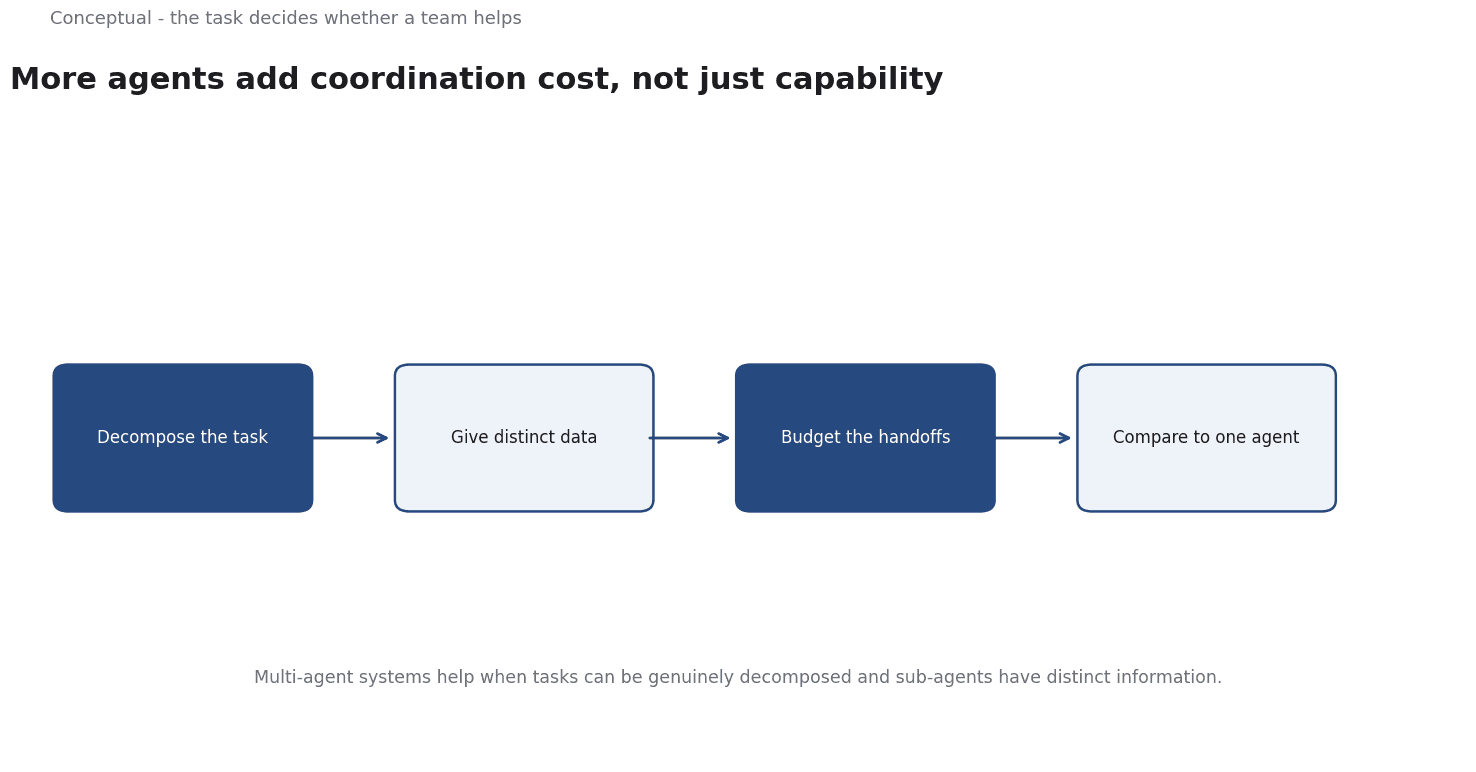
What coordination costs
Three costs appear as soon as more than one agent is involved:
Context duplication. Each agent needs the task context, which means the same background is sent multiple times. The context-engineering article explains why that consumes a scarce resource.
Handoff loss. The output of one agent becomes the input of the next. If the first agent omits a detail, the second cannot recover it. This is the same failure as a broken tool response, which the tool-calling article covers.
Error compounding. Each agent has a probability of being wrong. A chain of four agents with 90% reliability each succeeds about 66% of the time, before considering miscommunication — the arithmetic the autonomous-business article shows.
A worked comparison
The following is hypothetical and illustrative.
A team compares two designs for a market-research task:
- Single agent: retrieves sources, synthesises findings, writes a report in one continuous run. 20,000 input tokens, 4,000 output tokens, 3 tool calls.
- Three agents: a researcher retrieves, an analyst synthesises, a writer drafts. Each handoff passes a summary. Total 45,000 input tokens, 7,000 output tokens, 3 tool calls plus 2 handoffs.
Three questions decide:
- Does decomposition improve quality? If the analyst can use a different model or a stricter verifier than the writer, specialisation may help. If all three use the same model and prompt style, the extra structure adds cost without a new capability.
- Where do errors enter? If the researcher misses a source, the analyst and writer produce a confident but incomplete report. Check the handoff content, not only the final output, which the evaluation article recommends.
- Is the cost justified? The three-agent design costs more than twice as much. It wins only if the quality gain is material and the task is infrequent enough to absorb it.
Three conclusions follow:
- Specialisation must be real, not nominal role labels.
- Handoffs are a failure surface and need validation.
- The single-agent baseline must be measured first, as the routing article argues for model choice.
When multiple agents help
Distinct tools or permissions. One agent can read a database; another can act on it. Separating them enforces a boundary, which the security checklist recommends.
Genuinely independent subtasks. If two research threads do not depend on each other, parallel agents reduce latency.
Adversarial review. A critic agent with a different prompt can catch errors the author missed, provided it is evaluated rather than trusted, as the evaluation-rubric article explains.
When one agent wins
Coherent tasks where the context must be held throughout.
Tight latency or cost budgets where handoffs are expensive.
Tasks without a clear decomposition — forcing sub-agents to split an indivisible problem produces fragmentation, not parallelism.
The counterargument — that multi-agent systems mirror human teams — is an analogy, not evidence.
Human teams share persistent context and have mechanisms for resolving disagreement that agent handoffs do not automatically replicate.
Reducing coordination cost
When multiple agents are justified, three mechanisms reduce the cost:
Pass structured artifacts, not prose. A handoff that is a schema — findings, sources, confidence, open questions — is easier for the next agent to consume than a narrative summary, as the structured-output article explains.
Share read-only context. If all agents need the same background, provide it from a common source rather than asking one to summarise it for the others. The context-engineering article explains why repeated context consumes the budget.
Bound the conversation. A supervisor that routes tasks to specialists should limit the number of turns and the depth of the chain.
These mechanisms do not remove the fundamental trade-off — coordination is still work — but they keep it from dominating the task.
What the research does not settle
Not a universal result. The survey documents progress and challenges, not a rule that multi-agent systems outperform single agents. Task structure decides.
Not cheaper by default. More agents mean more tokens and more calls, as the cost estimator shows.
Not more reliable by default. Extra agents can catch errors or introduce them. The combined system needs evaluation, as the LLM evaluation article explains.
A decision test
- Measure a single-agent baseline first.
- Decompose only if subtasks are genuinely independent or need distinct tools.
- Give each agent a different capability, not just a different name.
- Validate every handoff, not only the final output.
- Price the extra tokens and latency at your volume.
- Check error compounding across the chain.
- Revert to one agent when the gain is not measurable.
For the orchestration context, see From LangChain to LangGraph; for the workload type, see AI Workflow Automation.
References & Further Reading
- Xu et al., 2024. Large Language Model based Multi-Agents: A Survey of Progress and Challenges — Survey of multi-agent systems, including coordination failures and emergent behaviours.
- Anthropic, 2025. Effective context engineering for AI agents \ Anthropic — The distinction between context engineering and prompt engineering, and why context is a scarce resource in agents.