Negotiation: Getting to Yes in Business and Career
Negotiation is a design problem about the other party's choices, not a test of who argues better. Read how to prepare and what to trade.
Most people prepare for a negotiation by rehearsing arguments, and then wonder why the discussion stalls. The reason is structural: your argument is not the decision. The other side's decision is, and it is made inside a set of constraints — alternatives, mandates, risk tolerance, and internal politics — that have almost nothing to do with how persuasive you are.
Direct answer: A negotiation succeeds when both sides can say yes to a structure that is better than their alternatives. The work is therefore to understand the other party's alternatives and interests before the conversation, to make the trade-offs explicit rather than positional, and to know your own walk-away point with enough clarity that you can leave calmly. The frame is not "how do I win" but "what structure would make this a better option for both of us than what each would do alone".
The institution that framed the field
Negotiation as a teachable discipline has an institutional home, and it is worth naming because it shapes how the subject is taught. The Program on Negotiation at Harvard Law School describes itself as "a university consortium dedicated to developing the theory and practice of negotiation and dispute resolution", and as "a community of scholars and practitioners" serving a distinct role in the field.
The significance of that framing is that negotiation is treated as a practice with theory behind it — not a personality trait, not a talent, and not a trick. The implication for an individual is useful: if negotiation is a practice, it can be studied, rehearsed, and improved in the same way any other professional skill is.
The occupational side reinforces this. O*NET, the Department of Labor's occupational database, exists to define what roles involve and what competencies they require, and negotiation appears across a wide range of them — not only in sales or law but in management, product, and engineering leadership. Career advice that treats negotiation as something that happens once, at an offer, misses how often the skill is actually used.
Prepare on the other side of the table
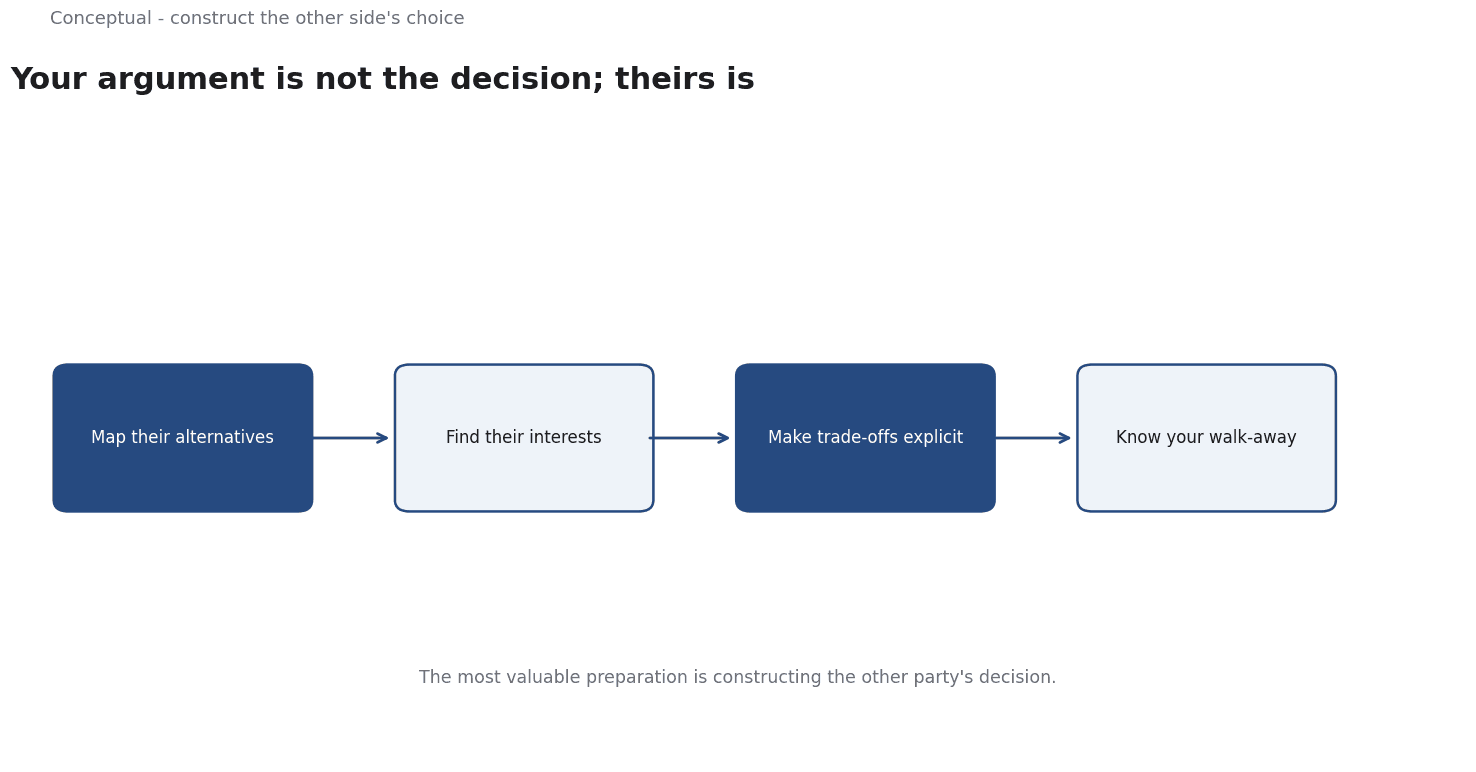
The most valuable preparation is not scripting your case; it is constructing the other party's decision.
What are their alternatives? A counterpart with a strong alternative has power regardless of how good your offer is; one with no alternative is negotiating from a position you can improve. Their alternative is not always another supplier — it may be doing nothing, delaying, using an internal team, or absorbing the cost of the problem.
What are they actually optimising? The stated position — a price, a date, a title — is usually a means to something else. The underlying interest might be risk reduction, an internal commitment, a need to show progress to their own board, or the preservation of a relationship elsewhere. A position can only be traded; an interest can be satisfied in several ways, which is where creative outcomes come from.
Who has to say yes? In business negotiations the person across the table is often not the decision-maker but an advocate with a mandate. Understanding who else must approve, and what that person needs to see, prevents a discussion that feels successful and then fails at approval.
Trade-offs, not positions
Porter's strategy framework is stronger than it first appears when applied here. "Trade-offs occur when activities are incompatible — more of one thing necessitates less of another", and "trade-offs create the need for choice". In a negotiation, this is the difference between splitting a fixed pie and finding a structure where each side's lower-cost item is the other side's higher-value one.
Concretely: a higher price with a longer commitment, a faster delivery date with a smaller initial scope, a lower fee with a reference or a case study, a broader role with a later start date. Each of these works because the two sides value the dimensions differently, and the value of making the trade-offs explicit is that it reveals which dimensions matter.
When a discussion fixates on price, it is usually because nobody has put the other variables on the table — and the side that introduces them first often captures the value, because the conversation then happens on dimensions where they are strong.
Career negotiations are the same structure
An offer conversation looks different and is not. The employer has a band, a headcount approval, a set of peers whose salaries matter internally, and a role they are trying to fill. You have alternatives, a set of things you actually value — scope, learning, flexibility, location — and a tolerance for uncertainty.
Three habits transfer directly:
- Know your walk-away point before the conversation, and make it a real alternative rather than a bluff. A walk-away you cannot execute is not a position; it is a bluff that collapses under a firm offer.
- Trade rather than demand. If the base is fixed by a band, ask what else is flexible: the start date, the review point, the scope, the title, the equipment, the learning budget.
- Ask what the constraint is. "Is the base fixed by the band, or is there room?" is a question that often changes the conversation, because it lets the other party tell you where the flexibility actually sits.
Google's published people practices are useful as a reminder that large organisations have structured processes and written criteria — which means the negotiation is partly with the process, not only with the person. When the process is transparent, the right move is often to work within its dimensions rather than try to argue around it.
A preparation checklist
- Write the other side's alternatives before you write your own case.
- Write their likely interests, and mark which you are guessing rather than know.
- Name the decision-makers and the approval path.
- List your tradeable dimensions — the things you could give that cost you little and matter to them.
- Set a walk-away point you can actually execute.
- Rehearse the trade-off language, not the argument: "If we could do X, would you be able to do Y?"
- Afterward, record what surprised you. Negotiation is a practice, and the debrief is where the improvement happens.
For the strategic frame that determines what is worth trading, see How Companies Build Competitive Advantages; for the career context, see Career Transitions.
A worked example
The following is hypothetical and illustrative. A regional software firm is negotiating a two-year contract with a data provider and expects the vendor to hold firm on price. Before the call, the team builds the vendor's decision on paper rather than rehearsing arguments. First, it writes the vendor's alternatives: a larger competitor's offer, an in-house build, and simply delaying. Second, it separates positions from interests, noting that the vendor's stated price may mask an interest in a reference customer and a predictable renewal, both cheap for the firm to give. Third, it maps the approval path, identifying that the vendor's account team needs regional sign-off, not just the rep's agreement. The firm then prepares trade-offs - a longer commitment against a lower unit price, a public case study against a faster start date. When the vendor does hold on price, the conversation moves to those dimensions instead of stalling. The bounded outcome is a signed agreement at a slightly lower rate in exchange for the two-year term and a reference, with the firm's walk-away - an in-house build - never tested.
A counterargument
The framework presumes a negotiation where value can be created and dimensions can be traded, which is not the situation in every room. Porter's trade-off logic concerns incompatible activities in competitive positioning, not a two-party conversation where both sides should end up better off than their alternatives - in a fixed-budget or single-slot dispute there may be no second dimension to introduce. The institutional sources reinforce an orderly, process-driven picture: PON treats negotiation as a practice and Google's published practices assume transparent written criteria, both of which fit a repeat player with a process more than a one-off counterpart with no genuine alternative.
The article insists a walk-away must be executable but never examines what its method offers someone with no alternative to execute.
References & Further Reading
- Harvard Law School, 2026. Program on Negotiation at Harvard Law School — A university consortium dedicated to developing the theory and practice of negotiation and dispute resolution.
- Michael E. Porter, 1996. What Is Strategy? — The differentiation-versus-cost argument behind competitive-advantage analysis.
- U.S. Department of Labor, 2026. O*NET OnLine — The standard occupational taxonomy used to compare roles across industries.
- Google, 2026. Google re:Work — A large company's published people practices, including hiring and growth frameworks.