Career Transitions: Moving Between Industries and Roles
A career change is a search problem over skills, not a leap of faith. Read how to map transferable tasks, test the gap, and avoid the common traps.
Career transitions are usually narrated as stories of reinvention. That makes them sound like acts of will, when the more useful view is prosaic: a transition is a matching problem between what you can already do and what a different role requires. The work is to make that match explicit, then test the parts that do not fit.
Direct answer: Move between industries by decomposing both your current role and the target role into tasks and skills, identifying the overlap, and running a small, cheap test of the gap before committing. O*NET OnLine is a primary source for this: it offers "detailed descriptions of the world of work" across "900+ occupations", including skills, tasks, and occupation requirements. The boundary is that an occupation database describes the average job in a category; your actual target employer may be different, and no taxonomy tells you whether you will enjoy the work.
Why the "transferable skills" advice fails
The standard advice — emphasise your transferable skills — is correct but too vague to act on. It fails in two ways.
First, it treats skills as a single list, when a role is a bundle of tasks performed under particular constraints. A project manager in construction and one in software may share the word "coordination" while doing very different daily work.
Second, it assumes the reader knows which skills transfer. Most people overestimate the ones that are visible on a CV and underestimate those learned implicitly — navigating ambiguity, negotiating with stakeholders, reading a room.
O*NET is useful here because its records separate tasks from skills and both from "requirements, characteristics, and available opportunities". That separation is the point: it lets you compare two occupations at the level of work performed rather than job titles.
A method for mapping the gap
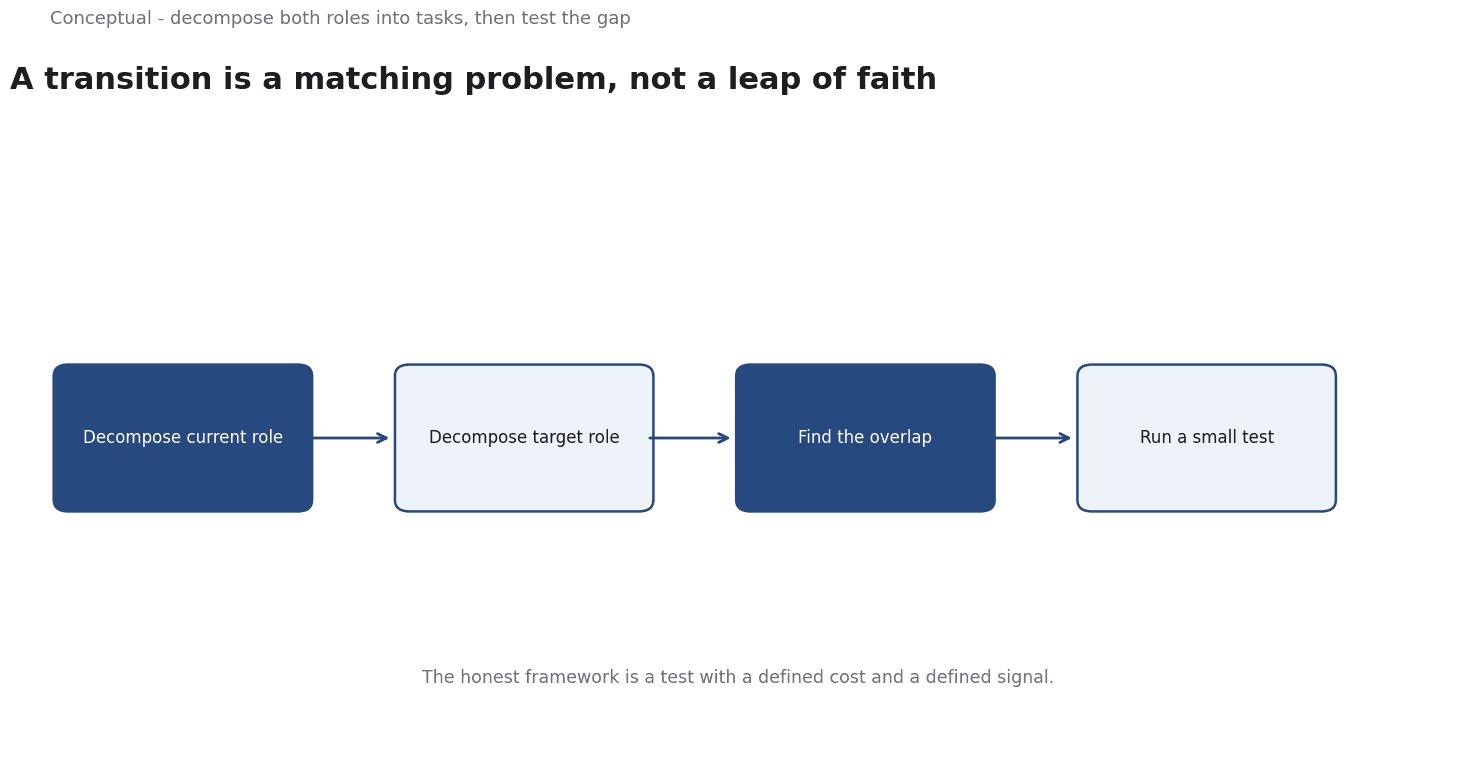
Four steps turn a vague intention into an evidence-based plan.
1. Describe the source role in tasks, not titles. Write down what you actually did last month, with the frequency and the level of autonomy. "Managed a team" is too coarse; "ran weekly planning for six people and escalated two design conflicts" is usable.
2. Describe the target role the same way. ONET's occupation search by keyword or ONET-SOC code gives a structured starting point, and its "Bright Outlook" labels flag occupations expected to "grow rapidly", have "large numbers of job openings", or be "new and emerging". Treat that as a labour-market signal, not a personal recommendation.
3. Classify each task as transferable, partially transferable, or new. The middle category is where most of the work sits: a skill you have in one context may need re-validation in another.
4. Test the largest gap cheaply. A course, a small project, or a conversation with someone doing the job can reveal whether the gap is a matter of knowledge, credentials, or something harder to acquire.
The sequence matters.
A worked example of a transition map
The following is a hypothetical composite, not an account of a real person.
Suppose a operations lead in logistics wants to move into product management at a software company. Using role descriptions, they map the current role:
- Run weekly planning across three teams — transferable to product coordination.
- Negotiate delivery dates with suppliers — partially transferable to stakeholder management; the counterparties differ.
- Analyse shipment delays in spreadsheets — partially transferable to data analysis; the tooling and the metrics differ.
- Manage warehouse safety compliance — new in the target role.
The target role requires:
- Prioritising a feature backlog — new, and the largest gap.
- Writing specifications — partially transferable from writing process documentation.
- Running user interviews — new.
- Working with engineers on estimates — partially transferable from supplier negotiations.
The map produces a narrow test: can this person write a one-page specification and prioritise a small backlog for a real product? A four-week project on an open-source tool answers that question far better than a general course in product management.
The map also reveals what not to emphasise: the safety-compliance experience is real but irrelevant to this target, while the supplier negotiation is relevant if framed as stakeholder management with evidence.
The cost of being wrong, and the value of a test
A transition is an investment under uncertainty, so the right size of the first step depends on what a mistake would cost. Two questions make this concrete.
What is the downside if the test fails? Suppose a move requires six months of preparation and 8,000 in costs, and the reader has no savings buffer. The rational test is not a six-month course but a two-week conversation-and-prototype exercise that costs almost nothing and can falsify the assumption. The same reader with a year of savings and no dependants can afford a more expensive probe.
What would the test actually tell you? A course completion certificate tells you that you can complete a course. A small piece of work in the target domain — a specification, an analysis, a shipped artifact — tells you whether you can do the job and whether you enjoy it. The second is a better test because it produces the same kind of evidence the employer will eventually use.
This is why the sequence in the earlier method puts the task map first: it identifies the specific assumption worth testing. A generic "try the industry out" is too vague to have a failure condition, and a test without a failure condition cannot update your beliefs.
There is also an option value in staying. Keeping your current income while testing a transition preserves the ability to change course. Quitting first removes that option and puts pressure on the test to succeed, which distorts the evidence you gather.
What the evidence does not settle
Three limitations change how much weight to give any transition plan.
Occupation data is an average. O*NET describes categories, not specific jobs. A "product manager" role at a regulated enterprise and one at an early-stage startup may share a title and little else. Use the taxonomy to generate questions, not answers.
Success stories are survivorship-biased. The visible transitions are the ones that worked; the people who made the same move and struggled are less likely to publish an account. A successful career-change story is a single case, not a base rate.
Average effects are not individual prescriptions. Labour-market data can tell you which occupations are growing; it cannot tell you whether a particular person will thrive in one.
The decision remains personal, and the honest framework is a test with a defined cost and a defined signal, not a prediction.
There is also a structural constraint that individual advice often ignores: some transitions require credentials, licences, or years of domain experience that cannot be compressed. A map that ignores this produces a plan that is logically sound and practically impossible.
A decision test
- Write both roles as task lists before comparing titles.
- Classify the overlap into transferable, partial, and new — with evidence for each claim.
- Identify the largest gap and define the smallest test that would falsify your assumption.
- Check hard requirements — credentials, licences, years of experience — early, not after investing in preparation.
- Set a time and money budget for the attempt, including the cost of failing.
- Talk to people doing the target job about what they actually do, not what the title suggests.
- Decide in advance what result would change your mind.
For the broader skills question, see The Future of Work; for how to evaluate learning options, see Why Learning How to Learn Is a Competitive Advantage.
A counterargument
The method assumes the target is a stable, knowable bundle of tasks, and that is where a critic would push. O*NET OnLine describes the average occupation, yet the article itself notes that two "product manager" roles can share a title and little else - so the map is only as good as the specific employer's actual work, which a taxonomy cannot supply. More importantly, the framework treats transition as an individual planning problem, while the cited Google re:Work material documents how organisations actually hire: through structured practices and signals, not through a candidate's correctly classified skill list. A four-week prototype can prove capability but cannot manufacture the credential, referral, or title history that often gates the first interview.
Reducing a structural gate to a testable gap risks producing a plan that is logically sound and still never gets the applicant in the room.
References & Further Reading
- U.S. Department of Labor, 2026. O*NET OnLine — The standard occupational taxonomy used to compare roles across industries.
- Google, 2026. Google re:Work — A large company's published people practices, including hiring and growth frameworks.