Network Effects without the Hype
More users do not automatically make a product better. Read the conditions for a real network effect, a worked test, and why it often fails.
"Network effects" is used to explain almost any fast-growing platform, which makes the term nearly useless. A network effect exists only when each additional user increases the value of the product for other users, and that is a specific, testable claim. Many products grow without one, and some claimed effects are actually scale economies or brand.
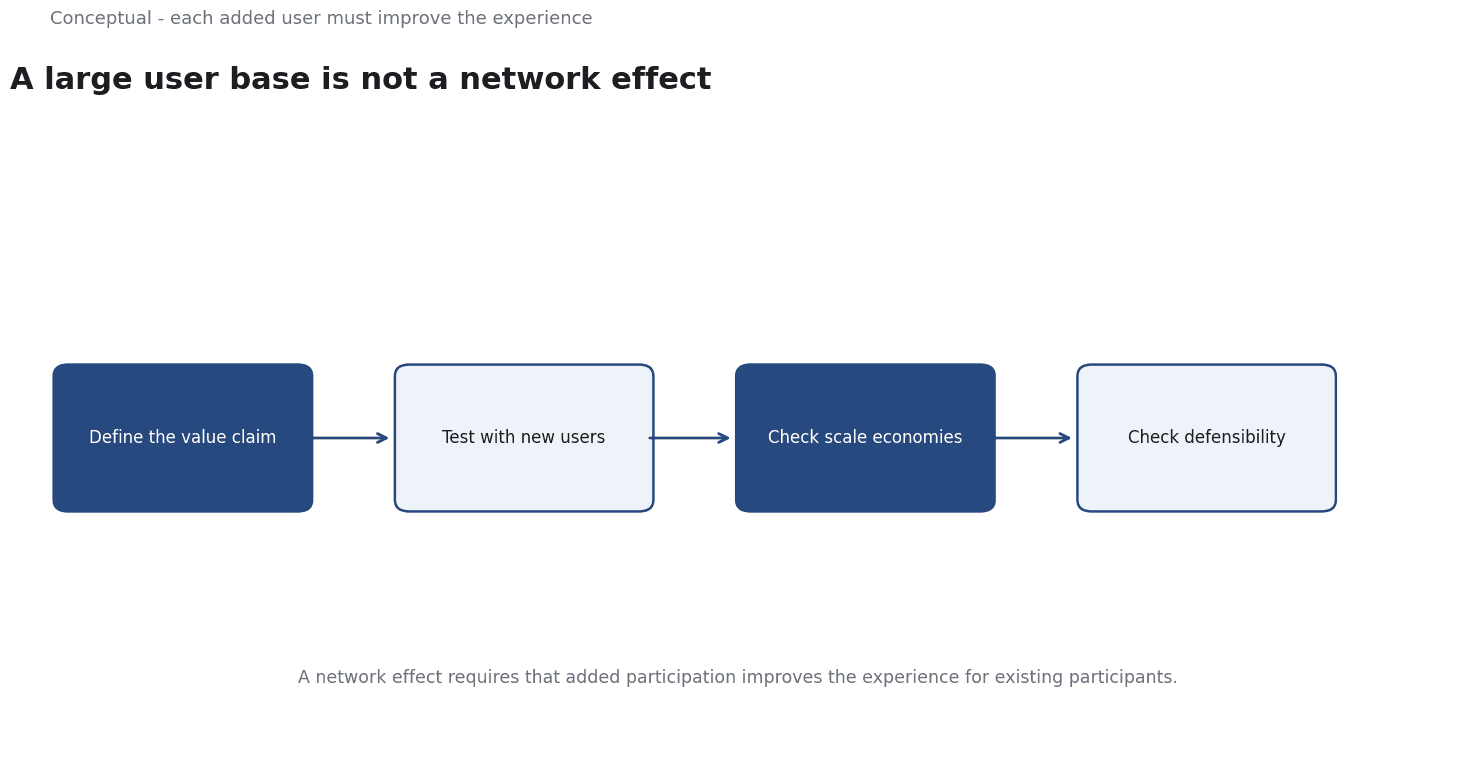
Direct answer: A network effect requires that added participation improves the experience for existing participants, which Wikipedia's overview describes as the change in value with user count. Porter's strategy argument is a reminder that an effect, even if real, is not a defensible position unless competitors cannot easily copy the structure. The boundary: growth without a network effect is still growth, and a claimed effect that does not appear in user behaviour is a story, as the attribution article warns about credit rules.
What counts
Same-side effects. More users of the same kind improve the product — a messaging tool becomes more useful when your contacts join. The value depends on who joins, not just how many, as the segmentation article argues for real differences.
Cross-side effects. More participants on one side improve the value for another — more sellers attract buyers, and more buyers attract sellers. The marketplace article explains how these two sides are balanced, which is the central operating problem.
Data effects. More use generates data that improves the product, which the data-strategy article treats as an asset when it is actually captured and used.
Three consequences follow. An effect must be identified from the user's perspective, not the company's, which the jobs-to-be-done article advises for framing value.
A large user base without interaction is not a network effect, as the community article describes for the preconditions of peer value.
And a negative effect is possible — congestion, noise, or irrelevant content — which the platform-moderation literature treats as a design problem.
A worked test
The following is hypothetical and illustrative. A collaboration tool claims a network effect: each new user supposedly makes it more valuable for existing users.
Three checks decide whether the claim is real. First, measure whether existing users' activity rises when a colleague joins, as the product-analytics article recommends for observed behaviour. Second, check whether the value comes from interaction rather than from the company's own improvements, which the attribution article treats as separating effect from background. Third, ask whether the effect weakens at scale — more members can mean more noise, as the community article warns about degradation.
Three conclusions follow. If activity rises with colleague joins and not otherwise, the effect is plausible, but it should still be reported as a hypothesis with a test date, as the decision-memo article requires for recorded judgements. If it does not, the growth is driven by something else — acquisition spend or product quality, which the demand-generation article treats as preference building. And if the effect turns negative, the product needs moderation or structure, which the platform literature addresses as a design choice.
What network effects cannot do
They cannot create a product people want, which the value-proposition article treats as the prior question. They do not guarantee a defensible position, as Porter's fit argument requires activities that support the position, not merely a large base. And they are not permanent: a superior alternative can migrate a network, as the competitive-dynamics literature treats switching as a real possibility.
The counterargument that network effects are the only durable advantage in software is too strong.
Brand, integration, and switching costs are also sources of advantage, as How Companies Build Competitive Advantages explains for multiple bases of defensibility.
A decision test
- State who benefits when another user joins, as the network-effect overview requires.
- Measure the change in existing users' behaviour, as the product-analytics article advises.
- Separate the effect from company-led improvements, as the attribution article warns.
- Check for negative effects at scale, as the community article advises.
- Verify that competitors cannot copy the structure, as Porter's strategy article requires.
- Record the claim as a hypothesis with a test date, as the decision-memo article requires.
- Re-test after a product or audience change, as the monitoring article advises.
For the platform context, see How Marketplace Business Models Actually Work; for the competitive frame, see How Companies Build Competitive Advantages.
References & Further Reading
- Wikipedia contributors, 2026. Network effect - Wikipedia — How the value of a product changes with the number of users; a secondary reference.
- Michael E. Porter, 1996. What Is Strategy? — The differentiation-versus-cost argument behind competitive-advantage analysis.