Paid Social without the Hype
Paid social blends reach, engagement, and demand generation. Separate what the metrics show from what they cannot prove, then tie the numbers to a bounded budget decision.
Paid social programs are often judged by dashboards that fold reach, engagement, and attributed conversions into a single story of demand created. The Wikipedia entry on social media marketing describes promotion through social platforms, while the demand generation entry describes building awareness and interest in a market. The real problem is that a credited conversion is an attribution outcome, not proof that a paid exposure caused the demand.
Direct answer: Paid social measures delivery, engagement, and conversions credited under a chosen model; it does not measure demand that would not otherwise have existed. The two sources define promotional activity and demand generation as concepts. The limit on causation is a synthesis, not a claim either source makes.
Delta: This article adds a claim-status table beyond the sources: it maps credited conversions to a budget decision, with claim status explicit.
The mechanism
The Wikipedia entry on social media marketing describes the use of social platforms to promote products and services, typically through posted content, paid advertisements, and direct engagement with audiences. The practical consequence is that a platform can count what it delivers and what users do on its own surfaces: impressions, reach, clicks, likes, and shares are recorded as events. What the platform cannot count is the persuasive effect of those events. A recorded impression establishes that an ad was served, not that it changed a mind, so the most direct metrics in a paid social report are also the ones furthest from the business outcome.
The demand generation entry describes activities aimed at creating awareness and interest in an offering, with the goal of building a pipeline of potential buyers rather than closing a single transaction. Demand generation is therefore a market-level outcome that accumulates over time and across many touches. The practical consequence is that paid social can contribute to awareness and interest, but the path from an exposure to a later purchase passes through steps the platform does not observe: a search, a recommendation from a peer, a visit to a review site, a sales conversation. The credited conversion is the last visible link in a chain that is mostly invisible.
Read together, the two concepts occupy different layers. Social media marketing describes a set of channels and promotional activities; demand generation describes an outcome in the market. A dashboard collapses these layers whenever it presents a platform-attributed conversion as though the platform activity alone had manufactured the demand. The practical consequence is a specific error: a team scales spend on a channel that is receiving credit for demand created elsewhere, then wonders why total pipeline does not grow with the reported conversions.
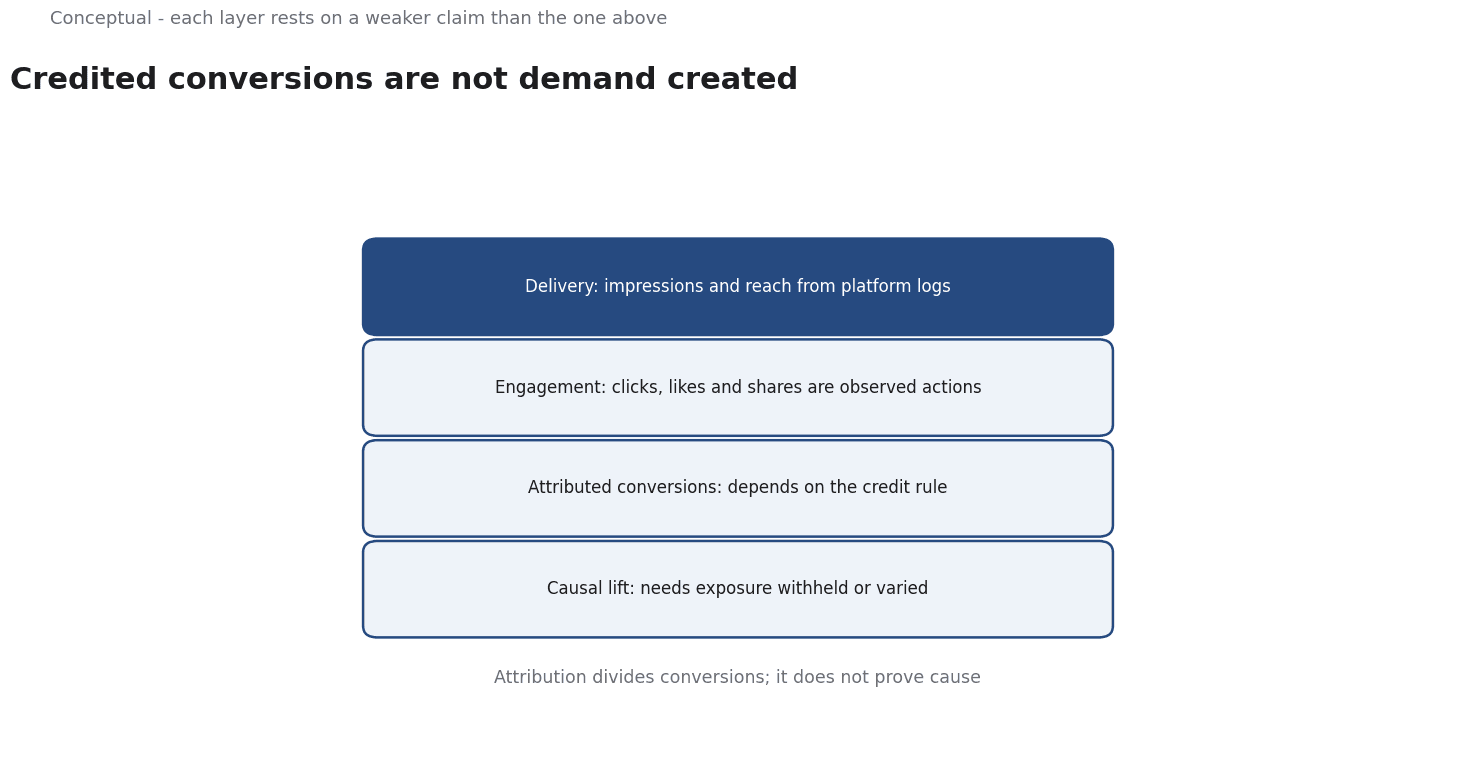
A coherent reading keeps the layers separate. Delivery metrics such as impressions and reach come from the platform's own logs and are relatively direct. Engagement metrics are user actions and are still observed, but they are weaker evidence of intent. Attributed conversions depend on a credit rule chosen by the analyst, which makes them partly a property of the model rather than of the campaign. Causal lift, the change in demand attributable to the spend, requires a comparison in which exposure is withheld or varied. That ordering, from delivery to action to credited outcome to causal inference, is the mechanism, with each layer resting on weaker claims than the one before it.
A worked example
The following is hypothetical and illustrative. A brand runs paid social and sees 400 conversions credited to a campaign in one month under a last-click model, and considers doubling the budget on that basis. Three checks decide. First, rerun the report under a linear or data-driven model and note how much credit leaves paid social; a large shift shows the figure depends on the credit rule. Second, inspect reach and frequency: if the same audience absorbed repeated exposures while the conversion rate stayed flat, more impressions are unlikely to add interest. Third, look at a period when the campaign was reduced or paused and check whether total inbound demand fell with it. The outcome is a qualified decision: hold the increase until the credited conversions survive a model change and a reduction test, and treat the remaining number as an upper bound on the channel's effect. The figures are invented; the sequence of checks is the point.
Evidence status
| Claim | Status | Source | Verified | Recheck when |
|---|---|---|---|---|
| Social media marketing promotes products through platforms and engagement | source-reported | Wikipedia, Social media marketing | 2026-11-18 | Platform features or the entry's definition change |
| Demand generation builds awareness and interest rather than closing one sale | source-reported | Wikipedia, Demand generation | 2026-11-18 | Definitions of demand generation shift |
| Credited conversions do not prove the paid exposure caused the demand | inferred | Derived from the sources | 2026-11-18 | A controlled experiment on the channel is available |
The first two rows are documented in the sources: one describes promotional activity on platforms, the other describes demand building. The third row is an inference from combining them, since neither source states that a credited conversion equals demand caused. Recheck it if experimental evidence is introduced or if the reporting model changes materially.
What it cannot do
Attribution cannot establish causation.
It divides observed conversions among touchpoints according to a rule, but a divided conversion is not evidence that any single touchpoint was necessary. A paid social ad can receive credit for a purchase that would have happened anyway, and no model, by itself, reveals that. The limit is structural: the data records what happened along one observed path, not what would have happened along a path without the ad.
A hidden cost of model choice is that it quietly sets incentives. Teams optimize toward the number their dashboard reports, so a last-click view rewards channels that appear near the purchase and penalizes channels that introduce the buyer to the problem. The cost surfaces when budgets migrate toward whichever touchpoint the chosen rule favors, even if total demand does not rise. Measurement is therefore also a management decision, not a neutral observation, and the choice of model should be recorded as deliberately as a budget line.
Several platforms can each report conversions under their own rules, and the sum can exceed the actual number of orders. A reader who adds platform figures together will overstate performance. The error is hard to spot because each platform number is internally consistent; the distortion appears only when figures from different systems are combined. Paid social conversions should be reconciled against a single source of truth before they are quoted alongside other channels.
The boundary of the measurement is the platform view. Paid social data captures exposures and conversions inside its own tracking environment, which excludes offline effects, private conversations, and conversions that occur outside tracking. Demand generation often spreads through interactions the platform cannot see, so the reported figures describe a partial picture. Claims about total brand effect, or about the channel's influence on people who never clicked, exceed what the data can support.
These figures need review whenever the tracking setup, the credit model, the audience definition, or the channel mix changes. A number that was comparable last quarter may not be comparable now if a pixel was replaced or an audience was broadened. Recording the model and configuration beside each reported figure is the only reliable way to keep a time series interpretable. Without that record, a trend line can reflect an instrumentation change rather than a change in buyer behavior.
The counterargument that platform-reported conversions are useful for consistent within-channel tracking is fair for trends inside one system and incomplete for cross-channel budget decisions, where differing credit rules and unseen influence distort the comparison.
A decision test
- State which attribution model produced each reported conversion figure.
- Rerun the report under a second model and note how much credit moves.
- Separate delivery metrics from engagement metrics from attributed outcomes.
- Check reach and frequency for signs that the audience is saturated.
- Look for a reduction or pause period as an informal counterfactual.
- Avoid adding together conversions reported by different platforms.
- Record the model and tracking setup beside every figure before comparing periods.
These steps turn a credited number into a bounded decision. They do not prove causation, but they remove the most common mistake: treating an attribution outcome as if it were demand created. The result is a spend choice tied to what the measurement can actually support, and a clear note of what remains unproven. For further reading, see marketing dashboards without the hype.
References & Further Reading
- Wikipedia contributors, 2026. Social media marketing - Wikipedia — Use of social platforms to promote products.
- Wikipedia contributors, 2026. Demand generation - Wikipedia — An overview of demand generation as a marketing discipline distinct from lead generation; secondary reference used with the lead-generation entry.