Partner Ecosystems: Channel Strategy, Marketplace, and ISV Partnerships
A partner does work you cannot do at the decision moment. Read how to design that exchange, price it, and avoid channel conflict.
Partner programmes are often launched as a growth shortcut — someone else's sales force, someone else's customers, someone else's brand doing the work. They frequently disappoint, and the reason is that the partner is not a channel you switch on. It is a separate business with its own incentives, and a programme that does not make the exchange attractive for both sides produces activity without outcomes.
Direct answer: A partner exists because it can perform work at the moment of decision that you cannot: reach, trust, integration, procurement status, or a relationship the buyer already relies on. You are paying for that work with margin, control, and sometimes exclusivity. The design question is whether the work the partner performs is worth more than what you give up — and the hardest part is that the answer changes as both businesses grow. Porter's trade-off logic applies with full force: a position built on a partner channel is incompatible with some direct-sale and mass-channel positions, and trying to hold both creates the conflict that kills most programmes.
What you are actually buying
The word "partner" hides a set of very different arrangements. Each one buys something different:
Referral partners buy you access to a relationship. The customer already trusts the referrer, and that trust transfers to the introduction. This is the cheapest form of partnership and usually the most under-invested — a referrer needs a reason to keep referring, and "we have a partnership" is not one.
Resellers and channel partners buy you reach and local presence. They carry the relationship, the procurement conversation, and often the implementation. The cost is margin and a reduction in control over how the product is positioned.
Marketplaces buy you a decision context. A buyer who is already in a marketplace has a shortlist, a payment method, and a trust framework, and being present there removes three sources of friction at once. The cost is that the marketplace owns the customer relationship and the terms.
ISV and technology partners buy you legitimacy and integration. If your product works with the systems your customer already uses, you reduce the perceived risk of adopting it. The work here is real engineering work, and a partner designation with no integration is marketing, not capability.
Amazon's marketplace is instructive from the outside not because its model transfers wholesale but because it shows what a distribution and service system looks like when built as one structure: the partner's ability to serve the customer and the platform's ability to surface the product are the same mechanism.
Channel conflict is the main failure mode
The most common reason partner programmes fail is not weak partners. It is that the company simultaneously runs a direct motion that competes with its own partners.
A rep who sees a partner-owned opportunity and discounts to win it directly has taught the partner that bringing deals to you is unsafe. The partner then stops bringing deals, and the company concludes that the programme did not work. The behaviour is rational on both sides, and the fix is structural, not motivational.
The question Porter's framework forces is: what would you have to stop doing to make the channel position real? For a partner-first strategy that usually means accepting that some customers will be served indirectly, on the partner's terms, with the partner owning the relationship. That is a genuine trade-off, and it is why partner-led companies look different from direct-led ones — not just in their sales organisation but in their product, pricing, and support design.
Pricing the exchange honestly
The economics of a partner programme must be written from both sides.
From your side: margin given up, support cost, deal-registration overhead, and the cost of the partner's influence on your roadmap. From their side: the margin they earn, the training and certification cost, the opportunity cost of selling your product instead of another, and the risk that you will compete with them later.
The last item is the one that determines whether good partners invest.
A partner who has to fear disintermediation will not build a practice around your product, and no amount of co-marketing budget compensates for that.
Durable programmes make the boundary explicit and keep it stable.
Public company material is useful here as a check on how large organisations actually talk about their channels — Amazon's own published news and case material is one such primary source. The point is not to copy the model but to compare the structure of the exchange: what each side does, what each side earns, and what each side gives up.
How to tell whether the programme works
The measures most programmes report — number of partners, partner-sourced pipeline, co-marketing activities — are activity metrics. They tell you the programme exists, not that it creates value.
The decision-relevant measures are:
- Partner-sourced revenue as a share of the whole, measured over enough time to include renewals.
- The partner's economics, including their margin and their cost to serve. If they are not making money, the programme is running on borrowed time.
- Time to productivity for a new partner, which is the real measure of whether your enablement works.
- Renewal and expansion in partner-served accounts, which tells you whether the partner is selling the right thing to the right customer.
- The conflict rate — how often partner and direct motions collide — which is a leading indicator of partner attrition.
A design sequence
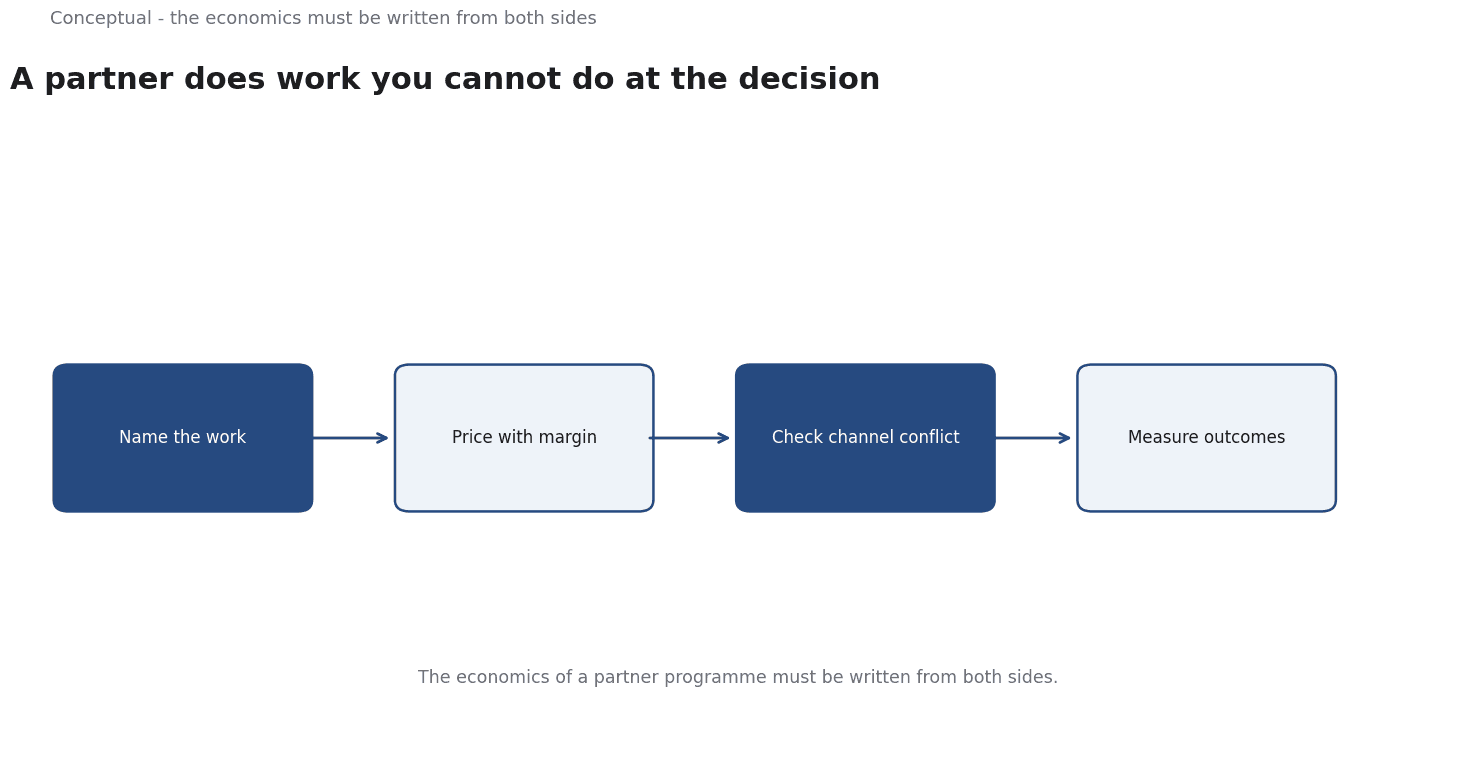
- Name the work the partner performs at the decision moment. If you cannot name it, the programme has no purpose.
- Choose the partner type that performs that work — referral, reseller, marketplace, or technology.
- Write the exchange from both sides, including margin, control, and exclusivity.
- Decide what you will not do directly, and communicate the boundary clearly enough that partners can invest.
- Build the enablement around the partner's first deal, not around a certification catalogue.
- Measure renewal, not just sourcing.
- Review the boundary when either business changes materially. What was a fair trade-off at one scale can become a constraint at another.
For the broader positioning these choices express, see How Companies Build Competitive Advantages and Why Distribution Is Often More Important Than Product Quality.
A worked example
The following is hypothetical and illustrative. A mid-sized B2B software company is considering a reseller programme after a competitor announced one. Rather than signing partners first, it works through three checks from the design sequence. First, it names the work a partner would actually perform at the decision moment: local procurement experience and an existing relationship with the buyer, not merely lead volume. Second, it writes the exchange from both sides, listing the margin it would surrender and the control it would lose over positioning, alongside the partner's training cost and the risk that the company later sells directly into the same account. Third, it decides what it will stop doing, committing to leave a defined set of mid-market accounts to partners and to keep that boundary stable. The bounded outcome is a small programme of a handful of resellers, measured on renewal in partner-served accounts rather than partner-sourced pipeline. Activity looks lower than the competitor's headline numbers, but the economics are written down and the boundary is one the partners can invest against.
A counterargument
The framework borrows more from its sources than they can bear. Porter's trade-off logic concerns a single firm's incompatible activities, not the incentives between two independent businesses, so describing channel conflict as a strategic trade-off is an analogy rather than a claim the source makes. The Amazon material is illustrative: the article itself says the model does not transfer wholesale and that Amazon is 'instructive from the outside', making it a picture of a distribution system, not evidence about partner programmes. A reasonable critic would push back that the central claim - that a partner performs work worth more than the margin and control surrendered - is sound synthesis, but it is not demonstrated by these sources. Its failure mode and measures are local judgements, not findings from Porter or Amazon.
References & Further Reading
- Michael E. Porter, 1996. What Is Strategy? — The differentiation-versus-cost argument behind competitive-advantage analysis.
- Colin Bryar and Bill Carr, 2019. Amazon Company News — Primary company material on how the working-backwards method is applied.