Personal Branding: Building Your Professional Reputation
A professional reputation is accumulated evidence, not a slogan. Read how to build it with verifiable work and why self-promotion without proof backfires.
Personal branding has a bad name because it is often taught as self-promotion: pick a niche, post consistently, perform expertise. That approach produces visibility without credibility. A more durable view is that reputation is a by-product of work other people can inspect and verify — the artifacts you leave behind and the way you explain them.
Direct answer: Build a professional reputation by producing verifiable work, explaining it clearly, and making it easy for the right people to find. GitHub's documentation treats the repository README as the first thing a visitor sees, which makes it a concrete starting artifact; O*NET provides structured descriptions of occupations and skills, useful for choosing which evidence matters. The boundary: reputation is not a substitute for competence, and no tactic can manufacture experience you do not have.
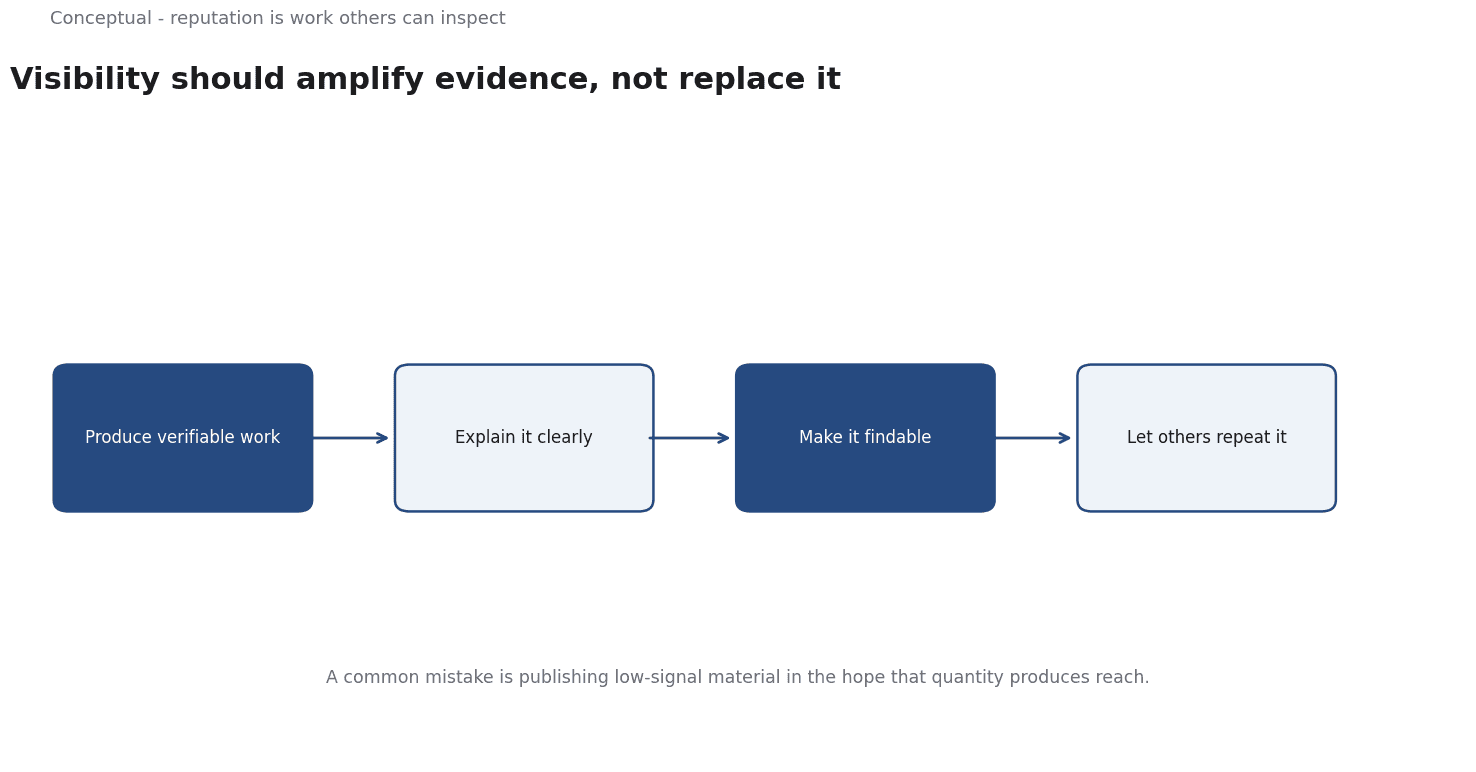
Why evidence beats claims
Three mechanisms explain why proof-based branding is more durable.
Claims are cheap. Anyone can write "expert in machine learning". A reader discounts the claim until something corroborates it, so uncorroborated statements add noise rather than signal.
Artifacts are checkable. A repository, a written analysis, or a talk with a recording can be inspected. The reader forms their own judgement, which is more persuasive than an assertion.
Explanation reveals depth. A person who can explain why a design failed demonstrates more understanding than one who lists successful projects. The failure analysis is the signal.
This is not a rejection of visibility. Work that nobody can find does not build a reputation.
The point is that visibility should amplify evidence, not replace it.
The three-artifact portfolio
A useful portfolio is small and deliberate. Three artifacts cover most of the signal a reader needs:
- A working artifact — a repository, a tool, a published analysis. The README should follow the discipline described in Technical Writing: a clear description, a runnable example, and stated constraints.
- An explanatory piece — a short write-up of a decision, a failure, or a trade-off. This shows how the author thinks, not only what they built.
- A reference point — a profile or page that states what the person does, which problems they work on, and where the evidence lives.
The third artifact should be consistent with the first two. A profile that claims a specialty the artifacts do not demonstrate creates doubt rather than interest.
O*NET's occupation records — with tasks, skills, and requirements across 900+ occupations — are a practical tool for choosing which artifacts matter. If the target role emphasises data analysis and stakeholder communication, a repository plus a clear write-up of a decision communicates more than a long list of tutorials completed.
A worked example of an audit
The following is a hypothetical composite, not a real person's history.
A developer wants to be known for reliable data infrastructure. Their current public presence consists of:
- A profile that says "passionate about data and AI".
- Six repositories, four of which are forks with no README.
- A blog with two posts, both summaries of courses they took.
Audit against the three artifacts:
Working artifact. Of the six repositories, two are original and one has a runnable example. The forks are not evidence of skill and dilute the signal. Action: archive or clearly label the forks, and improve the one strong repository's README.
Explanatory piece. The two course summaries show that the author consumed material, not that they can apply it. Action: write one piece about a data pipeline that broke — what the symptom was, how it was diagnosed, and what changed. That single post carries more signal than ten summaries.
Reference point. "Passionate about data and AI" is a claim with no object. Action: replace it with a specific statement — the problems worked on, the kind of role sought, and a link to the two strong artifacts.
The rebuilt presence has fewer items and more signal. The general principle: a reader should be able to answer "what can this person do?" within two minutes, from evidence.
Choosing what to publish
The opposite is usually true: a small body of strong work is easier for the right reader to evaluate. Three questions filter a potential artifact:
Would a stranger learn something from it? A repository that merely imports a library and prints a result demonstrates very little. One that solves a small real problem, with tests and a note on what broke, demonstrates judgement.
Can you defend it in a conversation? If a reviewer asked why you chose a particular design, would you have an answer? Artifacts you cannot explain are liabilities, because they invite a question you cannot answer.
Does it match the reputation you want? Publishing ten introductory tutorials while claiming specialist depth sends a mixed signal. The artifacts should be evidence of the claim, not adjacent to it.
The filter is deliberately strict. A professional reputation is built over years, and a handful of durable pieces will do more work than a continuous stream of material that nobody cites. There is also a maintenance cost: every published artifact is something you may be asked about in an interview, and something that may age badly if it depends on a specific tool version.
This is why the three-artifact portfolio is a floor rather than a ceiling. Once the core evidence exists, additional work should be added only when it strengthens the same claim.
What branding cannot do
Three limitations deserve clear statement.
It cannot create experience. Inventing projects, outcomes, or credentials is fabrication, and it fails the moment someone asks a specific question. Everything published should be something the author can explain in detail.
Platform dynamics are not merit. Visibility depends on timing, audience, and algorithm changes. A post that performs well is not necessarily the best work, and a quiet portfolio is not necessarily a weak one. Optimising for metrics rather than evidence produces content that looks successful and persuades nobody.
It can crowd out the work. Time spent maintaining a personal brand is time not spent developing the skill the brand claims. For most people at most career stages, the balance should tilt heavily toward the work.
The counterargument — that in a competitive market, invisible competence is wasted — is legitimate.
The response is not to abandon evidence but to make it findable: a clear reference point and a small number of strong artifacts are enough.
A decision test
- State what you want to be known for in terms of problems solved, not adjectives.
- Check that your artifacts support the claim a reader would make after seeing them.
- Build one working artifact with a README that makes it runnable.
- Write one explanatory piece about a real failure or trade-off.
- Make the reference point consistent with the evidence.
- Remove material that dilutes the signal rather than adding to it.
- Spend more time on the work than on promoting it.
For the career context, see Career Transitions; for the documentation craft, see Technical Writing.
References & Further Reading
- GitHub Docs, 2026. About the repository README file - GitHub Docs — The platform's own guidance on what a repository README should contain.
- Colin Bryar and Bill Carr, 2019. Amazon Company News — Primary company material on how the working-backwards method is applied.
- U.S. Department of Labor, 2026. O*NET OnLine — The standard occupational taxonomy used to compare roles across industries.