Personalization at Scale: What Actually Needs to Be Personal
Most personalization effort is wasted on things customers do not care about. Read which dimensions matter and a worked prioritisation.
Personalization is often treated as a universal good: more of it must be better. In practice, personalizing the wrong dimension adds complexity and can make an experience feel intrusive rather than relevant. The useful question is which parts of an interaction a customer actually experiences as different, and which are invisible to them.
Direct answer:
Personalize the dimensions that change the customer's decision — the offer, the timing, the language, the proof — and keep the rest consistent.
Demand-generation principles explain which decision a touchpoint serves, and AAPOR's standards apply when personalization is based on survey data. The boundary: personalization cannot substitute for a clear value proposition, which the value-proposition article argues, and it fails when the underlying data is wrong, as Data Governance: Managing Data as an Asset explains.
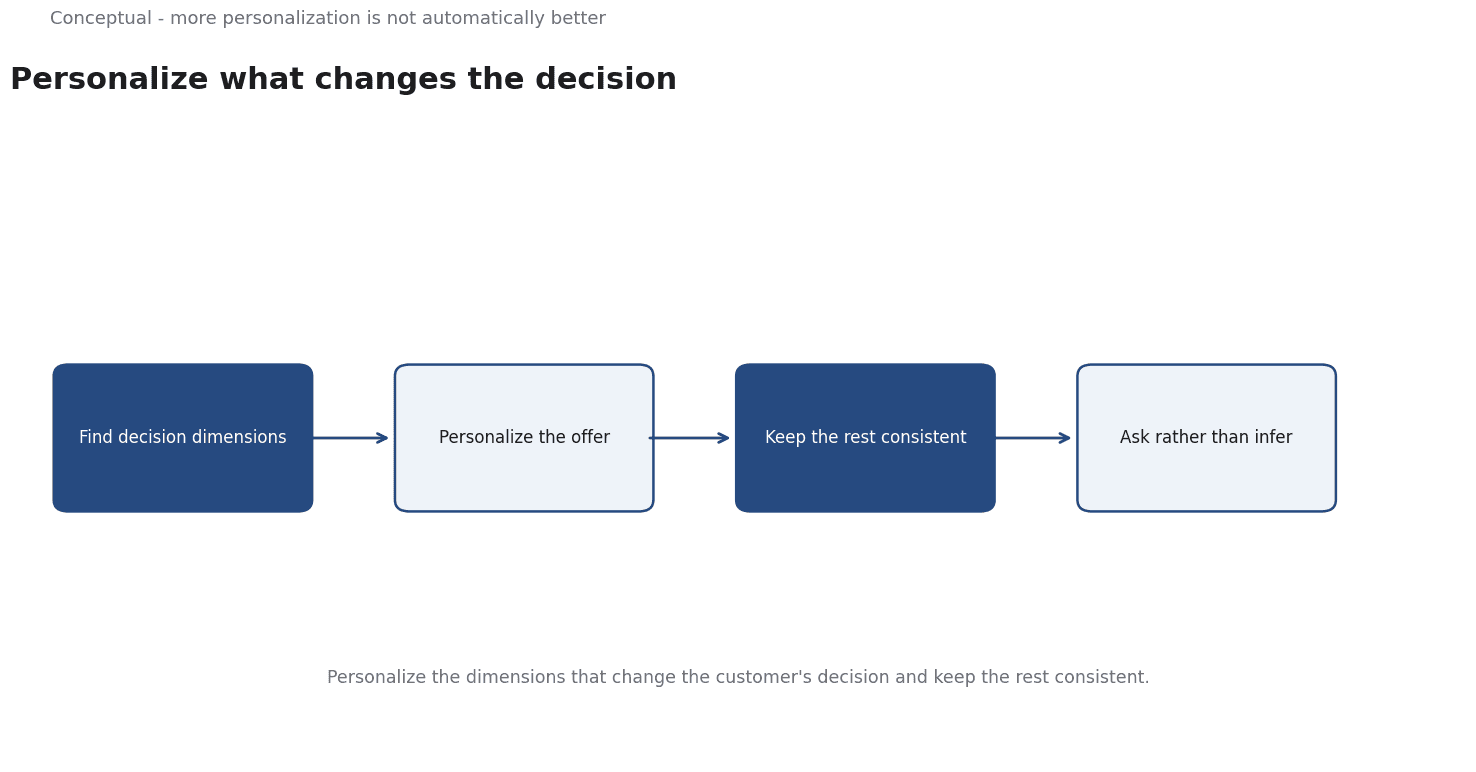
What is worth personalizing
The proof. A prospect in a regulated industry wants compliance evidence; a startup wants speed of setup. The claim stays the same, the evidence changes, as the landing-page article recommends for B2B pages.
The timing. A renewal reminder is useful because the date matters, not because the message is clever, as the lifecycle-email article explains.
The language and terminology. A developer and a finance buyer use different words for the same feature, which the O*NET task descriptions help ground for role-specific copy.
The next step. A ready buyer sees a demo option; an early researcher sees an evaluation guide, which the funnel article describes as matching intent.
What usually is not
Cosmetic details. Changing colours or greeting style by segment rarely changes a decision and adds maintenance cost.
Deep behavioural inference.
Price without a basis. Personalised pricing has trust and fairness consequences, which the pricing-psychology article treats as a separate question.
A worked prioritisation
The following is hypothetical and illustrative.
A B2B company has four personalization ideas and limited engineering time:
| Idea | Decision impact | Data readiness | Risk |
|---|---|---|---|
| Role-specific proof on landing page | High | Good | Low |
| Personalised greeting by name | Low | Good | Low |
| Renewal timing by contract date | High | Good | Low |
| Inferred intent score in outreach | Medium | Poor | High |
Three decisions follow:
- Do role-specific proof and renewal timing first — high impact, good data, low risk, as the landing-page and lifecycle-email articles recommend.
- Skip the greeting — it has no decision impact, which the brand-voice article would treat as cosmetic.
- Block the intent score — poor data and high risk, as the risk-assessment article argues for data readiness before complexity.
Three conclusions follow:
- The prioritisation is about decisions, not about how sophisticated the personalization sounds.
- Data readiness gates the work, which the data-governance article requires.
- Risk is a first-class criterion, as the data-ethics article explains.
Asking rather than inferring
The cheapest way to learn what to personalize is to ask. Three practices make the evidence useful:
Ask at the point of decision. A question on the landing page — what are you trying to do? — produces a stated intent that can drive the next step, which the customer-journey article recommends for evidence tied to a stage.
Use consistent wording. A question about "your role" and one about "your job function" measure different things. AAPOR's standards on wording apply as much to a product survey as to a research study, which the survey-design article explains.
Compare stated preference with behaviour. A customer may say they want customisation and ignore it, or say they do not care and respond to relevant proof. The voice-of-customer article recommends treating stated and observed evidence together, not choosing one.
These practices reduce reliance on inference, which the data-ethics article argues is a source of both error and distrust in personalization systems.
What personalization cannot do
It cannot fix a weak offer. Different words for an unattractive product do not change its value, which the value-proposition article argues.
It cannot replace segmentation. A segment defined by a real difference in needs is more useful than individual guesses, which the customer-segmentation article explains.
It is only as good as the data. A wrong role or stale contract date produces a confident wrong message, which the data-quality article covers.
The counterargument — that customers expect personalization — is fair for relevance and overstated for surveillance.
The test is whether the customer would notice the absence of the personalization, which the voice-of-customer article recommends asking directly.
A decision test
- Name the decision the personalization should change.
- Check the data behind it with an owner and a definition.
- Score impact, readiness, and risk before building.
- Start with proof and timing, which the landing-page and lifecycle-email articles support.
- Skip cosmetic changes that do not affect a decision.
- Ask customers what they actually value, using AAPOR-style question wording.
- Re-evaluate after a data or product change, as the monitoring article recommends.
For the segmentation frame, see Customer Segmentation; for the data foundation, see Data Governance.
References & Further Reading
- Wikipedia contributors, 2026. Demand generation - Wikipedia — An overview of demand generation as a marketing discipline distinct from lead generation; secondary reference used with the lead-generation entry.
- American Association for Public Opinion Research, 2026. AAPOR — The professional association for public opinion and survey research; its standards and resources underpin the survey-design discussion.