Personas Reconsidered: Evidence Over Fiction
A persona is a summary of evidence or a work of fiction. Read how to tell the difference, a worked rebuild, and why invented quotes are harmful.
A persona can make a customer's situation memorable for a team, which is why they appear in countless decks. It can also be a collection of invented details — a name, a photo, a favourite hobby — presented as research. The difference matters: a fictional persona tells you more about the team's assumptions than about the customer.
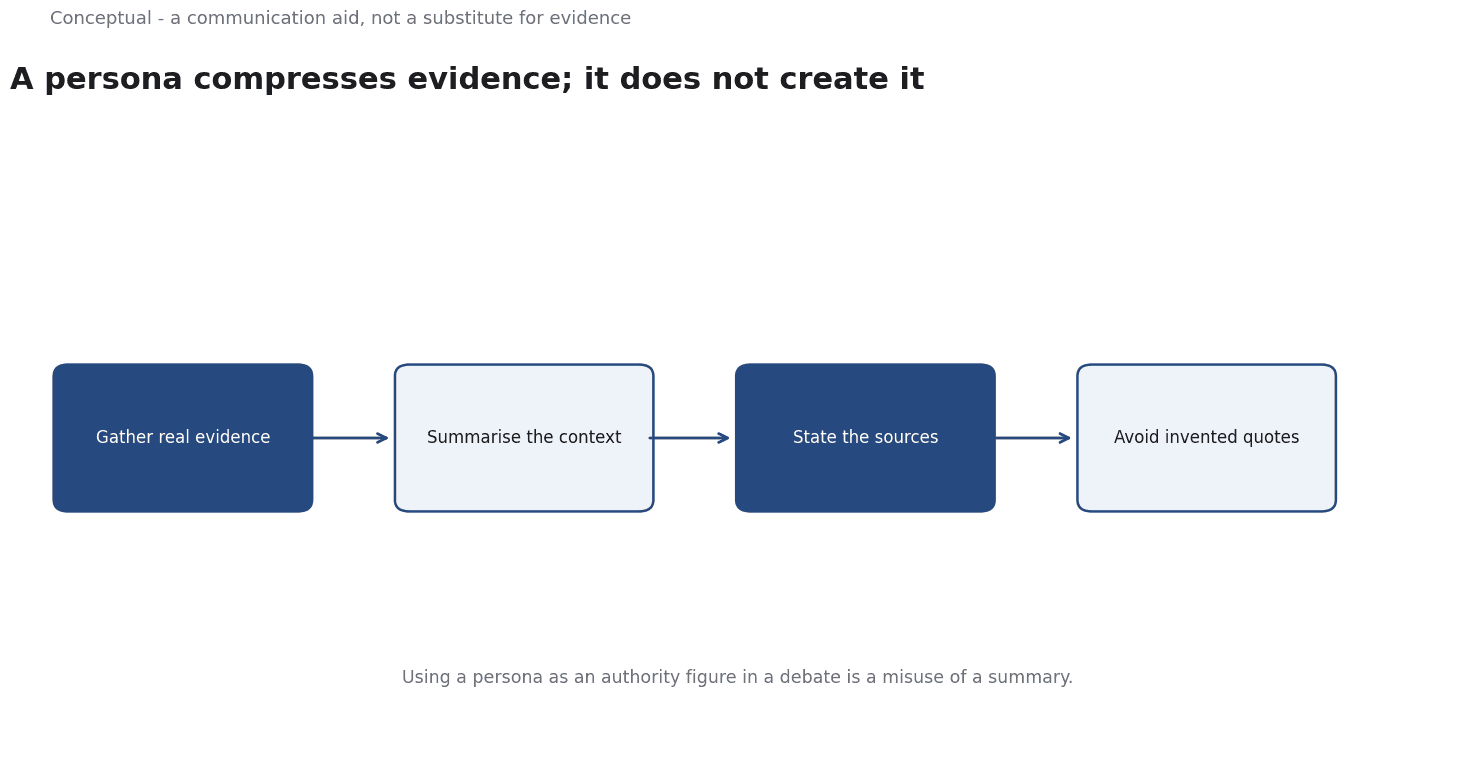
Direct answer: A useful persona is a compressed summary of evidence about a real group's context, goals, and constraints, with the sources stated. AAPOR's standards govern the survey and interview evidence behind it, and the segmentation article argues for differences that are real and observable. The boundary: a persona is a communication aid, not a substitute for evidence, and inventing quotes or details is fabrication, which the publication standard prohibits.
What to include
The situation. When the need arises and what the customer is trying to do, as the jobs-to-be-done article frames it.
The constraints. Time, skill, authority, and risk — the boundaries a solution must respect, which the design-brief article treats as real.
The evidence. Interview quotes with permission, behavioural data, and the sample behind each, which AAPOR's standards require you to state.
The uncertainty. Where the team is guessing, labelled as such, which the evaluation-rubric article argues for distinguishing evidence from interpretation.
A worked rebuild
The following is hypothetical and illustrative.
A team's existing persona reads: "Sarah, 32, a marketing manager who loves yoga and wants to feel empowered." It has no source and implies no decision.
The rebuild:
- Replace the biography with a context. "A marketing manager preparing a quarterly report under a two-day deadline," drawn from twelve interviews with defined wording, as AAPOR's standards require.
- State the goal and constraint. "Needs defensible numbers quickly; lacks time to reconcile systems," which the data-analysis article treats as a verification problem.
- Attach evidence. A real quote with permission, a count of how often the situation appeared in interviews, and a log pattern from the product-analytics article.
- Name the gap. "We have not tested whether this applies outside the twelve interviews," which the evaluation-rubric article treats as an honest limitation.
Three checks decide whether it works:
- Traceability — can every claim be traced to evidence, as the publication standard requires?
- Decision use — does the team change a product or message based on it, as the segmentation article asks for a usable difference?
- Absence of fiction — are there no invented quotes or decorative details, which the editorial rules prohibit?
Three conclusions follow:
- The persona becomes a summary, not a story, which the voice-of-customer article recommends for decisions.
- The uncertainty is visible, which the risk-assessment article treats as honest practice.
- It is checked against behaviour, as the product-analytics article argues for observed signals.
Presenting the evidence
A persona is a communication aid, so its format matters. Three choices make it useful rather than decorative:
Put the evidence on the page. A short note of the sample and sources should accompany the persona, which AAPOR's standards require for any survey-derived claim.
Use a real detail, not a stock photo. A verbatim quote with permission communicates more than an invented portrait, which the advocacy article treats as the value of a credible voice.
State what is unknown. A line listing the gaps makes the persona honest, which the evaluation-rubric article argues for distinguishing evidence from interpretation.
These choices keep the document anchored to customers, which the voice-of-customer article treats as the purpose of the whole exercise.
Where personas help and where they do not
A persona is well suited to orientation — helping a new team member understand a recurring situation quickly, as the customer-journey article recommends for shared context. It is poorly suited to decisions about an individual customer, which the segmentation article treats as a different kind of model.
It is also poorly suited to resolving disagreement. If two teams dispute what a customer wants, a persona cannot settle it; only evidence can, which AAPOR's standards require you to gather and state.
These boundaries make the tool useful within its scope, which the editorial standard requires for any claim about what a document can do.
What personas cannot do
They cannot replace research.
A persona compresses evidence; it does not create it, which AAPOR's standards make clear.
They cannot describe individuals. Treating a person as an instance of a persona is the failure the segmentation article warns about.
They go stale. Contexts change, which the monitoring article treats as a trigger to revisit any customer model.
The counterargument — that a memorable character helps a team empathise — is fair about communication and does not license invention, which the editorial standard treats as fabrication.
Use a real, sourced detail rather than an imagined hobby.
A decision test
- Start from evidence — interviews and logs, as the voice-of-customer article recommends.
- State the sample and wording behind every claim, as AAPOR's standards require.
- Frame a context, goal, and constraint, as the jobs-to-be-done article advises.
- Attach real quotes with permission, which the advocacy article covers for credible voices.
- Label guesses as guesses, which the evaluation-rubric article requires.
- Check that a decision changes, as the segmentation article asks for usable differences.
- Revisit on change, as the monitoring article advises.
For the research standard, see AAPOR; for the segmentation, see Customer Segmentation.
References & Further Reading
- American Association for Public Opinion Research, 2026. AAPOR — The professional association for public opinion and survey research; its standards and resources underpin the survey-design discussion.
- U.S. Department of Labor, 2026. O*NET OnLine — The standard occupational taxonomy used to compare roles across industries.