Podcast Marketing: Distribution and Measurement
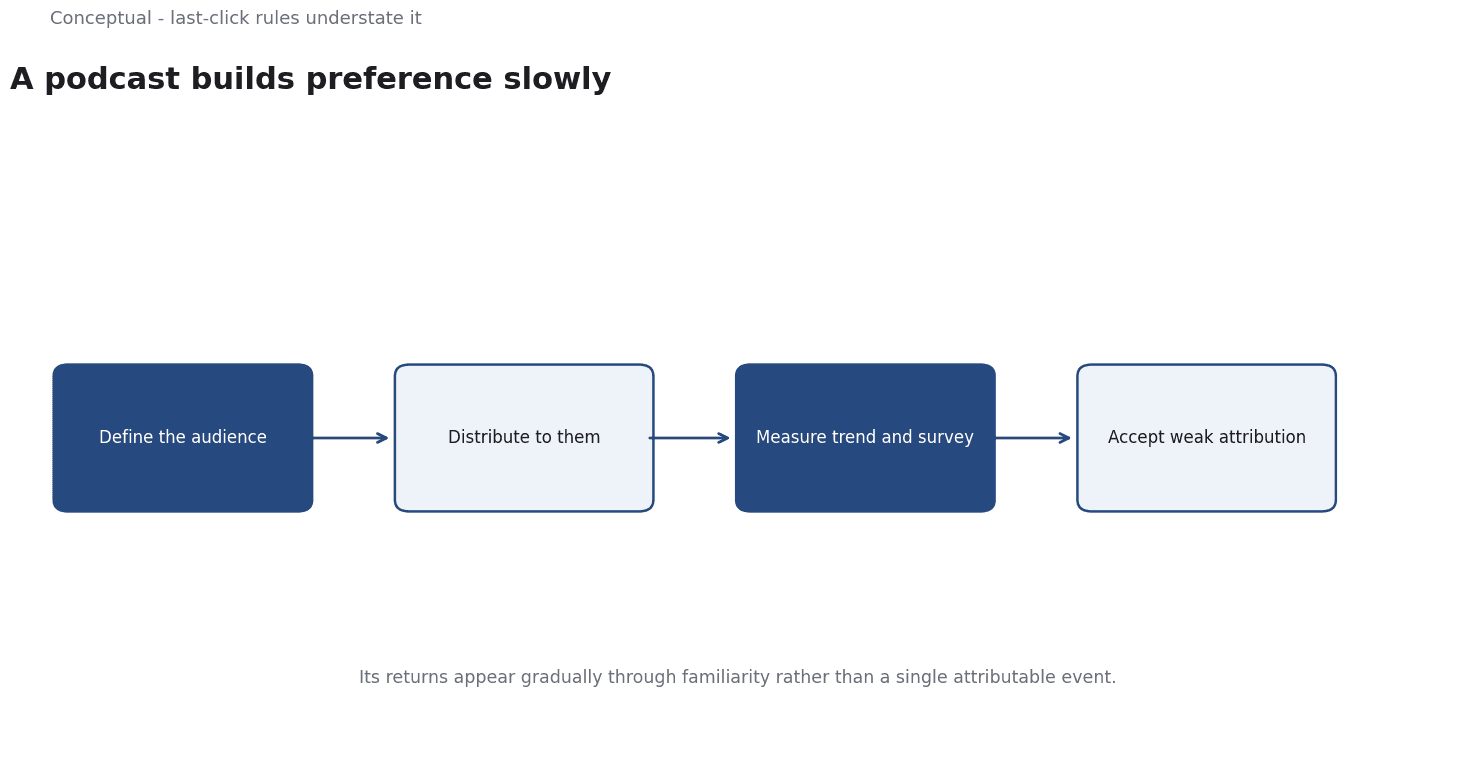
A podcast builds preference slowly and is hard to attribute. Read the distribution levers, a worked measurement approach, and honest limits.
Podcasts are often judged by download counts and dismissed when those look small. The format works differently from search or paid media: it builds preference over repeated exposure with a self-selected audience. Measuring it with last-click rules will understate what it does and overstate what any single episode caused.
Direct answer: Use a podcast to reach a defined audience with useful conversations over time, distribute through channels that audience already uses, and measure with trend and survey evidence rather than download counts alone. Demand-generation principles explain the preference stage a podcast serves, and AAPOR's standards govern listener surveys. The boundary: attribution is weak, which the measuring-GEO article argues for other hard-to-count channels, and no structure guarantees conversions, as the publication standard states.
Distribution levers
The audience fit. A show about a specific problem attracts the people who have it, which the customer-segmentation article treats as a real difference.
Cross-promotion. Appearing on shows the audience already trusts borrows credibility, as the advocacy article explains for credible voices.
Repurposing. Turning an episode into a clip, a quote, or an article extends its reach, which the content-repurposing article describes as adapting a claim to a channel.
A clear next step. A spoken call to action should lead to a memorable, short URL or a named resource, as the dark-social article notes that copied links lose tags.
A worked measurement approach
The following is hypothetical and illustrative.
A company runs a monthly podcast for a year. Measurement combines three signals:
- Trend in branded search and direct traffic against a category baseline, as the brand-lift article recommends for separating effect from background.
- A listener survey with AAPOR-style wording and a defined population — how did listeners first hear about the company, and what did they do after an episode? Self-reported, but useful with stated limits, as the survey standards require.
- Named-resource visits — a spoken URL that appears in logs, which the dark-social article treats as a lower bound because copied links lose tracking.
Three checks decide what can be claimed:
- Do the signals agree? A rise in branded search plus listener reports plus named visits is stronger than one alone, as the evaluation-rubric article argues for multiple measures.
- Is the horizon long enough? Preference builds over months, as the brand-awareness article distinguishes short spikes from lasting recognition.
- Is attribution labelled weak? No single episode can be credited with a sale, as the marketing-attribution article warns about credit rules.
Three conclusions follow:
- Downloads are an intermediate signal, which the email-metrics article argues for other channels.
- The evidence is directional, as the measuring-GEO article recommends for hard-to-count channels.
- The content must be useful on its own, which the content-marketing article treats as the reason to listen.
Making episodes worth sharing
A podcast grows through recommendations, which the referral article treats as a high-trust channel. Three choices make an episode shareable:
One useful idea per episode. A conversation that gives the listener something to try is worth passing on, as the content-marketing article argues for value before asks.
A specific guest or example. A credible voice with a concrete story travels further, which the advocacy article explains for trusted sources.
A clear, short reference. A memorable URL or name makes it easy to tell someone else, as the dark-social article notes about links shared in private messages.
These choices are content decisions, not distribution hacks, which the brand-voice article treats as substance over presentation.
The decision to run a podcast should be treated like any other long-horizon content investment.
It consumes production time every month, and its returns appear gradually through familiarity rather than through a single attributable event.
What podcast marketing cannot do
It cannot produce immediate conversions reliably. The format builds preference, which the funnel article treats as an earlier stage.
It cannot be measured precisely with current tools. Attribution is weak, as the measuring-GEO article argues for comparable cases.
It cannot replace a clear offer. A listener who is convinced still needs somewhere to go, as the landing-page article explains for the decision stage.
The counterargument — that podcasts are too slow for most businesses — is fair when the horizon is short.
The decision should follow the time the business can afford, as the marketing-budget article treats spend as a portfolio of horizons.
A decision test
- Define the audience by a real problem, as the segmentation article recommends.
- Distribute where the audience already listens, as the advocacy article advises for borrowed credibility.
- Repurpose episodes into other channels, as the content-repurposing article describes.
- Use a memorable spoken URL for a lower-bound signal, as the dark-social article suggests.
- Survey with AAPOR-style wording and state the limits, as the survey standards require.
- Track trends over months, as the brand-awareness article recommends.
- Label attribution as weak, which the measuring-GEO article treats as honest practice.
For the channel frame, see Demand Generation vs Lead Generation; for measurement limits, see Measuring GEO.
References & Further Reading
- Wikipedia contributors, 2026. Demand generation - Wikipedia — An overview of demand generation as a marketing discipline distinct from lead generation; secondary reference used with the lead-generation entry.
- American Association for Public Opinion Research, 2026. AAPOR — The professional association for public opinion and survey research; its standards and resources underpin the survey-design discussion.