Podcast Marketing: Common Questions
A podcast is a relationship format, not an ad slot. Read the common questions, a worked example, and why downloads are not attention.
Podcast marketing is often treated as buying inventory on a popular show. The Wikipedia entry describes podcast distribution, and the demand-generation entry covers the stages before a purchase. The question is whether the audience is relevant and whether the episode changed anything.
Direct answer: Choose podcasts by audience fit, judge an appearance by what listeners could do with it, and measure against a defined outcome. The sources describe the channel and the stages; the evaluation rule is a synthesis.
Delta: This article adds a claim-status table and a worked example, separating the documented format from local decisions about fit and measurement.
The mechanism
Three points matter:
- Distribution is episodic. The Wikipedia entry describes how podcasts are published and consumed. A listener chooses an episode, not a campaign impression.
- The host's voice carries the message. An appearance is an endorsement of attention, not a neutral placement. The fit between host and topic is part of the result.
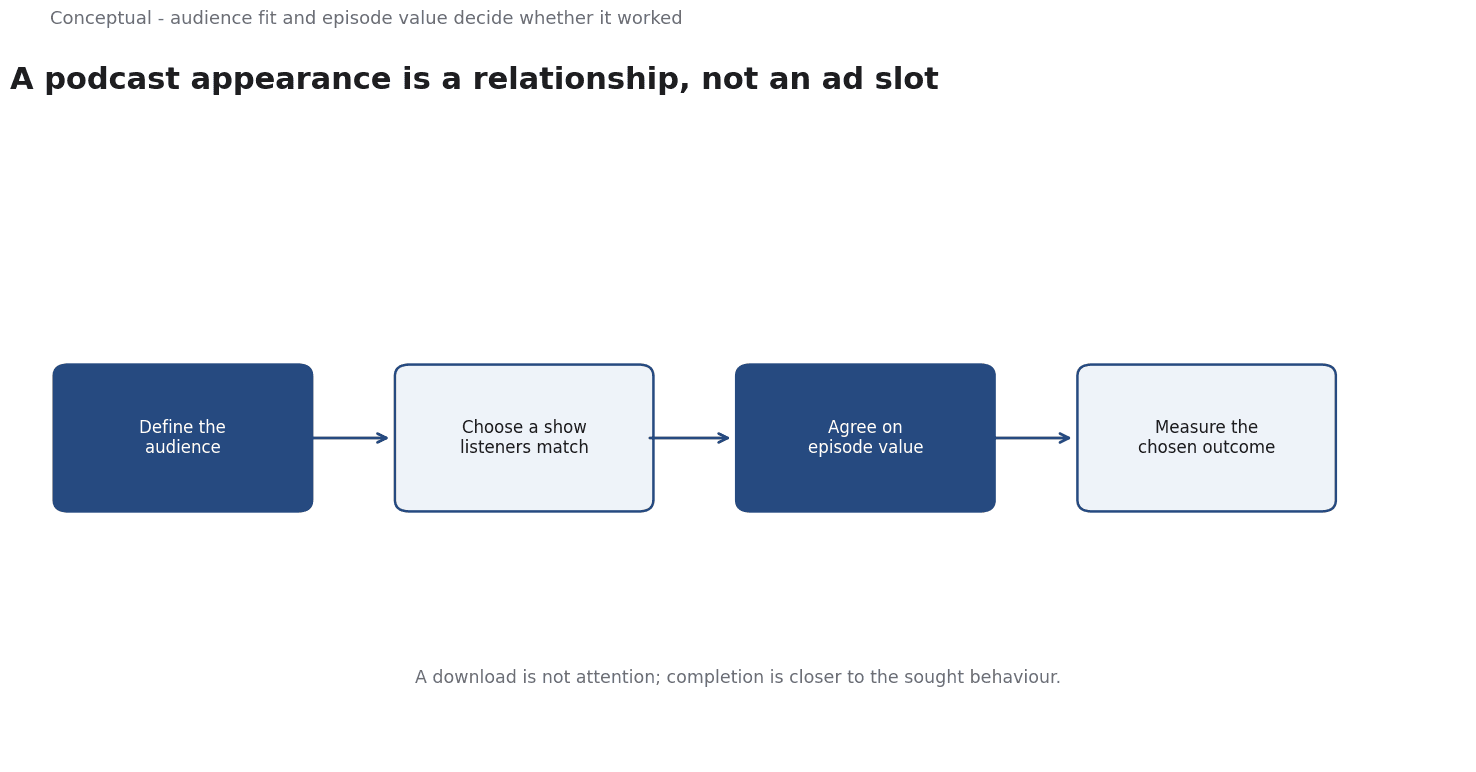
- Downloads are not attention. A download can be abandoned. A completion is closer to the behaviour the campaign needs.
The sequence is: define the audience, choose a show whose listeners match it, agree on what value the episode provides, then measure the chosen outcome. Choosing the audience is judgement, so it is inferred; the format is source-reported.
A worked example
Illustrative. A software team appears on a general business podcast and reports 5,000 downloads.
Three checks decide. First, are the listeners the people who could use the product, or a broad audience with a passing interest? Second, did the episode explain a problem the listener could act on, rather than describe the company? Third, is there any observable outcome — visits from the show, signups, or a named mention — against a baseline?
The outcome is a fit assessment, not a download count. The numbers are hypothetical; the evaluation sequence is the contribution.
Why the episode is the product
In most advertising, the placement and the message can be separated. In a podcast appearance they cannot: the host's questions, the guest's answers, and the conversation between them are the thing the listener receives.
This changes how a campaign is briefed. The useful brief states the problem the guest can help the listener understand, the evidence they can bring, and the boundaries they will not cross. It does not script a promotional sentence. A listener who hears a concrete method is more likely to remember the source than one who hears a slogan.
Measurement should follow the same logic. A download is evidence that the episode was selected, not that it was heard. Completion, mentions, and visits that can be traced to the show are closer to the intended effect. None of these is perfect, and a baseline from comparable appearances is more informative than an absolute number.
What a good review contains
A review should record the audience fit, the value the episode offered, the observable outcome, and the limits of the measurement. When a show performs well, that record explains why and makes a second appearance a decision rather than a habit.
Evidence status
| Claim | Status | Source | Verified | Recheck when |
|---|---|---|---|---|
| Podcasts are distributed as episodic audio | source-reported | Wikipedia, Podcast | 2026-11-18 | Format changes |
| Demand generation describes stages before purchase | source-reported | Wikipedia, Demand generation | 2026-11-18 | Definition revised |
| Select by audience fit and measure an outcome | inferred | Derived from the channel description | 2026-11-18 | Campaign goal changes |
Why fit beats reach
A large audience that does not include potential users is a poor channel, however cheap the appearance. A smaller show whose listeners share a specific problem can produce more useful attention.
Reach is a property of the show; fit is a property of the decision the campaign supports.
The episode itself matters more than the ad read. A conversation that helps a listener solve a problem is reusable and shareable; a scripted promotion is neither. This is why the host's interest in the topic is part of the selection criteria rather than a courtesy.
The format also rewards patience. An episode published today can remain discoverable for months, which makes a short measurement window a poor judge of its value. A review after a reasonable interval is more informative than a next-day report.
What it cannot do
It cannot guarantee listener action. It does not replace a clear value proposition, which determines whether the attention leads anywhere. And it cannot be measured reliably from download counts alone.
The counterargument that a big show always wins is fair for brand reach and incomplete for a specific outcome.
A decision test
- Define the audience.
- Check the show's fit.
- Agree on the value the episode provides.
- Measure an outcome beyond downloads.
- Use a baseline where possible.
- Record the decision and the recheck condition.
For the channel context, see Podcast Marketing.
References & Further Reading
- Wikipedia contributors, 2026. Podcast - Wikipedia — The format and distribution of episodic audio content.
- Wikipedia contributors, 2026. Demand generation - Wikipedia — An overview of demand generation as a marketing discipline distinct from lead generation; secondary reference used with the lead-generation entry.