Why Product Assortment Matters More Than Having More Products
A larger catalog does not automatically mean more sales. Learn how assortment depth and width affect inventory, customer choice, and retail profitability.
Adding more products to a catalog feels like growth, but each SKU carries costs that are easy to overlook. Retailers who expand assortment without discipline often find themselves with more inventory and less profit.
Direct answer:
Product assortment is the range and depth of products a retailer offers. A wider assortment can attract more customers, but every additional SKU increases inventory carrying cost, complexity, and the risk of dead stock.
Assortment matters more than raw product count because profitability comes from selling the right products at the right velocity, not from offering the most products.
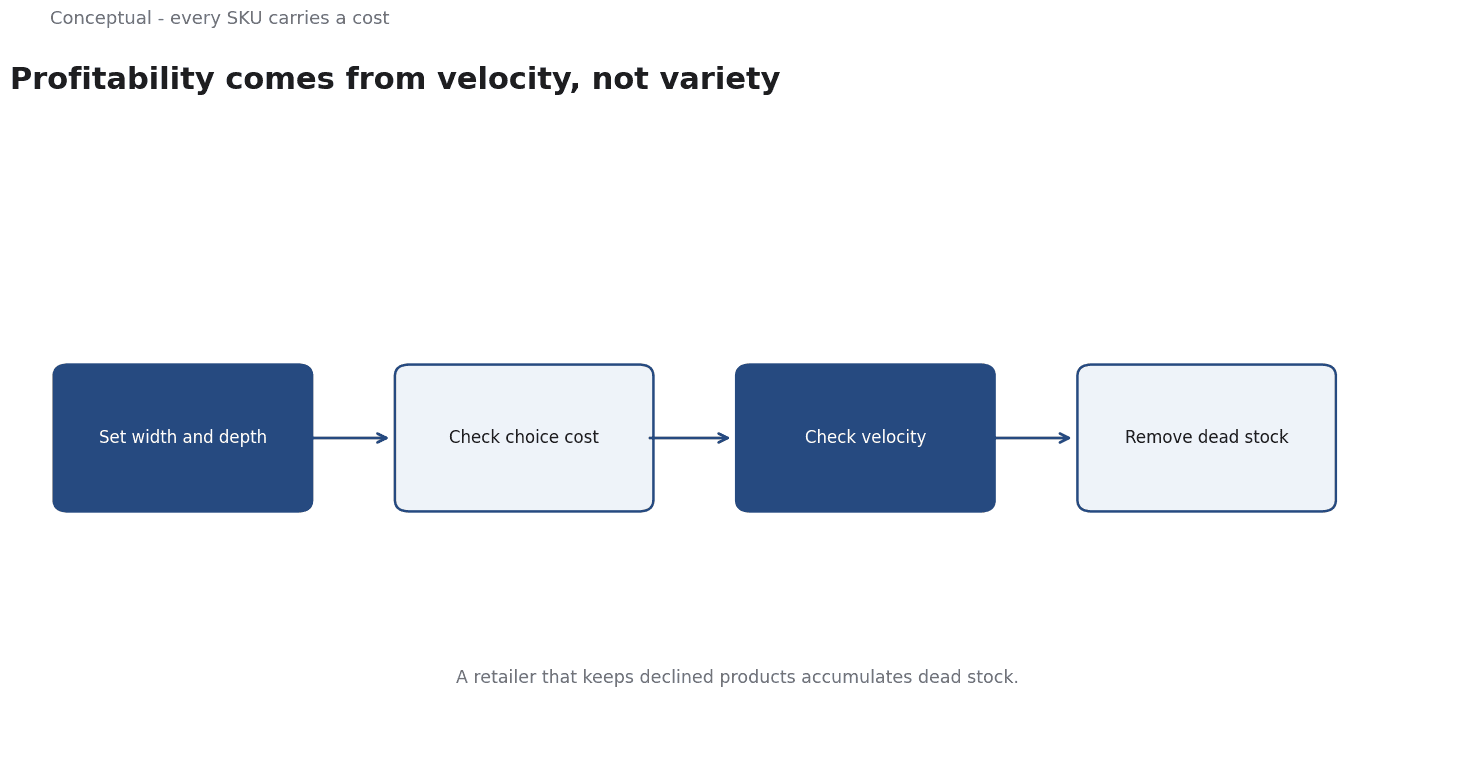
Width versus depth
Assortment has two dimensions:
- Width: the number of product categories carried. A store with wide assortment sells groceries, apparel, electronics, and home goods.
- Depth: the number of variants within a category. A store with deep assortment in toothpaste carries ten brands, five sizes, and three flavors each.
Increasing width attracts a broader customer base but requires more suppliers, more receiving docks, and more shelf categories. Increasing depth serves existing customers better but creates inventory that moves slowly. A retailer that is both wide and deep faces the highest complexity cost.
The challenge is that width and depth are not free. Each SKU needs warehouse space, replenishment planning, price management, and shrinkage control. A SKU that sells one unit per month may still cost more to hold than it contributes in margin.
The choice paradox
More options do not always help customers. Research on choice behavior shows that very large assortments can overwhelm shoppers, leading to decision fatigue and lower conversion. A customer facing 50 varieties of cereal may walk away without buying any, while a customer facing five well-chosen varieties is more likely to purchase.
This means the optimal assortment is not the largest one. It is the one that matches the customer's decision-making process: enough variety to satisfy different needs, but not so much that choosing becomes work. Retailers that understand this curate deliberately rather than expand indiscriminately.
Inventory velocity and carrying cost
Each product in the assortment ties up capital from the moment it is ordered until it is sold. The longer a product sits, the more it costs in storage, insurance, handling, and opportunity cost. A fast-moving SKU with low margin can be more profitable than a slow-moving SKU with high margin because the capital turns over more often.
Assortment decisions should therefore be made in terms of inventory velocity, not just product count. A category with 100 SKUs that all turn every two weeks is healthier than a category with 10 SKUs where three have not sold in six months. The second category looks smaller on paper but may be dragging down profitability.
Seasonality and lifecycle
Assortment is not static. Products move through lifecycle stages: introduction, growth, maturity, decline.
A retailer that removes them too early loses customers who still want them.
Seasonal products add another layer. A summer assortment that carries into autumn occupies space and capital that autumn products need. Timing assortment changes to demand cycles is one of the highest-leverage decisions in retail.
A practical framework for assortment review
Before adding or removing a SKU, answer:
- Velocity: how many units does this product sell per period, and how does that compare to similar products?
- Margin contribution: what is the gross margin per unit, and how much capital does it tie up?
- Cannibalization: does this product steal sales from another product in the same category?
- Customer need: does removing this product lose customers, or do they substitute to another SKU?
- Supplier terms: are there minimum order quantities, lead times, or exclusivity requirements that complicate stocking?
If a product fails most of these questions, it should be removed even if it has emotional or historical value to the retailer.
For the related question of how retailers measure performance at the product level, see [Understanding SKU Productivity in Modern Retail]—this publication does not yet have that article, so treat it as a planned topic rather than a published link.
For the retailer-side version of the same argument, see Private Label: Retailers Competing with Brands and Omnichannel Retail.
Assortment as a strategy choice
Porter's differentiation-versus-cost argument clarifies why assortment scope cannot be decided in isolation. A wide, deep catalog is a differentiation play: it competes on range and selection. A narrow, fast-turning catalog is closer to a cost play: it competes on efficiency and price. Trying to do both tends to produce the high-complexity retailer described above, with neither a clear value proposition nor a cost advantage.
The working-backwards method described in Bryar and Carr's material offers a way to keep the decision honest. Start from the customer experience you want - say, a curated set of options that can be chosen quickly - and derive the assortment that delivers it. That starting point argues against indiscriminate expansion, because a catalog built to impress rather than to be used creates the choice paradox the article identifies.
Seen this way, removing a SKU is not a retreat but a strategic act. It reinforces a position, whether that position is breadth or efficiency. The review framework of velocity, margin, cannibalization, customer need, and supplier terms is the operational expression of that choice.
Measuring the outcome through the channel
The following is hypothetical and illustrative. A retailer adds fifty SKUs to a category and reports higher sell-in because suppliers shipped the new stock. Sell-out, however, is flat: the added choices did not increase what customers bought, only what sat on shelves. The catalog grew while velocity fell, which is the failure mode the article attributes to undisciplined expansion.
The National Retail Federation's distinction between sell-in and sell-out is what makes this visible. Sell-in records shipments into the channel; sell-out records purchases by consumers. Assortment decisions judged only at sell-in reward stocking, while decisions judged at sell-out reward selling. The argument that profitability comes from velocity rather than product count depends on measuring the latter.
This also clarifies the role of curation. A smaller assortment that turns quickly can outperform a larger one because capital recycles and dead stock is avoided. When sell-out is the metric, the choice paradox and carrying cost point to the same conclusion: the right assortment is the one customers can navigate and the channel can move.
A counterargument
A critic could push back that the piece treats a smaller, curated assortment as universally superior when its own sources make that contingent. Porter's differentiation-versus-cost argument is the article's evidence that a wide, deep catalog can be a deliberate position, not a mistake - the retailer competing on range is accepting trade-offs, not merely paying complexity costs - yet nothing here distinguishes a disciplined breadth play from an undisciplined one in advance. Bryar and Carr's working-backwards method starts from the customer experience you want, which could be every option in one place as easily as a curated few. The NRF sell-in versus sell-out distinction shows whether stock moved, not whether the strategy was right.
Fast turnover measures efficiency, not proof that fewer SKUs created the value.
References & Further Reading
- National Retail Federation, 2026. NRF Press Releases | Latest Statements & Announcements | NRF — Primary retail-sales and channel data for sell-in versus sell-out definitions.
- Michael E. Porter, 1996. What Is Strategy? — The differentiation-versus-cost argument behind competitive-advantage analysis.
- Colin Bryar and Bill Carr, 2019. Amazon Company News — Primary company material on how the working-backwards method is applied.