Portfolio Rebalancing Checklist
Rebalancing restores a portfolio's target weights after market drift. Read the mechanism, a worked example and the costs that make a tidy target expensive.
A portfolio that starts at a chosen allocation will drift as asset prices move, so the target weights stop describing the risk actually held. The practical problem is deciding when drift matters enough to trade, because every correction has a cost. The rebalancing entry describes the mechanism, and Damodaran Online supplies the rate and risk inputs that give a target its meaning.
Direct answer: Rebalancing is the process of realigning asset weights to a target allocation after market moves have shifted them. Wikipedia's rebalancing entry describes time-based and threshold-based approaches and the trade-off with costs; Damodaran Online provides valuation and risk data that inform the target itself. The boundary: rebalancing maintains a chosen risk posture, it does not improve returns by definition.
Delta: This article adds a decision framing beyond the sources: it maps drift and cost concepts to the specific question of when a portfolio should be rebalanced, with claim status explicit.
The mechanism
The rebalancing entry defines rebalancing as realigning the weightings of a portfolio to maintain an original or desired asset allocation or risk level. Drift arises because asset returns differ; an asset that has risen becomes a larger share of the portfolio, increasing exposure. The practical consequence is that the target is a risk statement, and drift silently changes the risk being carried. A portfolio can look unchanged in size while becoming materially more aggressive or concentrated.
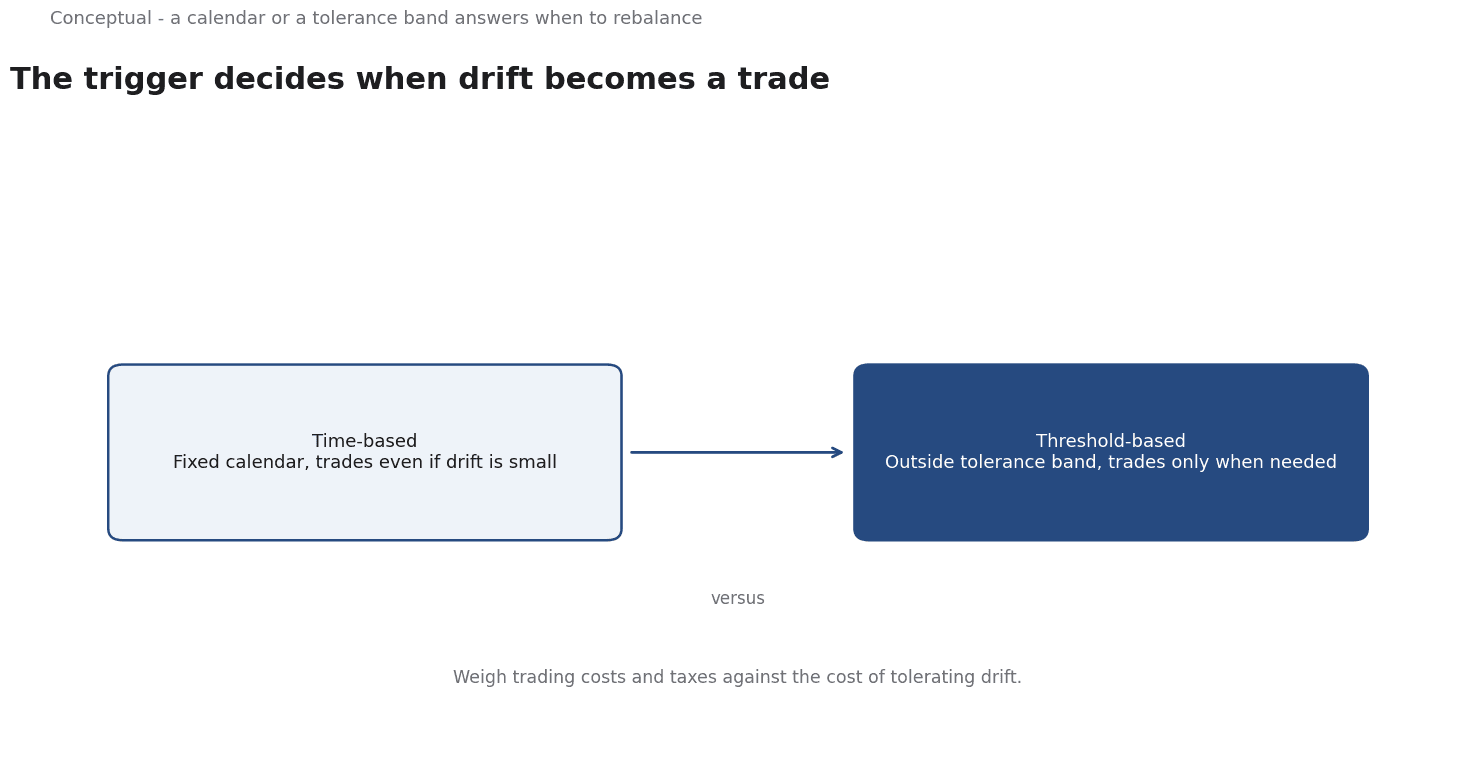
Two triggering approaches are described. Time-based rebalancing trades on a fixed calendar, such as quarterly or annually. Threshold-based rebalancing trades when an asset moves outside a tolerance band around its target. The practical consequence is that the calendar approach is simple but trades even when drift is small, while the threshold approach trades only when needed but requires monitoring. Neither is inherently better; the choice depends on the cost of trading and the cost of tolerating drift.
The entry also frames the trade-off: selling assets that have risen and buying those that have fallen is contrarian, which maintains the risk profile but can feel uncomfortable and can realise taxable gains. The practical consequence is that the checklist must include after-tax and after-cost thinking, because a target restored at high cost may leave the investor worse off than a small, tolerated drift. Discipline helps here, but discipline alone cannot make an expensive trade worthwhile.
Damodaran Online supplies the inputs that make a target defensible: data on risk-free rates, equity risk premiums, betas and cost of capital. The practical consequence is that a target weight is only as sound as the risk and return assumptions behind it. If those inputs are stale, rebalancing faithfully maintains an allocation that no longer fits the current environment. The mechanism therefore ends with a review of the assumptions, not just the weights, because a correct trade toward a wrong target is still a mistake.
A worked example
The following is hypothetical and illustrative. An investor holds a two-asset portfolio with a stated target and notices that one allocation has drifted above its band after a strong quarter. Three checks decide. First, trigger: has the drift crossed the pre-set tolerance band, or is it still within normal movement that the calendar rule would ignore? Second, cost: what are the transaction costs and the tax consequence of realising the gain, and do they exceed the expected benefit of restoring the weight? Third, assumptions: are the rate, premium and beta inputs behind the target current? The outcome is a rule rather than a trade: if drift exceeds the band, costs are modest and assumptions hold, rebalance; if the drift is small or the tax is large, tolerate it and record why. The scenario is hypothetical; the mapping from concepts to checks is the contribution.
Evidence status
| Claim | Status | Source | Verified | Recheck when |
|---|---|---|---|---|
| Rebalancing realigns portfolio weights to a target allocation or risk level | source-reported | Rebalancing - Wikipedia | 2026-11-18 | Definition or practice description changes |
| Rebalancing can be triggered by time or by tolerance thresholds | source-reported | Rebalancing - Wikipedia | 2026-11-18 | Approach descriptions are revised |
| Target weights depend on current risk and return assumptions | inferred | Derived from the sources | 2026-11-18 | Input data or valuation guidance is updated |
The two descriptive claims are reported directly from the reference entry and are stable as descriptions. The claim about assumptions is an inference from combining the rebalancing mechanism with the data resource, so it should be revisited when the rate and premium data or the valuation guidance changes. Keeping the statuses explicit shows which part of the check is documented and which is reasoned.
What it cannot do
Rebalancing cannot raise returns by itself; it maintains a risk posture.
Any claim that the trade adds return overstates the mechanism. Whatever benefit emerges comes from a risk premium captured consistently and from the discipline of staying at a chosen exposure, not from the act of selling one asset to buy another. Rebalancing also cannot correct a badly chosen target. It keeps you on the allocation you selected, for better or worse, so a flawed target is reproduced with more precision rather than fixed.
The hidden cost is the sum of trading expenses, taxes, operational effort and the behavioural discomfort of selling winners. Each correction consumes resources, and in taxable accounts the realised gain is an immediate cost against a future, uncertain benefit. There is also a cost in the claim that rebalancing harvests volatility: any such benefit depends on volatility being present and on markets not trending persistently. In strong trends the contrarian trade can underperform for long stretches, which is exactly when discipline is hardest to maintain.
The opposite failure, wide bands or no rule, lets concentration grow until the portfolio bears risks the investor never chose. A third failure is applying a target that was never justified by the investor's own risk tolerance, so the process faithfully enforces someone else's allocation. All three are failures of the rule, not of the market.
There are settings where rebalancing should not drive action. When the target itself is under review, trading toward it before the review is wasted effort. Large structural changes, illiquid assets and high transaction costs can make correction disproportionate to the drift. Very small portfolios can be dominated by fixed dealing costs, and tax-inefficient accounts can make a technically correct rebalance economically poor. In these cases tolerance of drift is a deliberate choice, not negligence.
Finally, rebalancing needs scheduled review because the inputs and the portfolio change. Rate and premium data are updated, asset weights move and the investor's circumstances shift. The practical requirement is to re-derive the target from current data on a fixed cadence, to record which target and which data version supported each rebalance and to keep the trigger rule consistent between periods. Without that discipline the checklist becomes a ritual of trading that nobody can explain.
The counterargument that rebalancing is unnecessary for long horizons is fair for very low-cost, highly diversified portfolios and incomplete for cases where risk drift or concentration has grown large enough to change outcomes.
A decision test
- State the target and the risk posture it represents.
- Check the current weights and the size of the drift.
- Identify the trigger rule: calendar, tolerance band or both.
- Estimate transaction costs and tax consequences of trading.
- Confirm the rate, premium and beta inputs behind the target are current.
- Compare the cost of trading with the cost of tolerating drift.
- Record the decision and the data version used, and set a review date.
These steps make rebalancing a governed decision rather than a reaction to market movement. The test is passed when a reader can see the target, the trigger, the costs and the data behind the trade, and failed when rebalancing is presented as a return strategy. For further reading, see Cash Flow Forecasting: A 13-Week Operating Model.
References & Further Reading
- Wikipedia contributors, 2026. Portfolio rebalancing - Wikipedia — The mechanics of restoring target weights in a portfolio.
- Aswath Damodaran, 2026. Damodaran Online: Home Page for Aswath Damodaran — Publicly maintained datasets for industry averages, WACC, and valuation.