Portfolio Rebalancing: Rules, Costs, and Taxes
Rebalancing restores a target mix, which costs money and may trigger tax. Read the rules, a worked example, and when to leave it alone.
A portfolio drifts as asset prices move. A 60/40 mix can become 70/30 after a strong equity run, which means the investor is taking more risk than intended. Rebalancing restores the target, but it is not free: trades cost money, sales can trigger tax, and frequent rebalancing can erode the return it is meant to protect.
Direct answer: Rebalance according to a stated rule — periodic or threshold-based — with the costs and tax consequences included in the decision. The investor-education material is explicit that all investments carry risk and returns are not guaranteed, and the asset-allocation article explains why the target mix is the primary decision. The boundary: rebalancing manages risk relative to a target, not returns, and it cannot fix a target that was wrong in the first place, as the factor-investing article treats assumptions about expected returns.
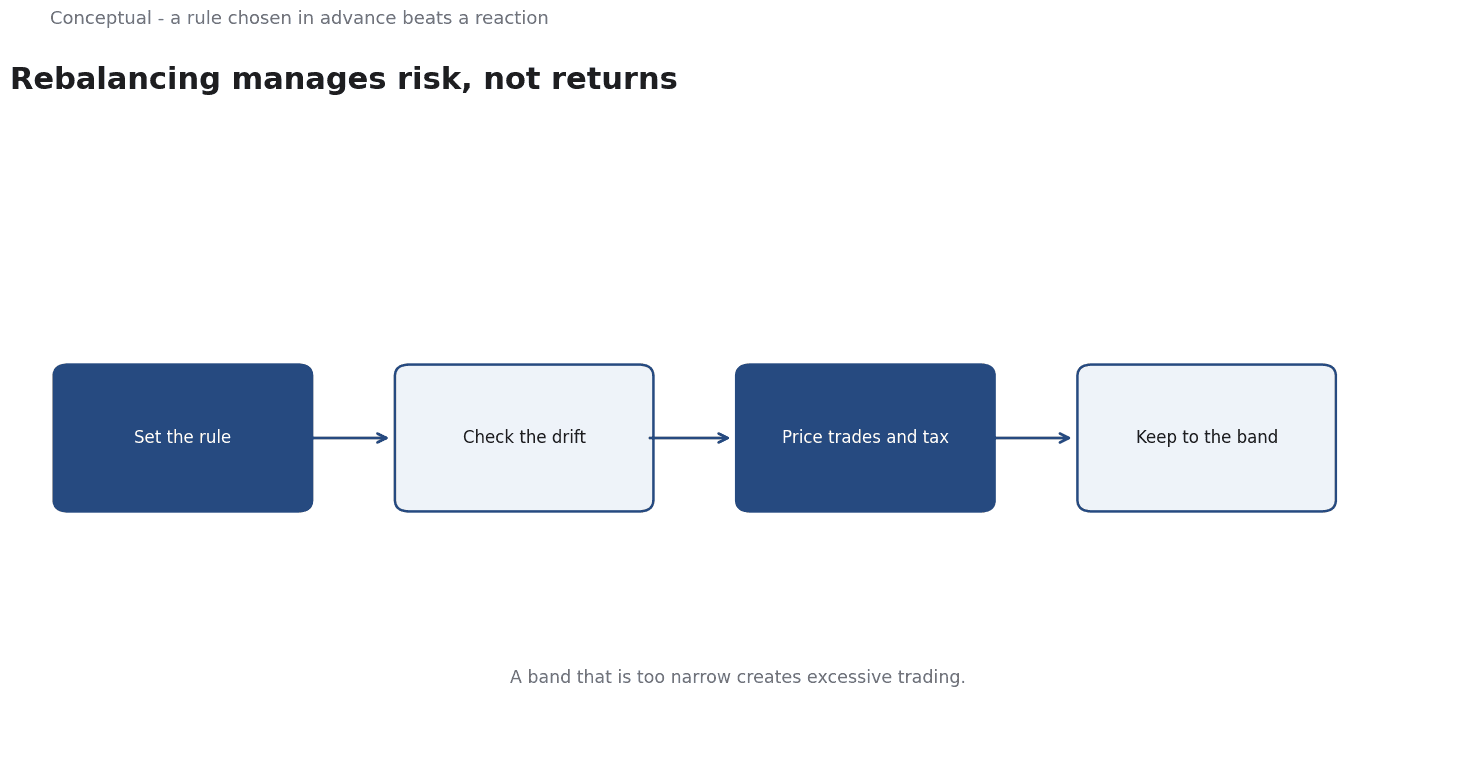
The rules
Calendar rebalancing. Review and restore on a fixed schedule — quarterly or annually. It is simple and easy to automate, which the reporting-automation article treats as a virtue for any repeated process.
Threshold rebalancing. Act when an asset's weight moves outside a defined band, such as plus or minus five percentage points. It responds to actual drift rather than the calendar, which the monitoring article recommends for any signal tied to change.
Rebalance with new money. Direct contributions to underweight assets instead of selling others. This avoids some costs and taxes, as Tax-Efficient Investing Basics explains for the return actually kept.
Three consequences follow.
A rule chosen in advance prevents decisions driven by recent performance, which the behavioural-finance article treats as a common bias.
And a target mix that is never revisited becomes a habit, which the asset-allocation article treats as a decision requiring periodic review.
A worked example
The following is hypothetical and illustrative. A portfolio targets 60% equities and 40% bonds, with a five-point band. After a strong year it is 68% equities and 32% bonds, with a 200,000 total.
To restore 60/40, the investor must move 16,000 from equities to bonds. Three checks decide whether to act. First, transaction costs: if trading costs are 0.5%, the immediate cost is 80, which the cost estimator treats as a certain expense against an uncertain benefit. Second, taxes: if the equity holding has a large unrealised gain, selling triggers a liability, which the tax-efficient-investing article requires including. Third, the reason for drift: if equities rose because the target's expected-return assumptions changed, the right response may be to revisit the target, as Asset Allocation for Long Horizons argues.
Three conclusions follow. The rule triggered an action, but the action should be checked against cost and tax, as the valuation article recommends for explicit assumptions. Using new contributions could achieve part of the rebalance without a sale, as the cash-flow article treats contributions as a lever. And the decision should be recorded, as the decision-memo article requires for consequential choices.
The behavioural case for a rule
Rebalancing is uncomfortable because it means selling what has performed well and buying what has performed poorly. That is precisely why a rule made in advance is valuable: it removes the decision from a moment when recent performance is most persuasive, which the behavioural-finance article treats as a systematic bias.
An investor who waits until they feel comfortable will usually wait until the drift is larger, as the trend-chasing literature would predict.
A rule also makes the process auditable. When a portfolio is reviewed, the question is not whether a trade felt right but whether the target band was breached, which the evaluation-rubric article argues for concrete criteria. This matters most for advisors managing money for others, where the governance checklist requires a documented decision and an accountable owner, as the financial-advice literature would expect.
The rule itself should not be treated as permanent. A change in horizon, withdrawal needs, or tax circumstances changes the right band, which the monitoring article treats as a change trigger. The discipline is to change the rule deliberately and record why, rather than to override it case by case, as the decision-memo article requires for consequential choices.
What rebalancing cannot do
It cannot improve a bad asset mix; it only maintains it, as Asset Allocation for Long Horizons treats the target as the primary decision. It cannot control taxes in every jurisdiction, which the tax-efficient-investing article makes date- and location-dependent. And it does not guarantee a better return — it reduces drift-related risk, which the factor-investing article distinguishes from expected return.
The counterargument that rebalancing is unnecessary because markets recover is a claim about a period and a portfolio, not a general rule, as the behavioural-finance article warns about recency.
A decision test
- State the target mix and why it fits your horizon, as Asset Allocation for Long Horizons requires.
- Choose a calendar or threshold rule in advance.
- Include transaction costs and taxes, as the cost and tax articles require.
- Prefer new contributions where possible, as the cash-flow article suggests.
- Check whether drift reflects changed assumptions, as Asset Allocation for Long Horizons advises.
- Record the decision, as the decision-memo article requires.
- Review the rule after a material change, as the monitoring article recommends.
For the target decision, see Asset Allocation for Long Horizons; for the tax treatment, see Tax-Efficient Investing.
References & Further Reading
- U.S. Securities and Exchange Commission (Investor.gov), 2026. Introduction to Investing — Primary regulator guidance on market mechanics and investor protection.
- Federal Reserve Bank of St. Louis, 2026. FRED economic data — The primary time-series database used for macro indicators.