Problem Solving without the Hype
Problem solving starts with a clear definition, not a toolkit. Read the method, a worked example, and why a fast answer can be the wrong one.
Problem solving is often sold as a collection of techniques, which hides the first step: defining the problem. The systems-thinking entry describes structure and feedback, and the decision-making entry covers the structure of a choice. The method starts with what is actually happening.
Direct answer: Define the gap, identify the structure that produces it, choose an intervention, and verify the result. The sources describe the concepts; the method is a synthesis.
Delta: This article adds a claim-status table and a worked example, separating documented concepts from local choices about the intervention.
The mechanism
Three points matter:
- A vague problem cannot be solved. The decision-making entry describes a choice with an owner and evidence. A problem without a measurable gap has no clear success condition.
- Structure produces patterns. The systems-thinking entry describes feedback over time. A recurring pattern points to structure, not to a single event.
- Verification closes the loop. An intervention that appears to work may have coincided with another change. The comparison is the causal-inference correction.
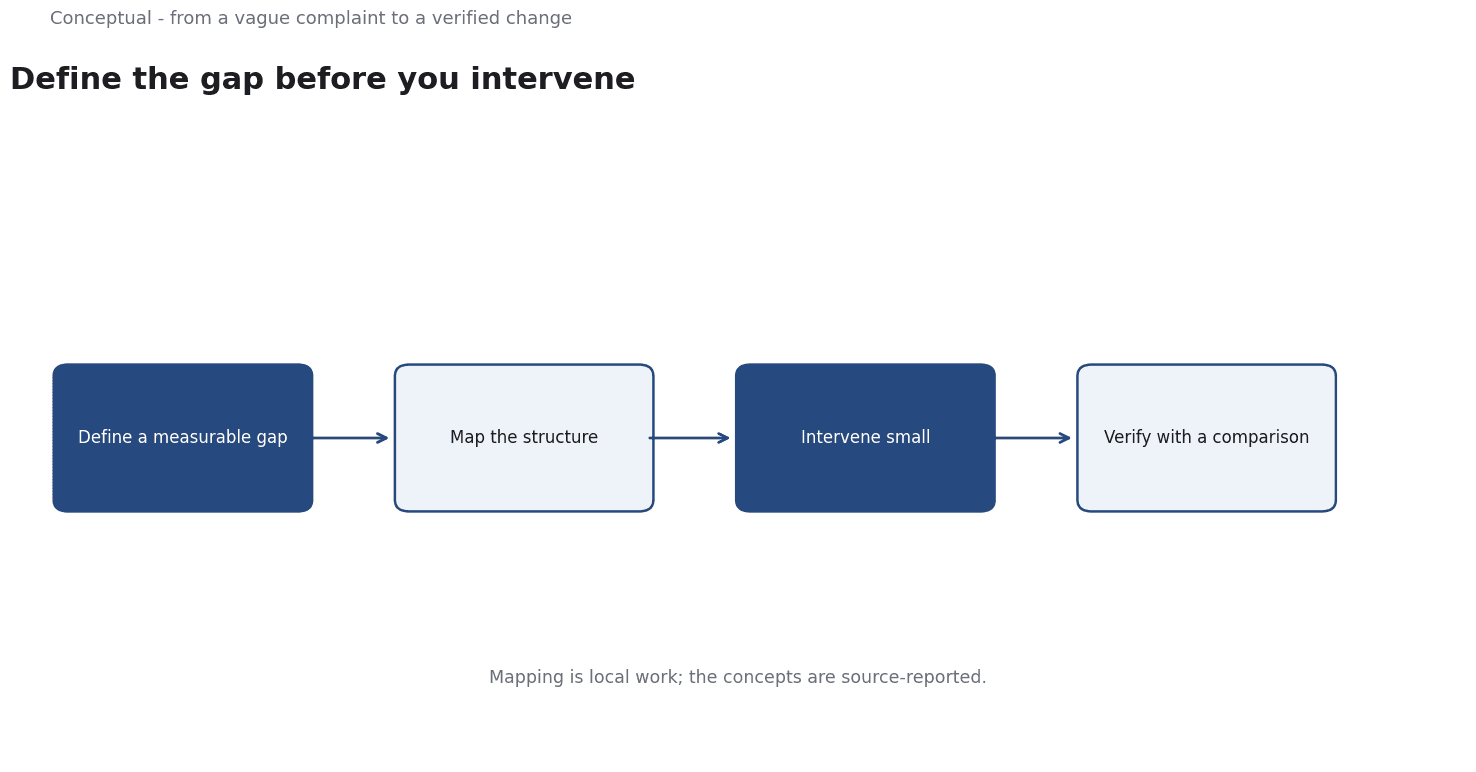
The sequence is: define the gap, map the structure, intervene small, then verify.
Mapping is local work, so it is inferred; the concepts are source-reported.
A worked example
Illustrative. A team is told to reduce delivery times and immediately adds staff.
Three checks decide. First, what is the gap — a target time and the current time? Second, what structure produces the delay, using a timeline rather than an assumption? Third, does adding staff change the structure, or does it mask the cause?
The outcome is a targeted intervention with a verification plan. The scenario is hypothetical; the method is the contribution.
Why a measurable gap comes first
A problem described as a feeling cannot be verified. Stating the current value and the target value turns a complaint into a question that can be answered. It also makes it possible to tell whether an intervention worked, which is the step most often skipped.
Why the timeline reveals structure
A timeline of events shows the order in which things happened, which is the evidence for a causal story. Without it, a team relies on memory, and memory tends to fit the explanation that was chosen first. Recording the sequence is a small step that improves the diagnosis.
Evidence status
| Claim | Status | Source | Verified | Recheck when |
|---|---|---|---|---|
| Systems thinking concerns structure and feedback | source-reported | Wikipedia, Systems thinking | 2026-11-18 | Definition revised |
| Decisions have owners and evidence | source-reported | Wikipedia, Decision making | 2026-11-18 | Source revised |
| Define the gap before intervening | inferred | Derived from the concepts | 2026-11-18 | Problem changes |
Why a fast answer can be wrong
A fast answer feels decisive, but it is chosen before the structure is known. When the problem recurs, the same answer is applied again, which is a sign that the cause was never addressed. The time spent defining the problem is recovered by not repeating the fix.
A method cannot supply knowledge the team does not have. It organises reasoning, but the quality of the diagnosis still depends on understanding the domain.
The intervention should also be bounded.
The result should be recorded with what was expected, so the next problem can be judged against a prediction rather than a memory.
A final point is that not every problem needs this method. A small, reversible issue can be fixed directly and revisited only if it recurs, which is cheaper than a full diagnosis.
The discipline is proportional: the more expensive and repeated the problem, the more time the definition and structure deserve. Deciding where to spend that effort is itself part of the work.
The gap should be measured with the same method each time, or the trend will reflect the measurement rather than the problem.
A diagnosis that cannot be stated in one paragraph is usually not finished, because the structure has not been reduced to its essential parts.
A written reversal condition is what distinguishes a tested intervention from a decision that cannot be challenged.
The structure may have more than one cause, and the test should be designed to tell them apart.
A problem that recurs after a fix is evidence that the diagnosis was incomplete, which is a reason to revisit the structure rather than repeat the fix.
The record of a solved problem is more useful when it states what was predicted, so the next diagnosis can be compared with it.
What it cannot do
It cannot guarantee a correct diagnosis. It does not remove uncertainty. And it cannot replace domain knowledge.
The counterargument that speed matters more is fair for reversible problems and incomplete for recurring ones.
A decision test
- Define the gap.
- Map the structure.
- Choose a small intervention.
- Verify against a baseline.
- Set a reversal condition.
- Record the decision and recheck date.
For the written form, see Decision Memos.
References & Further Reading
- Wikipedia contributors, 2026. Systems thinking - Wikipedia — Understanding feedback, structure and behaviour over time.
- Wikipedia contributors, 2026. Decision-making - Wikipedia — Overview of decision processes, trade-offs and the distinction between the decision and its outcome; secondary reference.