Private Label: Retailers Competing with Brands
A private label is a claim on the shelf and the customer relationship. Read the economics, the quality problem, and why the retailer's advantage is not automatic.
Private label is often described as a cheaper alternative that retailers sell for a higher margin, and that description is true in a narrow accounting sense while missing the strategic question. When a retailer puts its own name on a product, it is using the trust it has built with customers to enter a market it previously only distributed. The margin is a consequence; the real change is that the retailer is now a competitor as well as a buyer.
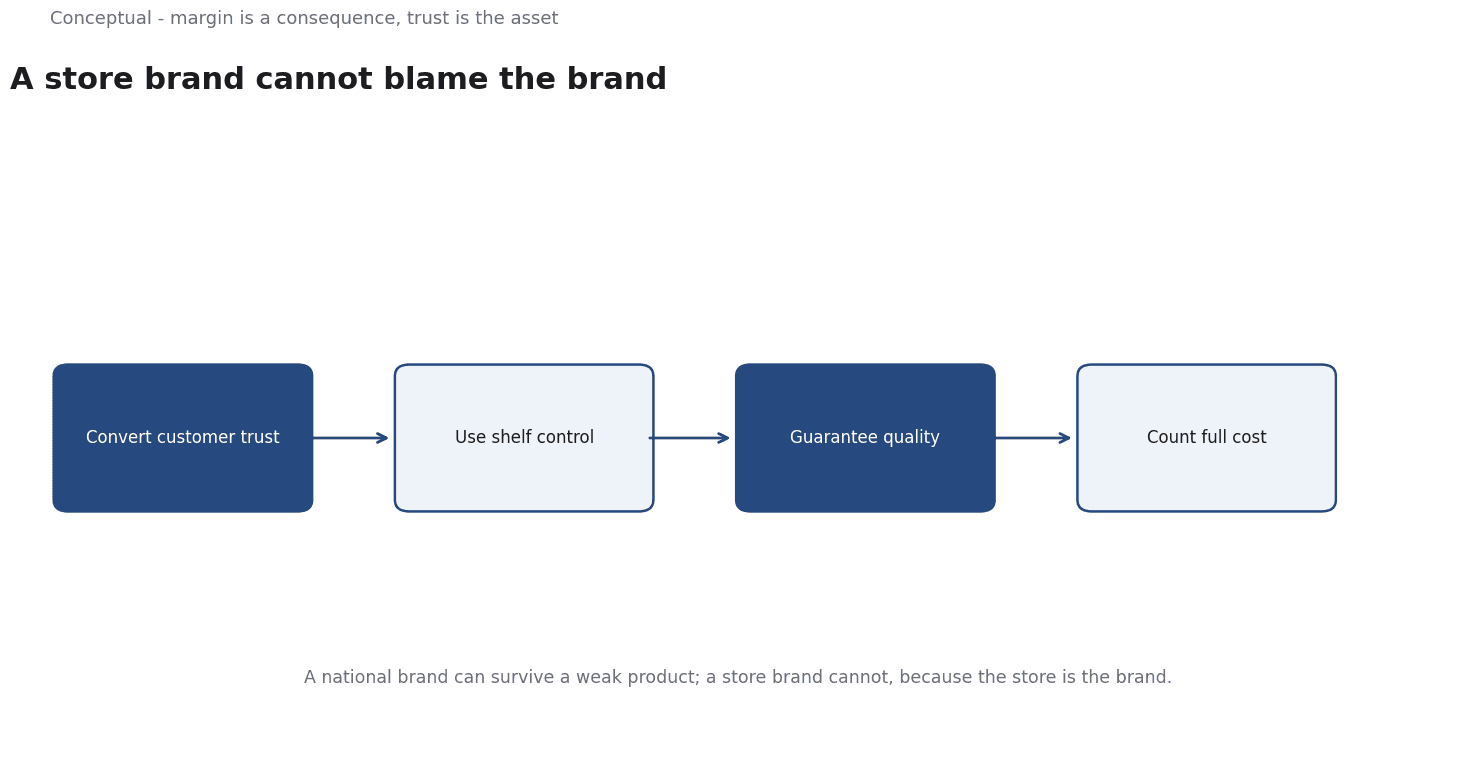
Direct answer: Private label works when the retailer can convert customer trust, shelf control, and demand data into a product that is good enough at a price customers accept — and when the economics account for the full cost of quality, marketing, and the risk of damaging the store's reputation. The National Retail Federation's channel and sales data is the right external benchmark for category behaviour, while Porter's trade-off argument explains the strategic cost: "a strategic position is not sustainable unless there are trade-offs with other positions". A retailer that carries both every national brand and an aggressive private label has avoided the choice, and often pays for it in relationships and trust.
What the retailer actually has
Three assets make private label possible, and none of them is a factory.
The customer relationship. A shopper who trusts the store to select products will extend some of that trust to a product bearing the store's name. This is the core asset, and it is also the one most easily destroyed: a bad private-label product is attributed to the retailer, not to an anonymous supplier.
Control of the shelf. The retailer decides where products appear, how much space they get, and what they are displayed beside. That is a distribution advantage no brand can match inside someone else's store.
Demand data. A retailer sees what customers buy, at what price, in what combinations, and in response to what promotions. The web Almanac's caution about sample scope has a retail analogue here: the data is exceptionally rich about the retailer's own customers and says little about shoppers elsewhere.
These assets explain why private label is not simply a manufacturing decision. The retailer is leveraging a position it already holds, and the strategic question is whether that position is strong enough to support the extension.
The economics are more than the margin
The apparent case for private label is straightforward: a branded product carries a margin for the manufacturer and an advertising cost embedded in its price; a private-label product removes those and delivers a higher gross margin to the retailer.
The full calculation has more terms:
- Quality and returns. A product that fails generates refunds, support contacts, and reputational damage that do not appear in the gross-margin line.
- Development and oversight. Even with a contract manufacturer, someone must specify, test, and monitor the product. That is a real cost and a real capability.
- Shelf opportunity cost. Space given to private label is space not given to a branded product that may draw customers into the category.
- Supplier relationships. Aggressive private label can damage the retailer's relationship with the brands it still needs, affecting terms, availability, and innovation.
- Price perception. A private label priced too low can signal inferior quality; priced too close to the brand, it loses its reason to exist.
The Web Almanac's lesson about denominators applies here: a higher margin per unit is not a higher profit per shelf if the unit velocity falls. The decision has to be made on contribution per unit of scarce space.
The quality problem is a trust problem
The most reliable way for a private label to fail is to be bad.
A national brand can survive a weak product in one category because the customer blames the brand; a store brand cannot, because the store is the brand.
This is why the retailers that sustain private-label businesses treat quality as a governance function rather than a procurement task: written specifications, independent testing, supplier audits, and a willingness to delist a product that underperforms. It is expensive, and it is the price of using the store's name as a guarantee.
The alternative — competing only on price — works in categories where quality is easy to verify and differences are small. It fails where the product's quality is experienced over time, because the customer discovers the problem after the purchase and attributes it to the retailer.
A worked margin comparison
The margin case is easiest to evaluate with a concrete shelf decision. A national brand sells 100 units a week at a retail price of 10, with a wholesale cost of 7 and a retailer margin of 3 per unit, or 300 a week.
A private-label alternative sells at 8 with a landed cost of 4.50, giving a margin of 3.50 per unit — a higher margin rate and a slightly higher absolute margin. But two adjustments change the picture:
- If the private-label product sells only 70 units, its total margin is 245, below the brand's 300, despite the better unit economics.
- If it generates two additional returns or complaints a week at an average handling cost of 15, another 30 disappears, leaving 215 — a substantial loss against the branded alternative.
The decision therefore turns on questions the margin rate cannot answer: what volume will the private label actually achieve at its price, and what is the full cost of quality failures?
The same arithmetic works in reverse when the private label succeeds. A product that achieves higher volume than the brand and few returns can generate substantially more contribution, and the retailer also captures the customer relationship that comes with the repeated purchase. The point is not that private label is bad; it is that the headline margin is the smallest part of the calculation.
For the measurement discipline this requires, see Customer Lifetime Value on the difference between a metric and the decision it should inform.
Porter's trade-off applies directly
The strategic error is trying to be both the trusted neutral selector of the best products and an aggressive competitor to those products, without acknowledging the conflict. Porter's argument that "a strategic position is not sustainable unless there are trade-offs with other positions" is precise here.
A retailer that positions itself as "the place where you find the best brands" has a different model from one that positions itself as "the place where you get good quality cheaply under our own name". Both can work. A retailer that says both, and fills the shelf with private label while continuing to market its brand selection, has no position — and the brand partners will notice the contradiction before the customers do.
The honest question is not "should we have a private label?" but "what does our private label allow us to refuse?" If the answer is nothing, the programme is a margin initiative without a strategy.
A practical assessment
- Name the source of trust the private label is borrowing, and what would destroy it.
- Calculate contribution per unit of shelf, including returns, development, and opportunity cost.
- Choose the categories where quality differences are verifiable and the customer's risk is low.
- Fund quality governance as a standing capability, not a launch checklist.
- Set the price relative to the branded alternative deliberately, and test whether the gap communicates value or inferiority.
- Assess the supplier relationship cost before expanding aggressively.
- State what the private-label strategy means you will not carry, and check that the rest of the assortment is consistent.
What the strategy requires over time
Private label is not a launch decision but a capability that has to be maintained, and the requirements change as the programme grows.
At the start, the binding constraint is usually quality — finding a supplier that can produce to specification and a process that catches failures before customers do. At moderate scale, the constraint shifts to assortment design: which categories the private label should occupy, and how the rest of the shelf should be adjusted around it. At large scale, the constraint becomes the retailer's relationships and reputation: brand partners respond to the competition, and customers begin to form an overall judgement about whether the store's own products are good value.
This progression is why a private-label programme that succeeds initially can fail later. The skills that got the first product to market — sourcing, price comparison — are not the skills needed to govern a portfolio without damaging the store's position. The retailer has to build quality governance, category strategy, and relationship management, or accept that the programme has a ceiling.
The honest measure of success is not private-label share, which can be increased by simply allocating more shelf, but total category performance and customer trust. A retailer can grow the private-label share and shrink the category; the metric will report a win while the business gets worse.
For the channel context, see Omnichannel Retail; for the broader positioning argument, see How Companies Build Competitive Advantages.
A counterargument
A reasonable critic would note that the article demands a Porter-style trade-off while its own worked example finds private label most defensible where quality differences are easy to verify and the customer's risk is low. In such categories the position being chosen is thin, and the trade-off argument, written about differentiated strategies, may be doing less work here than the article claims. The trust that the retailer is said to borrow is also asserted rather than measured: the article's contribution-per-shelf arithmetic handles returns and opportunity cost, but the cited channel-sales and valuation sources do not show that damage to the store's reputation would appear in that calculation.
The argument is strongest as a warning about margin myopia and weaker as a claim that trust can be captured in the same spreadsheet.
References & Further Reading
- National Retail Federation, 2026. NRF Press Releases | Latest Statements & Announcements | NRF — Primary retail-sales and channel data for sell-in versus sell-out definitions.
- Michael E. Porter, 1996. What Is Strategy? — The differentiation-versus-cost argument behind competitive-advantage analysis.
- Aswath Damodaran, 2026. Damodaran Online: Home Page for Aswath Damodaran — Publicly maintained datasets for industry averages, WACC, and valuation.