Product-Led Growth: Acquisition, Activation, and Retention Loops
PLG is not a marketing channel. Read the three loops, how they connect, and why a self-serve funnel still has real costs.
Product-led growth is often described as "the product sells itself", which is a useful phrase until you ask what has to be true for that to happen. The product does not sell itself; it performs a set of functions that a salesperson used to perform — demonstrating value, removing uncertainty, and creating a reason to return. Those functions have to be designed, instrumented, and improved like any other part of the system.
Direct answer: PLG works through three connected loops: acquisition brings people to the product with low friction, activation gets them to a first moment of real value, and retention turns that value into a habit and then into expansion.
The loops are multiplicative, so the weakest one determines the whole.
The cost is not removed from acquisition — it moves into product engineering, onboarding, and support, and those costs have to be measured alongside the lower CAC that PLG is supposed to deliver.
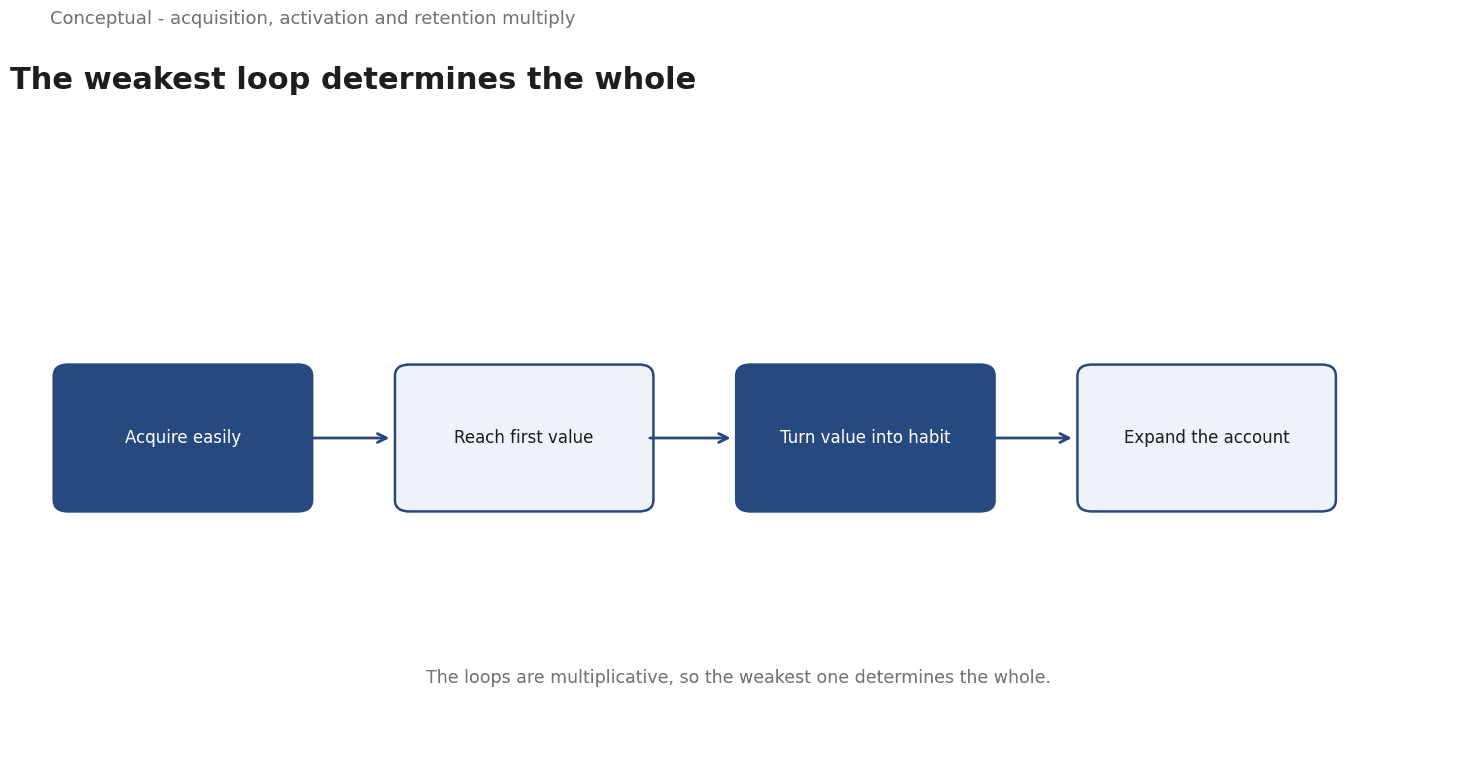
The three loops, and why order matters
Acquisition in a product-led motion is not primarily advertising; it is anything that makes a new user reach the product without talking to a person — a free tier, a template, a public artefact created by another user, a search result that answers a question the product also solves. The point is that the first interaction is with the product, which means the product has to do the explaining.
Activation is the moment the user gets the value they came for. Product-led teams organise around this deliberately, and the activation event has to be a real behaviour, not a signup. A collaboration product's activation might be inviting a colleague; an analytics product's might be connecting a data source and seeing the first chart. The definition matters because everything downstream — messaging, onboarding, support, and measurement — is built around it.
Retention is the loop that closes the system. A user who returns, gets value again, and invites someone creates the next cohort's acquisition. Without it, PLG is a leaky funnel with a cheap top: the low CAC is real, and it buys users who leave before they create value.
The order is not merely narrative.
Instrumentation is the prerequisite
Google Analytics describes the basic unit: "An event allows you to measure a specific interaction or occurrence on your website or app" — a page load, a link click, a purchase, an app crash, an impression served. The definition has a consequence that product teams routinely discover late: you cannot report on a behaviour you did not record as an event.
That is not a reporting problem; it is a product problem. If the team's definition of activation is "invited a colleague" and the instrumented event is "created a workspace", the metric is a proxy for the loop, and it will drift whenever the product changes. The first PLG work is therefore to name the events that constitute each loop and verify they are being recorded correctly in production.
The same applies to the business outcome. An activation event is not a success if the user never returns, so it must be validated against retention and ultimately against revenue. Otherwise the team optimises a step that feels like progress and is not.
The cost that does not disappear
The promise of PLG is lower acquisition cost, and it is real: no salesperson is involved in the initial conversion. But the work has moved, not vanished.
- Product engineering has to make the first-run experience work without human help, which is harder than building a guided sales demo.
- Onboarding has to handle the user who arrives without context, at any hour, with no one to ask.
- Support has to scale with a user base that has not been qualified by a sales conversation, and its cost per user can be high.
- Documentation becomes part of the product, because the user cannot ask anyone else.
A low CAC that ignores those costs is a misleading number. The honest measure is the fully loaded cost of acquiring an activated, retained customer — and that requires the same discipline about definitions that any other unit-economics calculation does.
When PLG is the wrong model
PLG fits products where value can be experienced quickly, by one person or a small group, without configuration that depends on the customer's environment. A product that needs a three-month implementation, a security review, or integration with a legacy system cannot be PLG in its first interaction — the product cannot demonstrate value before those steps happen.
Nor does PLG fit a market where the buying decision is structurally committee-based and the champion needs material to carry internally. In that case the "product" that has to sell itself includes a business case, a procurement path, and an internal narrative, and someone has to help build them.
The right conclusion is that most businesses run a hybrid: product-led acquisition for the parts of the market where it works, and a sales-assisted path for the accounts that need it. Pretending otherwise creates a programme that reports self-serve signups while the real revenue comes from deals nobody admits to.
A sequence for the first ninety days
- Define the activation event as a behaviour, and write why it predicts retention.
- Verify the events exist and are recorded correctly in production.
- Measure the current conversion from signup to activation before changing anything.
- Fix the largest drop-off first, usually in the first session.
- Add a retention check so activation cannot be gamed.
- Measure the fully loaded cost of an activated, retained customer.
- Decide which segment genuinely fits self-serve, and stop forcing the rest through it.
For the retention mechanics, see Customer Retention; for the launch context, see Go-to-Market Strategy.
A worked example
The following is hypothetical and illustrative. A collaboration tool is seeing strong signups but flat growth, and the team suspects the top of the funnel is not the problem. It runs three checks grounded in the loop model. First, it verifies the activation event is a behaviour - inviting a colleague, not creating a workspace - and confirms in production that the corresponding events are recorded, since an event is defined as a measured interaction and nothing can be reported that was never captured. Second, it measures the current signup-to-activation conversion and adds a retention check so a burst of invites is not success unless users return; this tests whether the activation event truly predicts the next loop. Third, it computes the fully loaded cost of an activated, retained customer, folding in onboarding, support, and documentation rather than reporting a low CAC that ignores the work moved off the sales team's plate. The bounded outcome is a first-session fix that lifts activation and holds retention, with the weakest loop, not acquisition, identified as the constraint. The team stops pouring traffic into a funnel that does not yet convert.
A counterargument
A reasonable critic would question the article's central claim that the three loops are multiplicative, so that the weakest determines the whole. The cited PLG material defines activation and engagement loops; it does not establish that relationship, and the article offers no evidence for that precision. The concession that most businesses run a hybrid, with sales-assisted paths for committee-based buying, also sits uneasily with the opening premise that the product performs the functions a salesperson used to perform. If that is right, the three-loop model describes one part of the system rather than the system itself, and the fully loaded cost of an activated customer becomes harder to compute because no single loop owns the outcome.
The framework is useful; its authority is overstated.
References & Further Reading
- Wes Bush, 2026. Product-Led Growth — The activation and engagement loop definition that PLG teams actually use.
- Colin Bryar and Bill Carr, 2019. Amazon Company News — Primary company material on how the working-backwards method is applied.
- National Retail Federation, 2026. NRF Press Releases | Latest Statements & Announcements | NRF — Primary retail-sales and channel data for sell-in versus sell-out definitions.