Real Interest Rates: Inflation Adjustment in Practice
A nominal rate is not what you earn. Read the inflation adjustment, a worked example, and why approximation breaks at high inflation.
A savings account paying 5% while prices rise 4% is not growing at 5%. It is growing at roughly 1% in purchasing power. The distinction between nominal and real rates is easy to state and easy to forget, which is why long-term plans built on nominal returns often disappoint.
Direct answer: The real interest rate is approximately the nominal rate minus the inflation rate; the exact relationship is (1 + nominal) / (1 + inflation) − 1. Wikipedia's inflation overview defines the measurement of price changes, and FRED publishes dated inflation series. The boundary: the approximation is accurate only when both rates are small, and expected inflation differs from realised inflation, which is the central problem for any forward-looking decision, as the central-banking article explains for policy.
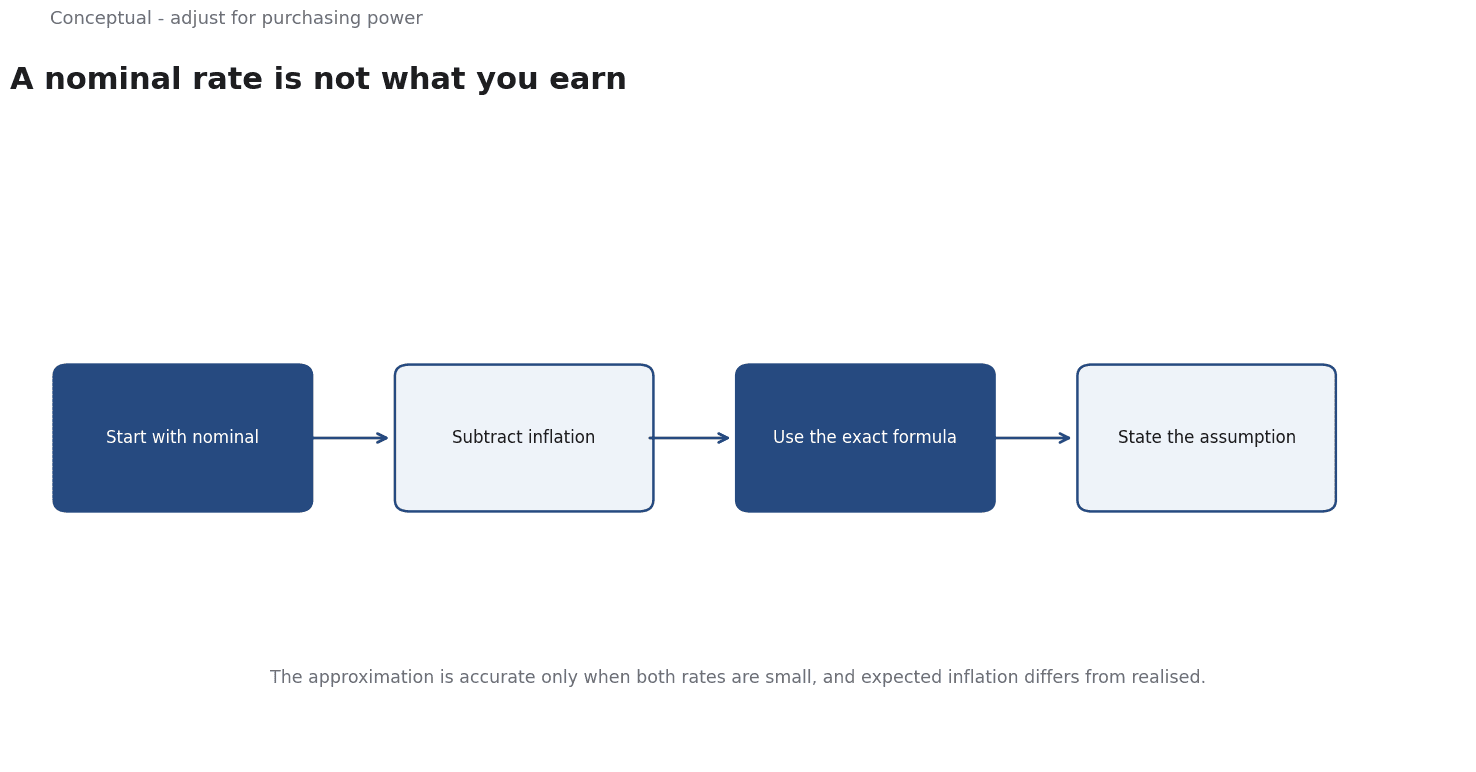
The calculation
The approximation. Real ≈ nominal − inflation. At 7% nominal and 3% inflation, the real rate is about 4%, which is fine for a quick estimate.
The exact form. Real = (1 + 0.07) / (1 + 0.03) − 1 = 3.88%. The difference grows with the rates, which matters in high-inflation environments, as How Inflation Affects Valuation Multiples treats measurement carefully.
Expected versus realised. A decision made today uses expected inflation; the outcome depends on realised inflation. The gap between them is a risk, which the risk-assessment article treats as uncertainty to be stated rather than ignored.
Three consequences follow. A nominal return quoted without an inflation assumption is an incomplete statement, as the compound-interest article argues for stating the basis of a projection. A comparison across periods with different inflation rates can be misleading, which the FRED data with dated releases helps avoid. And tax is a further adjustment, as the tax-efficient-investing article treats the return kept as different from the return earned.
A worked example
The following is hypothetical and illustrative. An investor puts 10,000 into an account paying 6% nominally for ten years while inflation averages 4%.
The nominal balance grows to about 17,908. Adjusting to today's purchasing power using the exact form: 17,908 / (1.04)^10 ≈ 12,097. The real gain is about 2,097, or roughly 1.9% a year, not 6%. Three checks decide how to interpret it. First, was the 4% inflation assumption the right period and series, which FRED with dated releases supports? Second, were taxes and fees included, as the tax-efficient-investing and compound-interest articles require for the return actually kept? Third, did inflation arrive steadily or in a burst, which the inflation article treats as relevant to how a fixed nominal rate feels over time?
Three conclusions follow. A 6% headline return can be a poor real outcome, which the personal-finance article warns about for long-horizon planning. A goal stated in today's money requires a real rate, as the emergency-fund article applies to future expenses. And a range of inflation assumptions is more honest than one point, as the sensitivity-analysis article recommends for consequential estimates.
Where the adjustment matters most
The nominal-real distinction is most consequential when decisions span long periods or when inflation is high and variable.
A corporate investment appraisal that discounts nominal cash flows at a real rate makes the same category mistake, as the DCF article explains for consistency between cash flows and discount rates.
It also matters in contracts. A lease or a supply agreement with nominal escalators transfers inflation risk to one side, as the inflation-linked instruments in the fixed-income article illustrate. Understanding which party bears that risk is a negotiation question, which the term-sheet article treats analogously for financing terms. The exact form of the adjustment matters more as the rates rise, which the inflation article explains for measurement at higher levels.
Finally, realised inflation differs from expected inflation, which is the risk that remains after the calculation. A borrower who expects 3% inflation and gets 6% repays a loan in cheaper money, as the debt article treats the terms as a transfer of risk. A saver in the same environment loses purchasing power, which the wealth-building article treats as the reason to hold assets that can adjust.
The real rate is a tool for seeing these transfers, not a way to eliminate them.
What real rates cannot do
They cannot predict future inflation, which the central-banking article treats as a policy and expectations question. They erase purchasing-power changes without telling you about relative price shifts — a basket that rises 4% overall can hide a 20% increase in something you buy often, which the inflation article explains for measurement. And they do not adjust for risk, which the portfolio article treats as a separate dimension.
The counterargument that only nominal returns matter because that is what appears in the account misses the point of what money is for, as the wealth-building article treats purchasing power as the real objective.
A decision test
- State every rate as nominal or real.
- Use dated inflation data from FRED for the period in question.
- Use the exact form when rates are high, as How Inflation Affects Valuation Multiples advises for precision.
- Separate expected from realised inflation, as the central-banking article explains.
- Include tax and fees in the return kept, as the tax-efficient-investing article requires.
- Use a range of inflation assumptions, as the sensitivity-analysis article recommends.
- Re-check when the inflation outlook changes, as the monitoring article advises.
For the broader context, see Inflation and Valuation Multiples; for the data, see FRED.
References & Further Reading
- Federal Reserve Bank of St. Louis, 2026. FRED economic data — The primary time-series database used for macro indicators.
- Wikipedia contributors, 2026. Inflation - Wikipedia — The definition of inflation, its measurement and its effect on nominal versus real quantities; secondary reference.