Real Estate Markets Costs Explained
Property cost is more than the purchase price. Read the cost layers, a worked example, and why a low sticker price can be expensive to hold.
Real estate looks simple — buy a property, sell it later — which hides the costs that accumulate while it is held: financing, taxes, maintenance, vacancy, and transaction fees. The real-estate entry describes the market and ownership, as the REIT overview treats property as an income-producing asset, as the fixed-income article explains how rate changes transmit into financing cost, as the cash-flow article requires for the cash actually spent.
Direct answer: Wikipedia's real-estate entry provides the structure, and Nareit covers the investment form. The boundary: this is educational orientation, not personalised advice — tax and financing terms are jurisdiction-specific and change, as the tax article requires a dated check, as the publication standard forbids guaranteed outcomes.
Understand real-estate costs by separating acquisition, financing, operating, and transaction costs, then reading them against the income the property generates.
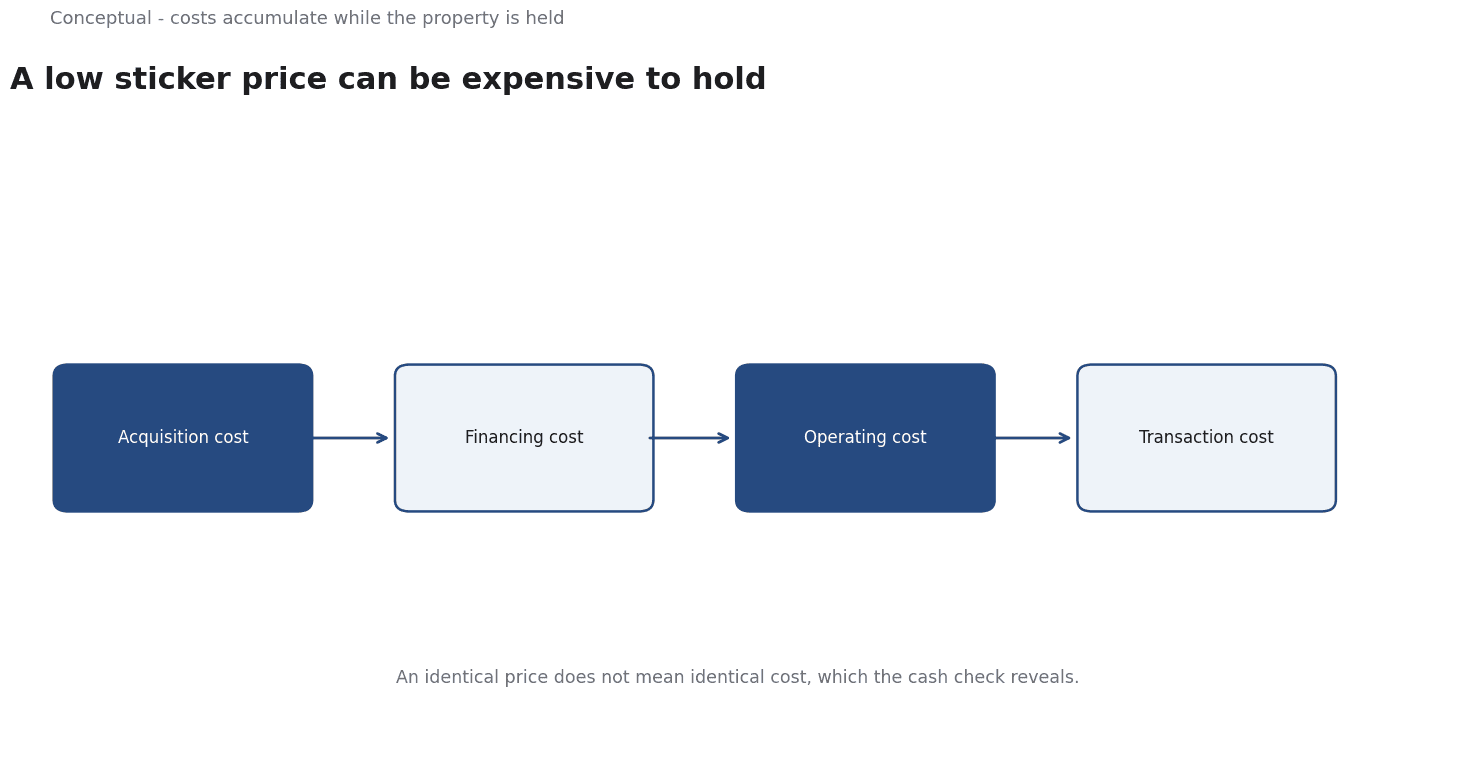
The cost layers
Acquisition. Purchase price, closing costs, and financing fees, which the real-estate entry describes, as the term-sheet article treats formal terms as substantive, as the cash-flow article requires for cash spent.
Financing. Interest and refinancing risk, which the fixed-income article explains for how rates transmit, as the debt-restructuring article treats covenants and maturity, as the duration article quantifies sensitivity, as the yield-curve article advises on shape.
Operating. Taxes, insurance, maintenance, and vacancy, which the insurance article treats as risk transfer, as the property-management literature treats operations, as the cash-flow-forecasting article requires for a dated plan, as the data-governance article requires for provenance.
Transaction. Selling costs and the tax treatment of a gain, which the real-estate entry treats as part of ownership, as the tax article requires a dated check, as the comparables article requires consistent definitions.
Three consequences follow. The layers should be modelled together, as the cash-flow article requires, as the scenario-analysis article advises for outcomes, as the risk article requires residual risk. Financing should be read against the rate environment, as the fixed-income and yield-curve articles advise. And the figures should be dated, as data governance requires, as the decision-memo article requires for a recorded judgement.
A worked example
The following is hypothetical and illustrative. An investor compares two properties with the same purchase price but different financing and vacancy.
Three checks decide. First, what is the total cash cost including financing, taxes, and maintenance, as the cash-flow and insurance articles require, with a dated plan, as data governance requires? Second, how does a rate change affect the financing, as the fixed-income, duration and yield-curve articles advise, with residual risk stated, as the risk article requires? Third, what are the selling costs and tax treatment, as the real-estate and tax articles advise, with current terms, as the tax article requires?
Three conclusions follow.
Financing risk matters, as the fixed-income and duration articles advise. And the decision should be recorded with the assumptions, as the decision-memo article requires.
Why the horizon changes the cost
A property held for one year has a different cost profile from one held for ten, which the real-estate entry treats as part of ownership, as the fixed-income and duration articles explain how rates transmit over time, as the cash-flow-forecasting article requires a dated plan, as the scenario-analysis article advises for outcomes under different horizons, as the risk-assessment article requires residual risk to be stated, as the monitoring article advises for review after a financing change, as the decision-memo article requires for a recorded judgement, as the comparables article requires consistent definitions across properties.
What real-estate cost analysis cannot do
It cannot predict property prices, which the real-estate entry treats as a market, as the scenario-analysis article requires conditional thinking, as the publication standard forbids guaranteed outcomes. It does not remove tax obligations, which the tax article requires a dated check, as the legal article advises. And it cannot guarantee income, which the REIT overview treats as dependent on properties, as the risk article requires residual risk.
The counterargument that the purchase price is the main cost is fair as a starting figure and incomplete once financing and operations are counted, which the worked example shows, as the cash-flow article advises.
A decision test
- Separate acquisition, financing, operating, and transaction costs, as the real-estate entry advises.
- Model total cash, as the cash-flow article requires.
- Check financing against rates, as the fixed-income and yield-curve articles advise.
- Account for vacancy and insurance, as the insurance article advises.
- Check selling and tax terms, as the tax article requires.
- Use dated figures, as data governance requires.
- Record the decision and residual risk, as the decision-memo and risk articles require.
For the market context, see Real Estate Markets; for the income form, see REIT Analysis.
References & Further Reading
- Wikipedia contributors, 2026. Real estate - Wikipedia — The structure of property markets and ownership.
- Nareit, 2026. What is a REIT? — REIT basics, types, sectors, history, and the REIT directory — the industry body that defines the structure.