Real Estate Markets: REITs, Property Cycles, and Investment Analysis
Property returns are a spread between a yield and a cost of capital, and both move with rates. Read how the structure and the cycle interact.
Real estate is usually described as a stable, tangible asset class, and at the level of the building that is true. At the level of an investment, it is a leveraged, illiquid claim on a stream of rents, and that characterisation explains both the long-run appeal and the sharp drawdowns.
Direct answer: A property's return comes from the spread between the yield it produces and the cost of the capital that financed it, plus any change in value. When the cost of capital rises faster than the rent yield, the spread compresses and the property's price falls even if the rent is unchanged. The REIT structure exists to make that exposure tradeable: Nareit describes REITs as "invest[ing] in the majority of real estate" and provides the taxonomy of types, sectors, and the REIT directory — a vehicle that holds real estate and passes its income through, rather than an operating business that happens to own buildings. Understanding the cycle means understanding which of those two levels you are exposed to.
Why the structure exists
A direct property is an awkward security. It is illiquid, it is leveraged, it has a holding period measured in years, and it produces an income stream that is taxed differently depending on structure and jurisdiction. A REIT solves the ownership-and-tax problem by requiring, in most jurisdictions, that the trust itself distribute most of its taxable income to shareholders — so the REIT is not taxed at the entity level and shareholders receive a dividend instead.
What the structure does not change is the underlying economics. The property still has a rent yield, still carries debt, and still has a value that depends on what capital costs. Some REITs also operate the assets rather than owning them passively, which changes the exposure again: an operating REIT's returns depend on the operator's execution, not only on the rent roll.
Nareit's taxonomy of types is worth knowing because it maps directly onto which risks you are taking: equity REITs own the properties and carry the leverage, mortgage REITs lend to property owners and are exposed to credit rather than to rents, and hybrid structures mix the two.
The cycle is a spread story
The mechanics of a property cycle are simple, which is why they are easy to get wrong under optimism.
A property has a yield — its net operating income divided by its price. That yield competes with the cost of capital available to investors. If investors require 8% and the property yields 5%, the property is worth less than its income stream alone suggests, and it only clears if you believe the income will grow or the terminal value will be higher. When the cost of capital rises to 9%, the required yield rises, and the property's price falls.
This is why the asset class has a reputation for stability and produces violent drawdowns at the same time.
The rent may not have changed; the discount rate did.
The rate series are published. The Federal Reserve's H.15 release provides "Selected Interest Rates (Daily)", including Treasury yields, and the Federal Reserve Bank of St. Louis's FRED database makes those and the wider macro set available with their release dates attached.
A property analysis that uses a rate assumption from three quarters ago is not conservative — it is wrong, and in the wrong direction during a tightening cycle.
Two second-order effects deserve attention because they are where the real damage lands. First, refinancing: much commercial property debt is fixed-rate with a maturity ladder, so the cost of capital hits suddenly rather than gradually, and each maturity is a repricing event. Second, the debt-market channel: property demand is partly financed, so a credit contraction affects transactions even when the underlying assets are fine.
How to analyse a property or a REIT, in order
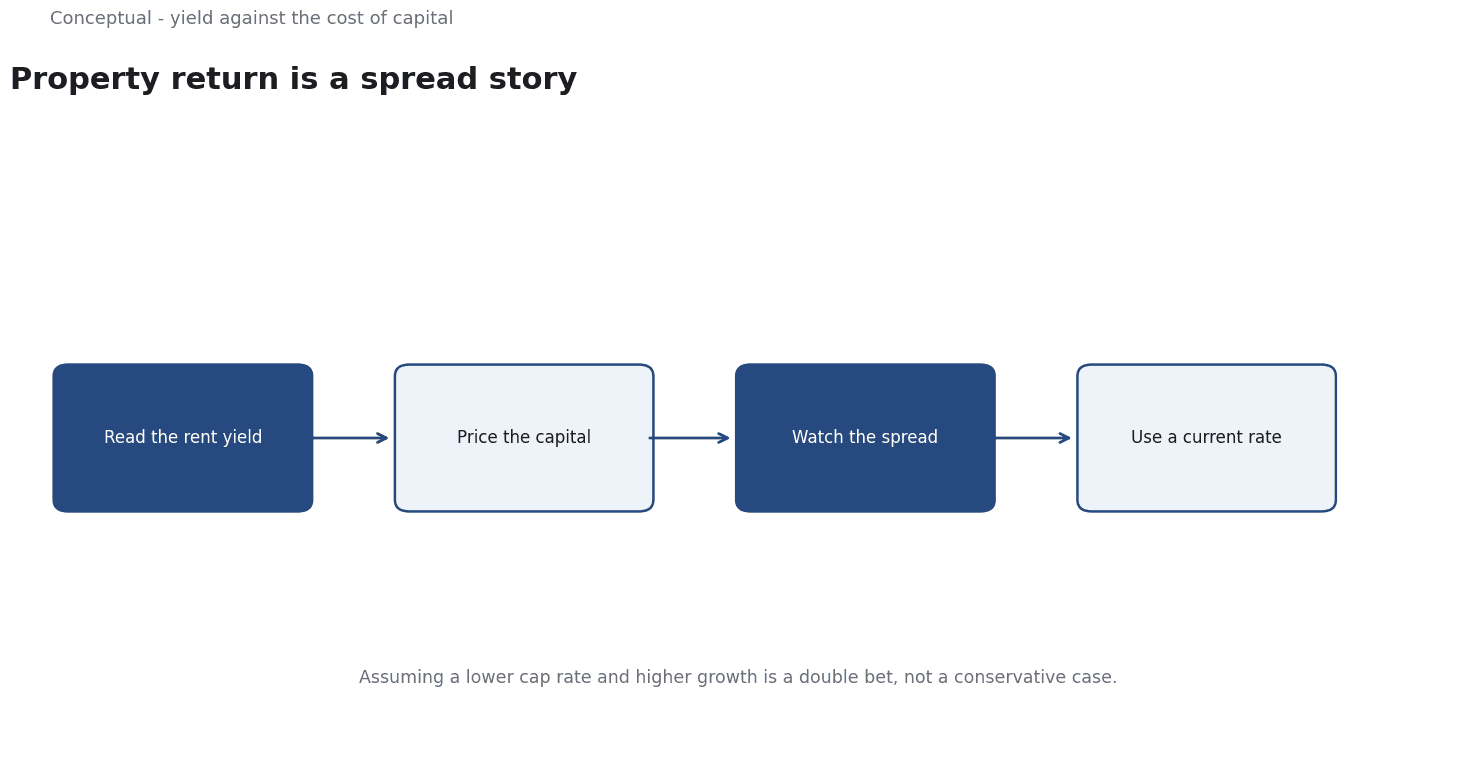
- Start with the yield and the capitalisation rate assumption. If the required yield is above the going-in yield, the investment depends on appreciation, and you should say so explicitly.
- Check the leverage and its maturity schedule. Debt-to-asset ratio tells you the sensitivity; the maturity ladder tells you when.
- Use the current rate environment, dated. Take the risk-free rate from the latest published release and record the observation date.
- Separate the income from the terminal value. For most REIT portfolios, a large share of the valuation is terminal. If the growth assumption is doing all the work, that is where the risk sits.
- Understand the sector. Nareit organises REITs by sector, and the sector determines the demand driver: office is a leasing and hybrid-work story, retail is an e-commerce and consumer story, data centres and industrial are tied to the physical build-out of technology.
- Distinguish leverage you chose from leverage you inherited. A conservatively levered REIT in a high-rate environment can be safer than an aggressively levered one in a low-rate environment. The absolute ratio matters less than the ratio relative to the cost of that debt.
The honest limitations
Two constraints should temper any confidence in a property analysis.
The first is that the inputs are forecasts, and they are the same forecast in both directions: a capitalisation-rate assumption and a growth assumption that are correlated.
The second is liquidity. Property and listed REITs are not interchangeable: a listed REIT trades daily but at a price that reflects sentiment as much as assets, while a direct property is illiquid and genuinely so. An investor who needs the cash in three years should not hold the same asset as one who does not, and the return required should reflect that.
For the rate environment that drives all of this, see Interest Rates and Their Effect on Technology Companies; for the valuation machinery, see Corporate Finance Essentials.
A worked example
The following is hypothetical and illustrative. Consider an equity REIT holding a hypothetical office portfolio with net operating income of 10 and a price of 200, a 5% going-in yield, financed with 40% fixed-rate debt. Three checks follow. First, take the risk-free rate from the latest published H.15 release and record its date; suppose the 10-year Treasury has moved from 4% to 5% since the last review, lifting the required yield above the property's 5% and pushing price down with rent unchanged. Second, inspect the maturity ladder: assume a quarter of the debt reprices within 18 months, so the higher rate arrives as a discrete refinancing event, not a gradual drag. Third, separate income from terminal value; if most valuation sits in an assumption that also presumes a lower cap rate and higher growth, that is a correlated double bet, not a conservative case. The outcome is bounded: the spread compresses, price falls toward the new required yield, and the position is reassessed against the investor's liquidity horizon. Nareit's taxonomy and FRED's dated series frame the checks; no real vehicle is implied.
A counterargument
A reasonable critic would object that the article reduces property analysis to a yield-versus-cost-of-capital spread while conceding, in the same breath, that operating REITs depend on execution and that listed REITs trade on sentiment as well as assets. Its framework has no term for either. The Nareit taxonomy it leans on is descriptive: it classifies equity, mortgage, and hybrid vehicles by what they hold, not by how they perform, and FRED supplies dated rates rather than the cap-rate and growth forecasts on which the article says the analysis actually rests. The spread is a clean statement of direction, not a mechanism that explains the drawdowns the opening paragraph promises to account for.
References & Further Reading
- Nareit, 2026. What is a REIT? — REIT basics, types, sectors, history, and the REIT directory — the industry body that defines the structure.
- Federal Reserve Bank of St. Louis, 2026. FRED economic data — The primary time-series database used for macro indicators.
- U.S. Securities and Exchange Commission (Investor.gov), 2026. Introduction to Investing — Primary regulator guidance on market mechanics and investor protection.