REIT Analysis: Common Questions
REITs look like stocks and behave partly like property. Read the questions that matter, a worked example, and what a high yield can hide.
A REIT is a company that owns income-producing property and distributes much of its income to shareholders, which makes it look like a cross between a stock and a bond. That hybrid nature creates questions that ordinary equity analysis does not answer: what is the property worth, how is the debt structured, and is the distribution covered, as the Nareit overview of the sector explains.
Direct answer:
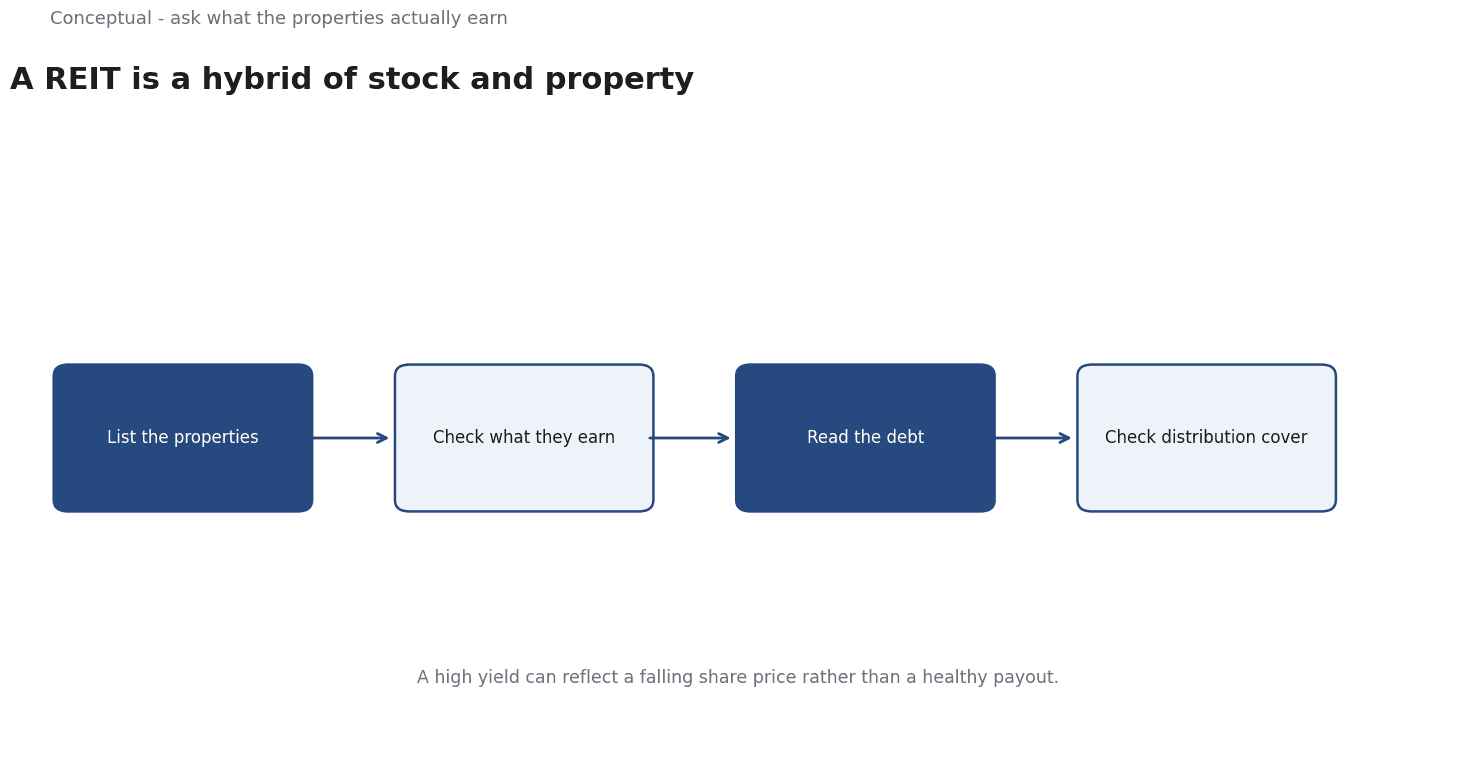
Analyse a REIT by asking what properties it owns, what they earn, how the debt is arranged, and whether the distribution is covered by recurring cash flow.
Nareit is the primary industry source for the structure, and investor education covers the risks of income investments. The boundary: this is educational orientation, not personalised advice — the figures are jurisdiction-specific and change, as Real Estate Markets: REITs, Property Cycles, and Investment Analysis treats property cycles as a source of variation, as the tax article requires a dated check.
The questions
What does it own? The property type, geography, and quality determine the income stream, which the real-estate article explains for how property cycles affect values, as the market-definition article advises for defining the market.
What do the properties earn? Occupancy, rent, and lease terms drive the cash flow, which the financial-statement article explains for how income is reported, as the free-cash-flow article requires for the cash actually generated.
How is it financed? Leverage, maturity dates, and interest costs decide what happens when rates rise or properties fall in value, which the debt-restructuring article treats as a covenant and refinancing question, as the fixed-income article explains for how rate changes transmit.
Is the distribution covered?
Three consequences follow. The metrics need a consistent period and definition, which the data-governance article requires for relied-upon figures. The yield should be read against the payout and the cash flow, as Dividend Policy and Share Buybacks advises. And the result should be recorded with the assumptions, as the decision-memo article requires.
A worked example
The following is hypothetical and illustrative. A REIT shows an 8% distribution yield, while a broad equity index yields 2%.
Three checks decide whether the yield is attractive. First, payout ratio: if distributions exceed recurring cash flow, the gap is being funded from debt or asset sales, which the free-cash-flow article treats as a structural problem, as Dividend Policy and Share Buybacks advises. Second, leverage and maturity: if a large share of debt refinances within two years at higher rates, interest cost will rise, which the debt-restructuring article explains for covenants and maturity. Third, property trend: if occupancy is falling in the REIT's main market, the income base is weakening, which the real-estate article treats as a cycle signal.
Three conclusions follow. The headline yield is a starting question, not an answer, which the dividend article argues for reading returns per share. A covered distribution with manageable debt is a different proposition from an uncovered one, as the cash-flow article explains. And the decision should be recorded with the checks, as the decision-memo article requires.
What REIT analysis cannot do
It cannot predict property prices, which the real-estate article treats as a question of cycles and valuation, as the valuation article requires conditional estimates. It cannot remove interest-rate risk, which the fixed-income article explains for how rates transmit, as the yield-curve article advises for reading conditions. And it does not replace tax advice, which the tax-efficient-investing article makes jurisdiction-specific.
The counterargument that a high yield always compensates for risk is wrong, which the worked example shows for an uncovered distribution, as Dividend Policy and Share Buybacks advises for reading the source of a payment.
A decision test
- Define the property types and markets, as Real Estate Markets: REITs, Property Cycles, and Investment Analysis advises.
- Check cash flow and payout coverage, as the cash-flow and dividend articles require.
- Review leverage and maturity, as the debt-restructuring article warns.
- Check occupancy and rent trends, as Real Estate Markets: REITs, Property Cycles, and Investment Analysis advises.
- Compare with peers using consistent definitions, as the comparables article requires.
- Check the tax treatment in your jurisdiction, as the tax article requires.
- Record the decision and the assumptions, as the decision-memo article requires.
For the sector context, see Real Estate Markets; for the income question, see Dividend Policy.
References & Further Reading
- Nareit, 2026. What is a REIT? — REIT basics, types, sectors, history, and the REIT directory — the industry body that defines the structure.
- U.S. Securities and Exchange Commission (Investor.gov), 2026. Introduction to Investing — Primary regulator guidance on market mechanics and investor protection.