Rebranding Without Losing Recognition
A rebrand changes meaning, not just appearance. Read what to preserve, a worked migration, and why recognition is the risk.
Rebrands are often framed as cosmetic — new logo, new colours — which underestimates the risk. Recognition is an asset built over years, and a change that discards it forces the market to relearn who you are. The useful question is not whether a rebrand looks better but what meaning must survive it.
Direct answer: Preserve the promise, the recognisable identifiers, and the equity in what customers already know, while changing what no longer fits. Brand-management principles treat identity as a maintained asset, and the brand-guidelines article covers what should travel intact. The boundary: a rebrand cannot fix a weak product or a broken promise, which the value-proposition article argues, and recognition effects take time to measure, as Brand Awareness Metrics That Are Actually Useful explains.
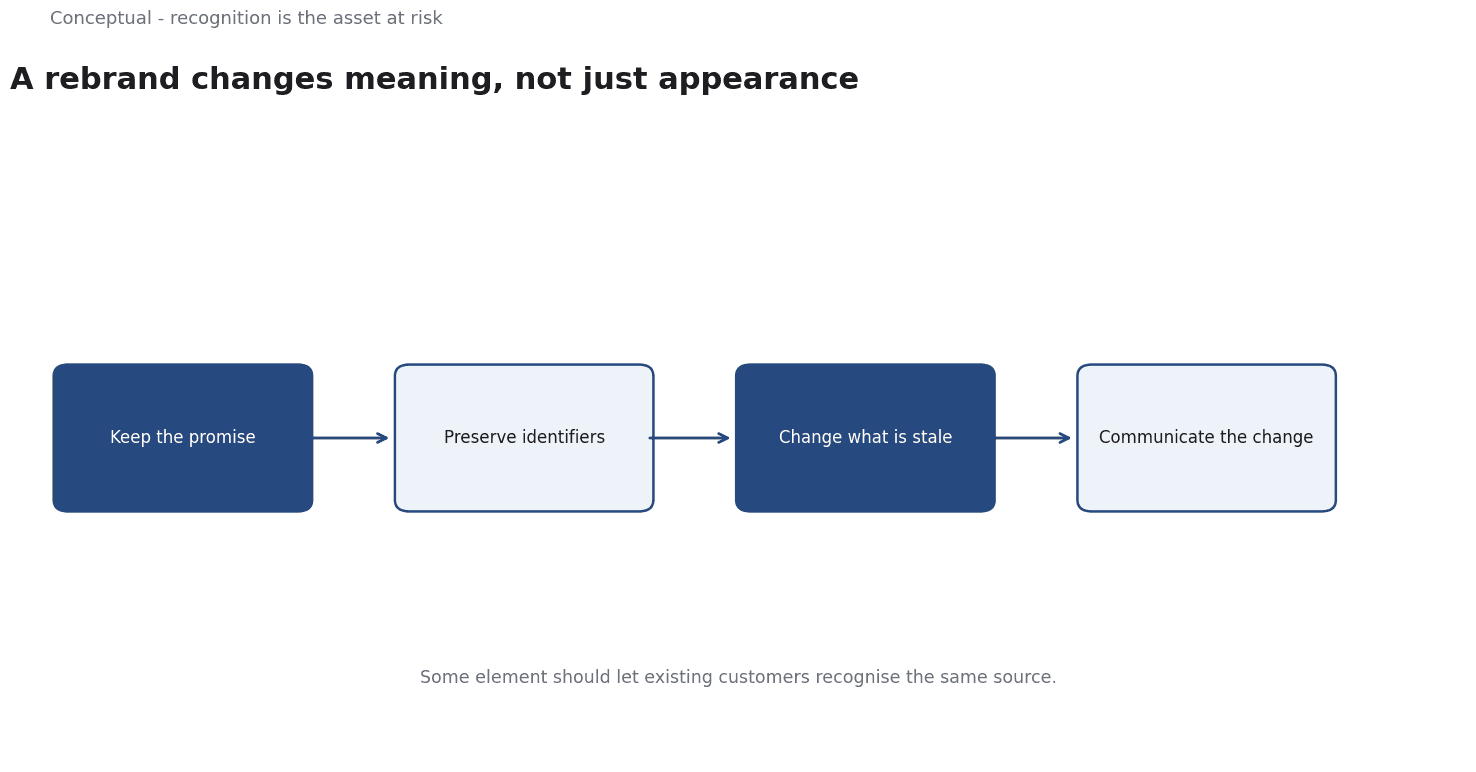
What to preserve
The core promise. What customers rely on should remain true and clearly stated, as the value-proposition article requires.
Recognisable identifiers.
Some element — a name, a colour, a mark, a voice — should let existing customers recognise the same source, which the brand-consistency article treats as the meaning that must travel intact.
The evidence. Customer relationships and the proof behind the brand are part of its equity, which the advocacy article covers as credible voices.
What can change
Visual expressions that no longer fit the channels, as Visual Identity Systems: More Than a Logo explains for context.
The vocabulary if terms have drifted, which the naming article treats as a maintained asset.
The positioning if the market has genuinely changed, which the positioning-workshop article frames as a decision with a test.
Three consequences follow:
- Change one thing at a time where possible, which the A/B testing article recommends for attributing effects.
- Recognition is the risk, which the brand-awareness article measures through recall and direct signals.
- The promise is the anchor, which the value-proposition article treats as the thing not to lose.
A worked migration
The following is hypothetical and illustrative.
A company updates its visual identity while keeping its name and promise. The migration plan:
- Audit recognition. Survey a defined sample with AAPOR-style wording — what do you associate with this brand? — to see what customers actually recognise, as Brand Awareness Metrics That Are Actually Useful recommends.
- Preserve the anchors. Keep the name and one distinctive identifier, which the brand-consistency article treats as the continuity element.
- Stage the rollout. Update digital channels first, then documents and physical touchpoints, with a clear date for each, as the website-migration article recommends for infrastructure checklists.
Three checks decide whether the rebrand worked:
- Recognition over time — does the target audience still identify the brand, as the brand-awareness article measures?
- Direct traffic and branded search — do the signals hold, which the geo-lift article helps separate from background trends?
- Customer comprehension — do people still understand what the company does, which the value-proposition article treats as the core test?
Three conclusions follow:
- The change is staged, which limits the risk of a sudden recognition drop, as the migration article advises.
- Evidence is gathered before, which turns the rebrand into a test rather than a hope, as the decision-memo article recommends.
- The promise is unchanged, which the consistency article treats as the continuity that matters.
Communicating the change
A rebrand that surprises customers creates confusion. Three practices make the transition legible:
Tell people why. A short explanation of what changed and why gives existing customers a reason to follow the new identity, which the value-proposition article treats as a clear statement of what the company stands for.
Announce where it matters. Customers encounter the brand in specific places; the change should be explained at those touchpoints, which the marketing-communications article treats as coordinated messaging.
Equip the people who represent the brand. Sales and support need the new language and the reasoning, which the brand-guidelines article covers as the decision rule communicated to a team.
These practices reduce the chance that a rebrand is read as instability, which the reputation article treats as a trust issue.
What a rebrand cannot do
It cannot fix a product problem.
It cannot manufacture preference. Recognition is not the same as trust, which the brand-awareness article distinguishes from favourability.
It is not free. Design, rollout, and relearning cost money and attention, which the marketing-budget article treats as allocation decisions.
The counterargument — that a rebrand signals change to the market — is valid when the underlying change is real and testable, as the positioning workshop article recommends for claims that must be supported.
A decision test
- State what must survive — the promise and the identifiers, as the guidelines article recommends.
- Audit current recognition with AAPOR-style wording, as Brand Awareness Metrics That Are Actually Useful advises.
- Change one dimension at a time where possible, which the A/B testing article recommends.
- Stage the rollout with dates, as the migration article requires.
- Measure recognition and comprehension against a baseline, as Brand Awareness Metrics That Are Actually Useful explains.
- Keep the promise true, which the value-proposition article requires.
- Review on a longer horizon, which the brand-lift article treats as necessary for preference effects.
For the identity system, see Visual Identity Systems; for the measurement, see Brand Awareness Metrics.
References & Further Reading
- Wikipedia contributors, 2026. Brand management - Wikipedia — The discipline of maintaining a brand across touchpoints; secondary reference used for channel consistency.
- Wikipedia contributors, 2026. Marketing communications - Wikipedia — The coordination of messages across channels and the distinction between consistent and identical communication.