Receivables Management in Practice
A bounded guide to accounts receivable and working capital: how to collect cash faster, what each collection lever costs, and where pushing too hard damages the business.
Money that a customer owes is not money the business can spend. A company can show strong sales and still struggle to pay suppliers because its invoices sit unpaid for weeks. Receivables management is the discipline of turning those promises into cash on a predictable schedule, and it sits directly on the line between accounting profit and survival.
Direct answer: Receivables management means setting clear payment terms, invoicing accurately, and following up systematically so that owed money arrives on time. It improves cash flow without changing sales, but it has costs: discounts, staff time, and the risk of straining customer relationships. The goal is predictable collection, not the fastest possible demand.
Delta: This article adds a bounded cost map beyond the sources: it maps the accounts receivable and working capital concepts to the specific decision of how hard a firm should push to collect, with claim status made explicit.
The mechanism
The Wikipedia entry on accounts receivable describes a receivable as a claim for payment that arises when a business delivers goods or services on credit. It is recorded as an asset, yet it is not cash. The practical consequence is that the balance sheet can look healthy while the bank account is empty, because the asset only becomes useful when the customer pays. That gap is why receivables deserve active management rather than passive record-keeping. A balance that grows without a matching inflow of cash is a warning sign, not a sign of growth, and it should be investigated before it is celebrated.
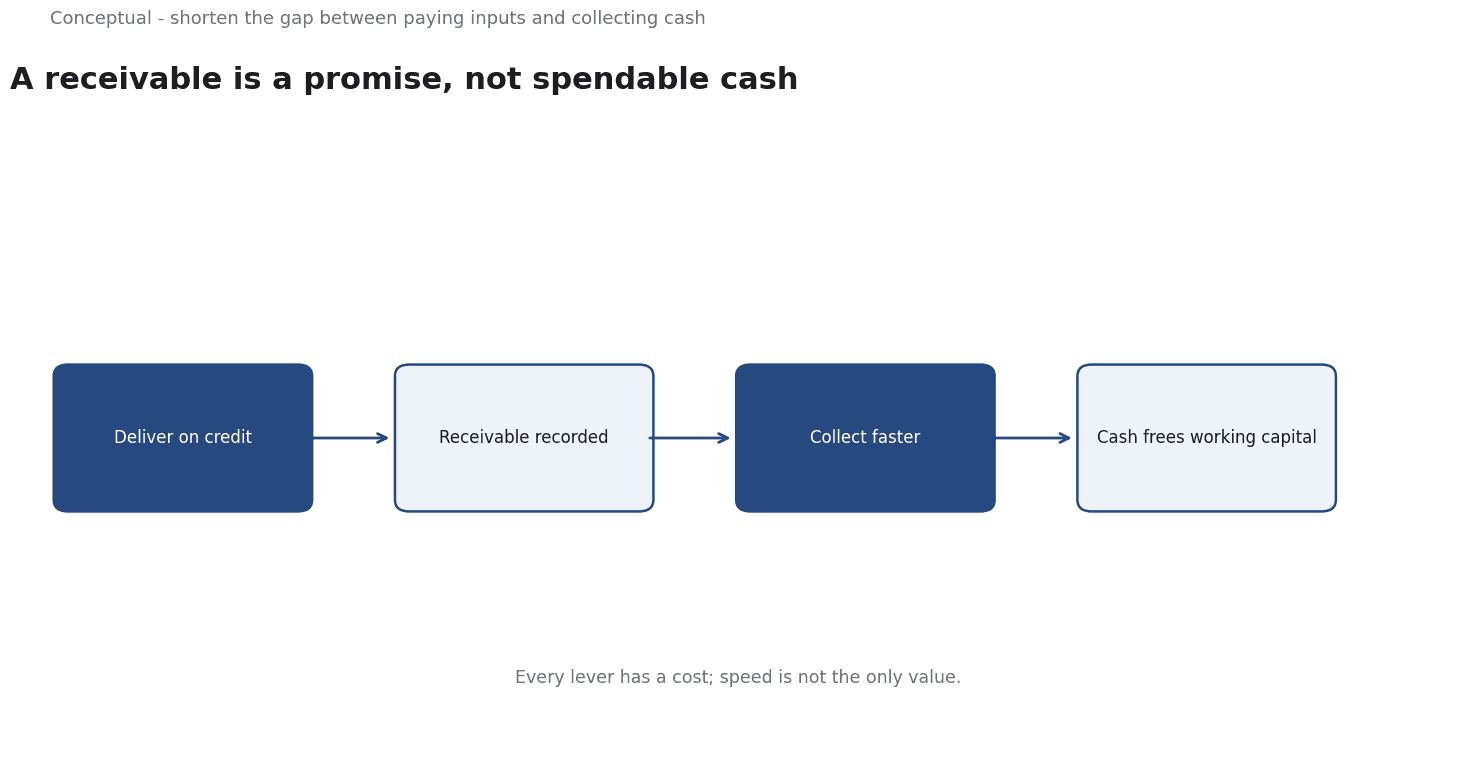
The Wikipedia entry on working capital defines it as current assets minus current liabilities, with receivables forming one part of current assets. Seen this way, an unpaid invoice is cash trapped in the operating cycle. When a firm collects faster, it releases that cash and reduces the capital it needs to fund day-to-day operations. The mechanism is arithmetic: the sooner money arrives, the shorter the interval between paying for inputs and receiving payment for outputs.
Shortening that interval is the lever that receivables management pulls, and it can improve liquidity without selling more or borrowing more from a lender.
The levers are ordinary but powerful. Clear terms state when payment is due and what happens if it is late. Accurate invoicing removes the disputes and errors that delay payment, because a customer will not pay an invoice it cannot reconcile. Systematic follow-up turns collection from a reaction into a schedule, so that reminders go out before an invoice is overdue rather than after it has aged. Each lever has a cost: earlier terms may require discounts, and persistent follow-up consumes staff time. Effective management weighs those costs against the value of cash arriving sooner, rather than assuming that faster is always better.
A worked example
The following is hypothetical and illustrative. A supplier sells on thirty-day terms and carries an average of one hundred thousand dollars in unpaid invoices. Its finance team tests three checks. First, aging: it sorts invoices by how long they have been overdue and finds that a fifth are past sixty days. Second, dispute rate: it discovers that a quarter of the late invoices contain a pricing error, so the delay is internal rather than a customer problem. Third, collection cost: offering a two percent discount for payment within ten days is costed against the value of cash arriving twenty days earlier. The outcome is targeted rather than blanket: fix the invoicing errors first, offer the discount only to slow payers, and reserve firm follow-up for the small set that ignores both. The blanket policy of chasing every invoice equally would have spent effort on customers who were never the problem.
Evidence status
| Claim | Status | Source | Verified | Recheck when |
|---|---|---|---|---|
| A receivable is a claim for payment from a credit sale | source-reported | Wikipedia (Accounts receivable) | 2026-11-18 | if accounting definitions are revised |
| Working capital includes receivables as a current asset | source-reported | Wikipedia (Working capital) | 2026-11-18 | if reporting standards change |
| Faster collection frees cash without increasing sales | inferred | Derived from the sources | 2026-11-18 | if evidence links tighter terms to churn |
The table separates definitions from the practical claim. The two source-reported rows are stable accounting descriptions. The inferred row follows from the working-capital arithmetic but assumes that customers do not react badly to tighter terms. That assumption is the weak point: if pressure to pay drives customers away, the cash gained today may cost more than it is worth. Treat the row as a hypothesis to test against your own collection data.
What it cannot do
Receivables management cannot create sales. It can only accelerate money that is already owed, so a business with weak demand will still struggle after its collections improve. There is a temptation to read a falling days-sales-outstanding figure as evidence that the company is performing better, when it may only mean that the finance team has become more persistent. The discipline operates on timing, not on volume or value. A firm that needs growth must look elsewhere, and should not let a clean receivables report mask a declining order book. Faster collection is a benefit, but it is a benefit on a small and bounded scale.
The hidden cost is in relationships and administration. Every hour spent chasing an invoice is an hour not spent on something else, and aggressive follow-up can annoy customers who were simply following their own payment cycle. A firm that pushes too hard may win the cash and lose the account. Offering discounts to collect sooner also has a real price: a two percent discount is a two percent reduction in revenue, and on thin margins that is significant. Effective management accounts for these costs explicitly rather than celebrating faster collection in isolation. The discount may be rational in one case and wasteful in the next, depending on what the customer would have done anyway.
Days-sales-outstanding can be improved by pressuring easy payers, offering discounts to customers who would have paid on time anyway, or tightening terms at the risk of losing business. Each move makes the number look better while leaving the underlying cash position barely changed, or worse. The measure becomes a target and stops being informative. Teams that manage to the number rather than to actual cash inflow will eventually be surprised when a large customer slips and the polished average conceals a concentrated risk. An average can look calm while one overdue account dominates the exposure.
There are boundaries where the discipline has little to offer. A business that sells only for immediate payment has no meaningful receivables to manage. Where terms are fixed by contract, regulation, or a dominant customer, the firm has limited room to change them. And in markets where credit is the norm, demanding faster payment than competitors may cost more in lost sales than it gains in liquidity. In these cases the effort is better spent on forecasting and on the terms agreed at the point of sale, not on chasing invoices after the fact. Policy at the moment of sale matters more than pressure applied weeks later.
The policy also needs review. Customer behaviour changes, a large account can shift from reliable to slow, and the economy can turn a small bad-debt provision into a real loss. Terms that were reasonable when a customer was small may be inappropriate after it grows. A firm should revisit its collection policy on a regular cycle, look at the aging of the balance rather than just the average, and adjust provisions when the risk mix changes. Without that review, a receivables process that once worked quietly accumulates unpaid or uncollectable balances. What was once a disciplined routine can become a source of quiet losses.
The counterargument that cash is always better than a receivable is fair for liquidity and incomplete for relationships.
Cash collected today by pressuring a reliable customer can cost more in future orders than the early payment is worth, so speed is not the only value at stake in a collection decision.
A decision test
- Sort outstanding invoices by how long they have been overdue.
- Identify the share of late invoices caused by internal errors.
- Estimate the cost of each collection lever before using it.
- Set clear terms and make them visible at the point of sale.
- Apply discounts only where the cash gained exceeds the discount.
- Watch the aging of the balance, not just the average collection period.
- Review the policy periodically and adjust for large or changing customers.
The test only helps if it leads to a decision about where to spend effort. Most receivables problems are concentrated in a small share of invoices, and a targeted response beats a blanket one. Assign an owner, record the thresholds that trigger action, and revisit them as the customer mix changes rather than treating collection as a fixed routine.
For related context, see Cash Flow Forecasting: A 13-Week Operating Model.
References & Further Reading
- Wikipedia contributors, 2026. Accounts receivable - Wikipedia — Amounts owed to a business by customers.
- Wikipedia contributors, 2026. Working capital - Wikipedia — Current assets minus current liabilities, and why a growing business can be cash-constrained; secondary reference.