Referral Loops for Small Teams
A referral loop grows through recommendations, not reach. Read how to build one, a worked example, and why an incentive can break it.
Referral loops are often reduced to a reward for sharing, which ignores that the loop depends on a customer choosing to recommend something. The referral entry describes structured incentives, and the word-of-mouth entry covers how recommendations spread. The design starts with the reason to recommend.
Direct answer: Build a loop around a product worth recommending, make sharing easy, and measure referred customers who stay. The sources describe the channel; the method is a synthesis.
Delta: This article adds a claim-status table and a worked example, separating documented channel behaviour from local judgements about incentives.
The mechanism
The first point is the reason. The word-of-mouth entry describes recommendations between people, which happen because the recommender has something to gain socially by being useful. A reward can support that reason but cannot replace it, and a loop built only on a discount attracts people who want the discount.
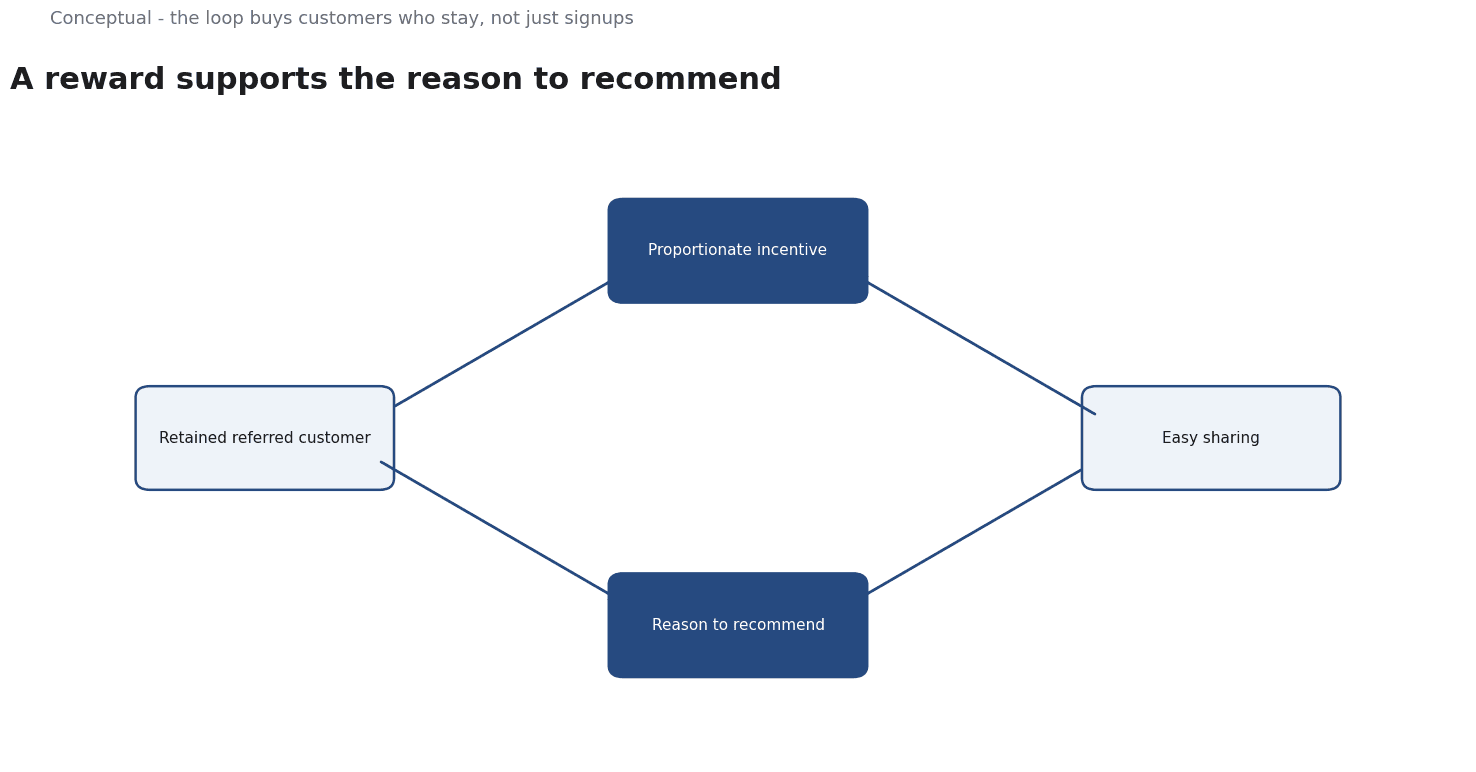
The second point is friction. The referral entry describes structured programmes, which work when the act of sharing is easy. A link that requires several steps will be abandoned, and the loss is invisible in a report that counts only people who completed it.
The third point is quality. A referred customer who leaves quickly is a cost, not growth. Measuring retained referred customers, rather than signups, is the measure that reflects whether the loop works.
The sequence is: define the reason, remove friction, add a proportionate incentive, then measure retention. The choices are local, so the conclusions are inferred; the channel is source-reported.
A worked example
Illustrative. A small tool offers a credit for every signup a customer refers.
Three checks decide. First, would customers recommend the tool without the credit, and what does the credit change? Second, how many steps does sharing take, and where do people abandon it? Third, do referred customers stay, or do they churn after the credit is used?
The outcome is a loop design with a recorded limit. The scenario is hypothetical; the method is the contribution.
Evidence status
| Claim | Status | Source | Verified | Recheck when |
|---|---|---|---|---|
| Referral programmes structure incentives | source-reported | Wikipedia, Referral program | 2026-11-18 | Practice changes |
| Recommendations spread through word of mouth | source-reported | Wikipedia, Word of mouth | 2026-11-18 | Definition changes |
| Measure retained referred customers | inferred | Derived from both | 2026-11-18 | Product changes |
Why an incentive can break the loop
A reward changes who refers and why. Customers who refer only for the credit may send links to people who are not a fit, and the resulting churn costs more than the signups are worth. The incentive should support an existing reason rather than invent one.
A further consideration is whether the reward is proportionate. A large credit can make the referral feel transactional, while a small one may not be noticed, and the right level depends on the value of a retained customer. Setting it from that value rather than from a competitor's programme is the practical rule.
The loop also needs to survive fraud.
Verification is part of the design, not an afterthought added once the numbers look suspicious.
The third limit is that a loop can saturate. A small team's customers know a finite number of people who need the product, and a programme that works at first will slow as the network is covered. Watching the rate over time is the way to distinguish saturation from a broken incentive.
A reward that replaces the reason to recommend buys signups, while one that supports it buys customers who stay.
The loop depends on a product worth recommending, which no incentive can manufacture.
Retention of referred customers is the measure, not the count of links shared.
A self-referral is a signup with no value, which is why verification belongs in the design.
Saturation is the limit of a finite network, not a failure of the incentive.
Sharing friction is invisible in a report that counts only completed referrals.
A loop that depends only on a reward buys signups rather than customers who stay.
The incentive should support the reason to recommend, not replace it.
A decision test
- Define the reason to recommend.
- Remove steps from sharing.
- Add a proportionate incentive.
- Check for self-referral.
- Measure retained referred customers.
- Record the design and recheck date.
For the programme, see Referral Programs.
A counterargument
A reasonable critic would note that the article's governing principle is itself one of its own inferred judgements. The cited sources establish that recommendations spread by word of mouth and that referral programmes structure incentives; neither shows that a reward displaces an existing reason to recommend. Yet the article repeats the claim that a reward buys signups rather than customers who stay as if it were settled, and its own evidence-status table marks the retention measure as inferred. The worked example is labelled illustrative, and the decision test is local, so the argument is honest about its status. The problem is emphasis: a plausible caution about incentives is presented as the mechanism of the loop, a weight the two general references do not bear.
References & Further Reading
- Wikipedia contributors, 2026. Referral marketing - Wikipedia — The mechanisms and incentives of referral marketing programmes.
- Wikipedia contributors, 2026. Word of mouth - Wikipedia — How recommendations spread between customers.