Referral Program Metrics that Matter
A referral is a recommendation with an incentive attached. Read the metrics, a worked example, and why a reward can corrupt the signal.
Referral programmes are often judged by the number of invites sent, which measures the incentive rather than the recommendation. The referral entry and viral-marketing entry describe growth driven by word of mouth, as the referral-design article treats incentives and fraud as linked, as the dashboard article argues for metrics tied to decisions, as the evaluation-rubric article requires for concrete criteria.
Direct answer: Measure referrals by qualified conversions, retention of referred customers, and fraud-adjusted cost, not by invites or signups. The referral entry provides the structure, and viral marketing covers the growth loop. The boundary: an incentive can change who refers and why, which the discount article warns about, as the publication standard forbids guaranteed outcomes, as the risk-assessment article requires residual risk.
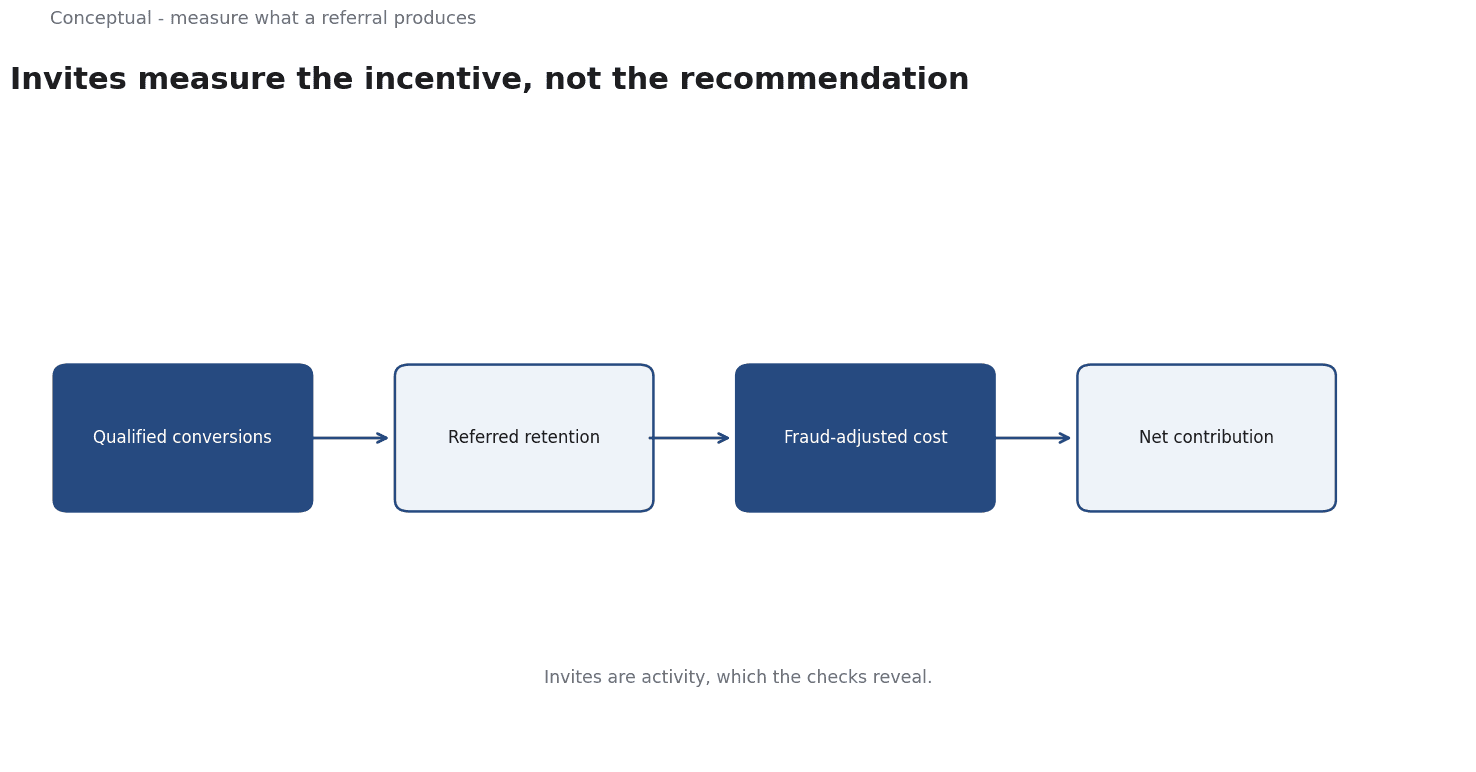
The metrics
Qualified conversion. How many referred signups become customers that fit the target, which the funnel article treats as a stage measure, as the evaluation-rubric article requires for concrete criteria, as the market-definition article advises on defining the target.
Retention of referred customers. A referred customer who churns immediately is a cost, which the retention article treats as an economic choice, as the retention-analytics article advises for grouping, as the unit-economics article requires for contribution.
Fraud-adjusted cost.
Incremental lift. How much of the conversion was caused by the programme, which the geo-experiment guidance tests with a comparison, as the causal-inference article treats as a different question, as the correlation article warns about association.
Three consequences follow. The metric should be tied to a decision, as the dashboard article argues, as the rubric article requires. The incentive should be checked for abuse, as the referral-design article advises, as the discount article warns about signals. And the result should be reviewed, as the monitoring article treats as a trigger.
A worked example
The following is hypothetical and illustrative. A programme pays for each signup and reports 5,000 invites and 500 signups.
Three checks decide whether it works. First, how many signups became retained customers, as the funnel and retention-analytics articles require, with contribution, as the unit-economics article requires? Second, how many were self-referrals or abuse, as the referral-design and fraud articles advise, with a fraud-adjusted cost, as the risk article requires? Third, how much conversion was incremental, as the experiment guidance and causal-inference article recommend, rather than customers who would have joined anyway, as the attribution article warns about credit rules?
Three conclusions follow.
Invites are activity, which the checks reveal.
Fraud and self-referral distort the signal, as the referral-design and fraud articles advise. And the decision should be recorded with the incremental estimate, as the decision-memo article requires.
Why the incentive is part of the measurement
The reward changes who participates, which the referral-design article treats as a design problem, as the discount article warns about incentives that train customers to wait, as the survey-design article advises for neutral wording where feedback is collected, as AAPOR's standards require for transparent reporting. A programme that pays for invites will produce invites, which the dashboard article treats as activity rather than an outcome, as the evaluation-rubric article requires for concrete criteria, as the decision-memo article requires for a recorded judgement.
That is why the metric should sit close to the decision the programme is meant to change, which the dashboard article argues, as the funnel article advises for stage measures, as the retention-analytics article advises for grouping customers by start period, as the unit-economics article requires for contribution, as the attribution article warns about credit rules, as the risk-assessment article requires residual risk to be stated.
What referral metrics cannot do
They cannot prove causation from a tracked link, which the attribution article treats as a credit rule, as the experiment guidance recommends for comparisons, as the causal-inference article warns. They cannot remove fraud, which the referral-design article treats as a design problem, as the risk article requires residual risk. And they do not guarantee retention, which the retention article treats as a separate economic question, as the publication standard forbids guaranteed outcomes.
The counterargument that invites are the simplest signal is fair for reach and incomplete for conversion and incrementality, which the worked example shows, as the dashboard article argues for metrics tied to decisions.
A decision test
- Measure qualified conversion, as the rubric article requires.
- Track retention of referred customers, as the retention-analytics article advises.
- Adjust for fraud, as the referral-design and fraud articles require.
- Estimate incremental lift, as the experiment guidance recommends.
- Treat tracked links as credit rules, as the attribution article warns.
- Check the incentive for signal distortion, as the discount article advises.
- Record the decision and residual risk, as the decision-memo article requires.
For the design, see Referral Marketing Design; for the measurement, see What Referral Programs Measure.
References & Further Reading
- Wikipedia contributors, 2026. Referral marketing - Wikipedia — The mechanisms and incentives of referral marketing programmes.
- Wikipedia contributors, 2026. Viral marketing - Wikipedia — Growth driven by word of mouth and referral loops.