Referral Marketing: Design, Incentives, and Fraud
Referrals grow when the reward matches the value and abuse is designed out. Read the mechanics, a worked programme, and the fraud controls.
Referral programmes look simple: give existing customers a reward for bringing new ones. The difficulty is that the reward can attract the wrong behaviour — self-referrals, fake accounts, or existing customers reclassified as new. A programme that ignores this pays for growth it did not create.
Direct answer: Design referrals around a verified conversion, an incentive proportional to the value of that conversion, and fraud controls that make abuse expensive. AAPOR's standards are relevant when surveying referred customers about their experience, and demand-generation principles explain which decision a referral serves. The boundary: a referred signup is not an incremental customer — a holdout is needed to estimate how many would have arrived anyway, as Marketing Attribution: Multi-Touch Models, Incrementality, and Budget Allocation explains.
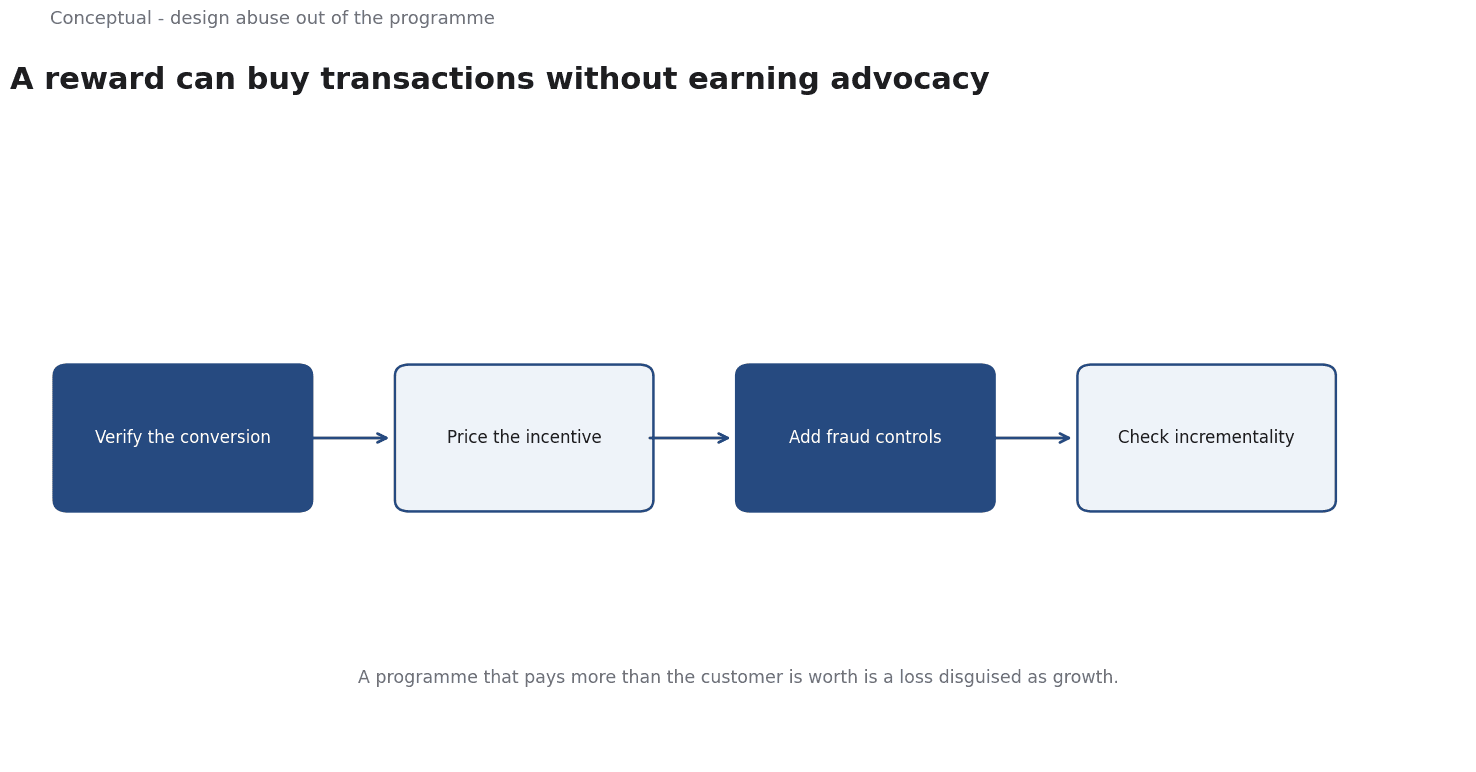
Three design decisions
What triggers the reward? A signup is cheap to fake; a completed first purchase or retained subscription is harder. The trigger should match the value the business receives, which the unit-economics article explains for contribution margin.
What is the incentive? Cash, credit, or a feature unlock each attract different behaviour.
How is abuse detected? Self-referral, duplicate accounts, and device or payment patterns are common signals. The control is a check at the reward trigger, not a manual review after payouts, which the security checklist recommends for consequential actions.
A worked programme
The following is hypothetical and illustrative.
A subscription product pays 20 credit to an existing customer when a referred friend completes a paid month. Design checks:
- Trigger — reward after the first paid month, not at signup, which removes cheap fake accounts, as the loyalty article recommends for measured behaviour.
- Incentive — 20 credit against a 30 monthly plan is a meaningful reward; the margin on one retained month must cover it, which the unit-economics article explains.
- Controls — reject referrals sharing a payment method or device, and cap rewards per customer per month, as the fraud checks in the security checklist suggest.
Measured over a quarter:
- 1,000 referrals triggered a reward.
- 80 were blocked by duplicate-payment or device checks.
- A holdout of similar non-referred prospects showed that 30% of the remaining 920 would have subscribed anyway.
Three conclusions follow:
- The naive programme would have paid for 1,000 conversions; the incrementality estimate is closer to 644.
- Fraud controls matter before the payout, not after, which the risk-assessment article argues.
- The reward must fit the margin, which the discount-strategy article treats as a first-order question.
Choosing the incentive
The reward shape changes who participates. Three options have different effects:
Account credit suits products with repeat use, because it drives another purchase, as the loyalty article explains for points that change behaviour.
Cash is universal but attracts people motivated by the payout rather than the product, which the discount-strategy article warns about for incentives that teach customers to wait for a reward.
Feature unlocks suit products where an extra capability has low marginal cost and high perceived value, which the freemium-conversion article covers as a boundary decision.
In each case the reward should be priced below the contribution margin of the behaviour it triggers, which the unit-economics article explains.
A programme that pays more than the customer is worth is a loss disguised as growth.
Detecting abuse early
Fraud controls should be designed before launch, because retrofitting them after payouts is expensive and unpopular. Three signals are worth instrumenting:
Shared identifiers. Multiple referred accounts using the same payment method, device, or address is a common pattern, which the security checklist treats as a boundary control.
Timing anomalies. Referrals that cluster in a few minutes or come from accounts created at the same time suggest automation rather than word of mouth, which the anomaly-detection article covers as a pattern to flag.
Reward concentration. A single referrer producing an unusual share of conversions deserves review, which the retention article warns about for averages that hide concentration.
Each signal should trigger a check, not an automatic rejection, because legitimate patterns can look similar, which the anomaly-detection article explains for false positives.
What referral programmes cannot do
They cannot create preference. A friend's recommendation helps when the product is good; it amplifies the truth rather than replacing it, as Demand Generation vs Lead Generation: Where the Funnel Breaks explains.
They cannot be measured by signup counts. Referred signups include people who would have arrived anyway, which the attribution article covers as the counterfactual problem.
They cannot run without trust. A programme that rewards spam damages the brand, which the online-reviews article treats as a reputation risk.
The counterargument — that referrals are the cheapest acquisition channel — is often true on an attributed basis and depends on the incrementality estimate, which the marketing-attribution article explains.
A decision test
- Set the reward trigger at a verified, valuable event.
- Price the incentive against contribution margin, as the unit-economics article recommends.
- Add fraud controls at the trigger, with a cap per customer.
- Measure incrementality with a holdout where the spend is material, as the geo-experiment guidance recommends.
- Survey referred customers with AAPOR-style wording if you ask about experience.
- Monitor abuse signals with an owner, as the observability article requires.
- Re-evaluate after a reward or product change, as the monitoring article advises.
For acquisition context, see Demand Generation vs Lead Generation; for the measurement, see Marketing Attribution.
References & Further Reading
- American Association for Public Opinion Research, 2026. AAPOR — The professional association for public opinion and survey research; its standards and resources underpin the survey-design discussion.
- Wikipedia contributors, 2026. Demand generation - Wikipedia — An overview of demand generation as a marketing discipline distinct from lead generation; secondary reference used with the lead-generation entry.