REIT Analysis Best Practices
REIT analysis combines property income with a distribution requirement. Learn the source definitions, a worked statement example, and where the method breaks.
A real estate investment trust is often screened with the same metrics as an operating company, which hides the constraint that defines it. The Nareit entry defines a REIT and describes its distribution requirement, while the Wikipedia financial statement entry sets out the statements analysts read. The real problem is that a REIT's income is governed by a payout rule that makes statement-level analysis essential.
Direct answer: A REIT is a company that owns income-producing real estate and must distribute most of its taxable income to shareholders. The sources define that structure and the statements used to examine it.
The bounded answer is that REIT analysis starts from the distribution rule and reads the income statement, balance sheet, and cash flow statement together.
Delta: This article adds a claim-status table and a statement decision test beyond the sources: it maps each disclosure to a coverage or leverage decision, with claim status explicit.
The mechanism
Nareit defines a real estate investment trust as a company that owns, operates, or finances income-producing real estate. A defining condition is that it must distribute at least ninety percent of its taxable income to shareholders. That rule changes how the entity should be read: retained earnings are limited by design, so growth depends on access to capital rather than on plowing back profits. The practical consequence is that an analyst cannot treat a high distribution as a sign of generosity; it is largely a structural obligation.
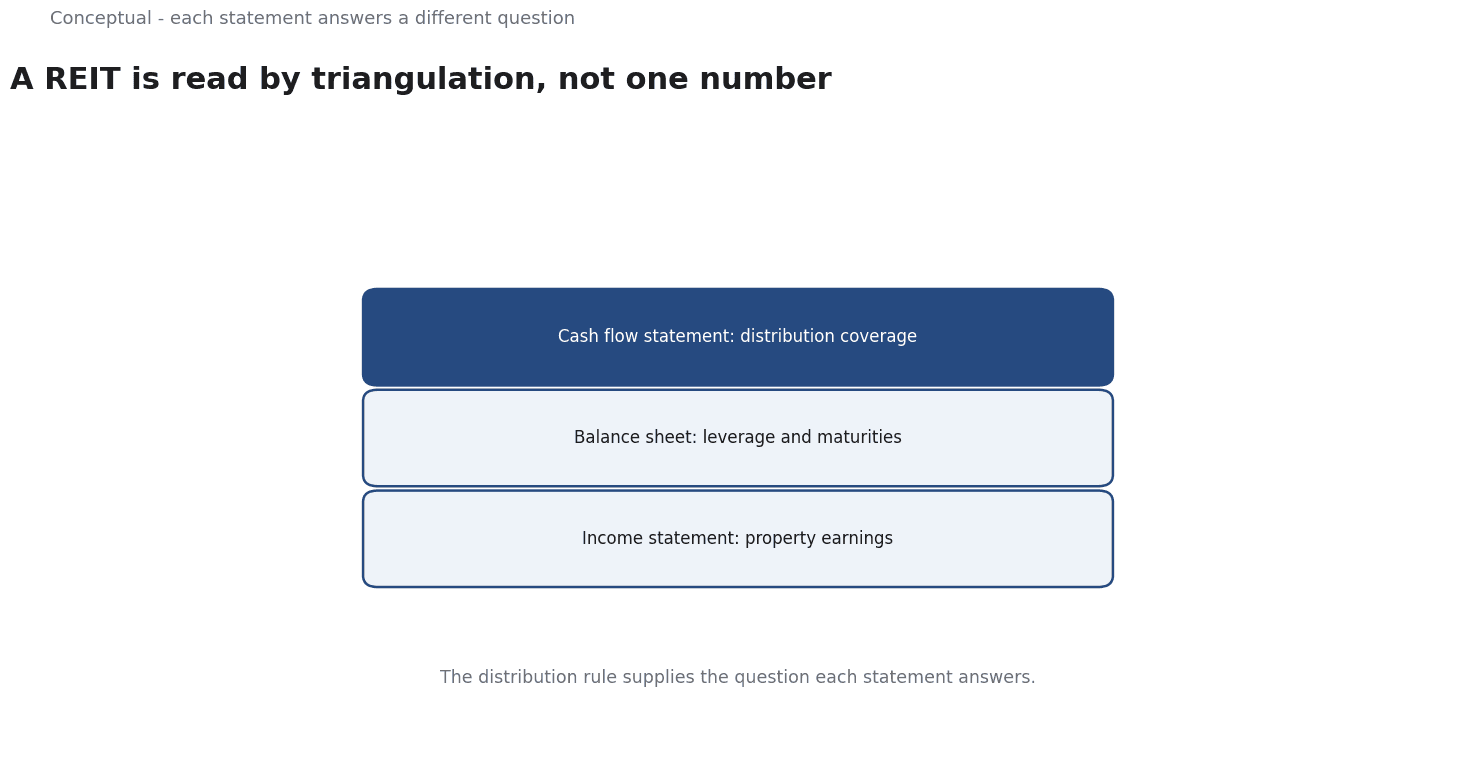
The Wikipedia entry on financial statements sets out the core reports: the balance sheet, the income statement, and the cash flow statement. The balance sheet shows assets, liabilities, and equity at a point in time; the income statement shows revenue and expenses over a period; the cash flow statement shows where cash came from and where it went. For a REIT, each report answers a different question. The income statement shows property-level earnings, the balance sheet shows the debt used to buy properties, and the cash flow statement shows whether the distribution was paid from operating cash.
Reading one statement alone produces a misleading picture. A REIT can report strong earnings while carrying debt that matures soon, or report modest earnings while generating steady cash from a large portfolio. The mechanism that makes the analysis work is triangulation: test the distribution against operating cash flow, test leverage against the balance sheet, and test earnings quality against the income statement. The distribution requirement supplies the question each statement must answer.
The output is a set of judgements about coverage, leverage, and capital access, not a single valuation number. The sources define what a REIT is and what the statements contain; they do not supply a valuation model or a target payout ratio. Those are analyst choices. The discipline is to keep each choice explicit, so a reviewer can see whether a conclusion rests on earnings, cash, or the balance sheet.
A worked example
The following is hypothetical and illustrative. An analyst reviews a hypothetical REIT that reports a distribution yield in line with its peers. Three checks frame the review. First, is the distribution covered by operating cash flow rather than by earnings alone? Second, does the balance sheet show debt maturities clustered in a single year? Third, does the income statement show that property revenue grew while expenses stayed flat? The review finds that cash flow covers the distribution but that a large maturity sits within eighteen months. The conclusion is a refinancing risk note, not a sell decision. The numbers are hypothetical; the verification method is the contribution.
Evidence status
| Claim | Status | Source | Verified | Recheck when |
|---|---|---|---|---|
| REITs must distribute most taxable income to shareholders | source-reported | Nareit, What is a REIT | 2026-11-18 | Tax rule changes |
| Financial statements include balance sheet, income statement and cash flow statement | source-reported | Wikipedia, Financial statement | 2026-11-18 | Definition revised |
| Distribution coverage should be tested against operating cash flow | inferred | Derived from the sources | 2026-11-18 | Payout practice changes |
The first two rows report definitions: the REIT distribution rule and the standard financial statements. The third is an inference about which statement should test coverage, because neither source recommends a metric. Recheck the first claim when tax rules change and the inferred claim when reporting practice or the payout convention changes.
What it cannot do
REIT analysis of this kind does not produce a valuation. The sources define a structure and describe statements; they do not supply a discount rate, a cap-rate method, or a price target. A coverage check says whether the distribution is supported, not whether the security is cheap.
The analysis narrows the question to whether the payout and the balance sheet are sound.
The hidden cost is data assembly. A proper review pulls three statements, reconciles property-level figures, and tracks maturities across notes that are not always summarized in one place. That work is slow and easy to get wrong, especially when a company reports segments differently over time. Teams often substitute a single headline yield for the full read, and the shortcut hides exactly the risks the method exists to find. The cost is paid in analyst time and in careful normalization.
A central failure mode is interest-rate sensitivity. Because REITs rely on debt to buy property and must distribute most income, rising rates can raise refinancing costs at the same time that property values fall. A statement review that looks only at the last reporting date misses this dynamic. A second failure is treating accounting earnings as cash: depreciation and other non-cash items can make earnings a poor proxy for the cash available to pay a distribution.
There is a boundary around the method. It covers published financial statements and the distribution rule. It does not assess the quality of individual properties, the skill of management, or the local rental market, all of which drive results but sit outside the statements. It also does not model a change in tax law that would alter the distribution requirement. A conclusion drawn from statements alone is incomplete by design.
Because capital structures change, the analysis needs repeating each reporting period. A maturity that was distant becomes near, and a coverage ratio can deteriorate after one acquisition. Each judgement should carry a recheck condition tied to a filing date or an event. Without that discipline, a review becomes a snapshot that ages silently while the underlying balance sheet moves.
The counterargument that the distribution rule makes REIT income easy to predict is incomplete when refinancing needs compete with the payout.
A decision test
- Confirm the entity meets the REIT structure defined by the source.
- Pull the income statement, balance sheet, and cash flow statement.
- Test the distribution against operating cash flow.
- Read the balance sheet for leverage and clustered maturities.
- Check the income statement for property revenue and expense trends.
- Note which conclusion rests on cash, earnings, or debt.
- Record each judgement with a recheck date tied to the next filing.
A REIT review is only as strong as the statements behind it. The test turns a headline yield into a set of reviewable judgements about coverage and leverage, so a reviewer can see which report supports each claim. For further reading, see Cash Flow Forecasting: A 13-Week Operating Model.
References & Further Reading
- Nareit, 2026. What is a REIT? — REIT basics, types, sectors, history, and the REIT directory — the industry body that defines the structure.
- Wikipedia contributors, 2026. Financial statement - Wikipedia — An overview of the four financial statements and the purpose of each; a secondary reference used here with primary documents where available.