Remote Work: The Economics and Culture of Distributed Teams
Distributed work trades office friction for coordination friction. Read the mechanism, a time-zone worked example, and what it does to career development.
Remote work is often argued as a question of preference — flexibility versus collaboration — when the more useful analysis is about cost structure. Removing an office eliminates a set of coordination mechanisms that happen naturally in a shared space, and replaces them with mechanisms that must be designed and maintained. Whether that is a good trade depends on the work.
Direct answer: Distributed work succeeds when a team replaces the implicit coordination of a shared location with explicit written communication, clear decision rights, and deliberate relationship-building. Google's re:Work offers research-based practices for "a people-first approach", and O*NET provides structured occupation descriptions that help identify which tasks actually require co-location. The boundary: not all work is equally remote-suitable, and the benefits are unevenly distributed — senior, established employees capture more of them than junior staff who need apprenticeship.
The mechanism: what the office was doing
An office is a coordination technology. It provides ambient information — who is working on what, who is available, when a discussion is happening — at almost no explicit cost. It also socialises new employees by exposing them to patterns of work they could not articulate.
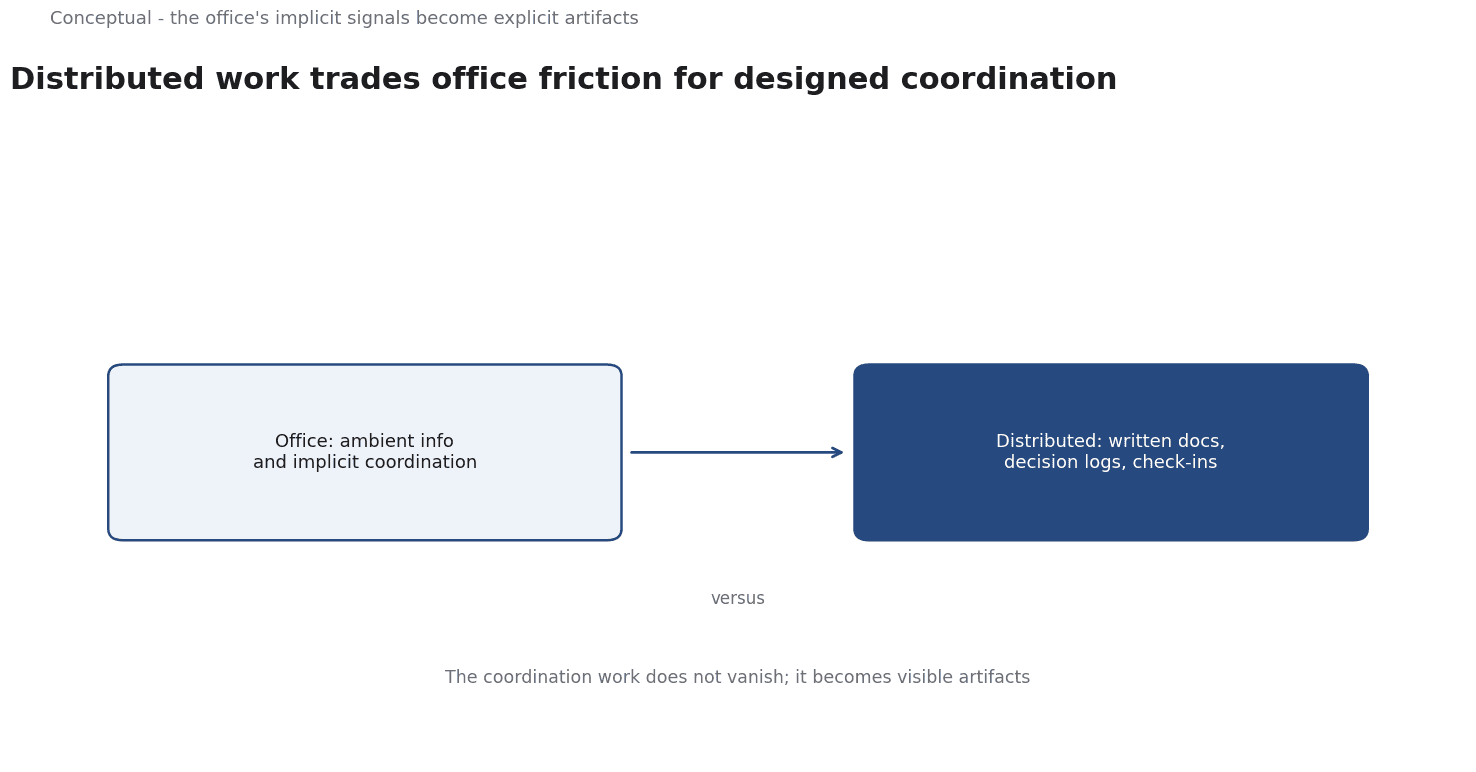
Removing it does not remove the need for those functions. It moves them into artifacts: documentation, meeting notes, decision logs, and scheduled check-ins.
These are not overhead added to the work; they are the work of coordination, now visible.
Three frictions appear:
Async ambiguity. A question that would take ten seconds in a hallway becomes a message that may sit unanswered for hours, and the delay compounds across a task chain.
Decision opacity. Without a shared room, it is unclear who decided what, so decisions get relitigated and people work from different assumptions.
Weak onboarding. A junior employee who learns by observing others loses most of that channel when the team is distributed.
re:Work's structure — hiring and onboarding, learning and development, organisational management, manager effectiveness — is useful here because it names the areas where the implicit mechanisms must be replaced. Its observation that "your team doesn't need an all-knowing leader" is especially relevant: in a distributed team, the manager's value is in making information flow, not in being the source of it.
A worked example of time-zone overlap
Suppose a team has three engineers in UTC+7 (Bangkok), two in UTC+1 (Central Europe), and two in UTC−7 (western North America). The working-hour windows, assuming 09:00–17:00 local, are:
| Location | UTC window |
|---|---|
| UTC+7 | 02:00–10:00 UTC |
| UTC+1 | 08:00–16:00 UTC |
| UTC−7 | 16:00–24:00 UTC |
The overlap between the first two groups is 08:00–10:00 UTC — two hours. Between the first and third groups there is no overlap at all: the first group's day ends exactly when the third begins.
Two consequences follow:
- A synchronous all-hands across all three locations is impossible without someone working outside normal hours. A recurring 06:00 UTC meeting works for Europe and Asia but is 23:00 the previous day for North America.
- The team must be async-first for most work, with the two-hour window reserved for decisions that genuinely need live discussion.
The practical design is to make written updates the default, require a clear decision owner on each thread, and rotate any unavoidable inconvenience.
This is a constraint of geography, not a failure of discipline. Recognising it early is cheaper than discovering it through months of delayed decisions.
The written layer is the product
In a distributed team, writing is not a courtesy added to the work; it is the substrate in which the work happens. Three artifacts do most of the load.
A decision record. For each consequential choice, capture the decision, the person who made it, the alternatives considered, and the date. This prevents relitigation and lets a new member understand why the system looks the way it does. It is also the cheapest way to discover, months later, that a decision was made on an assumption that has since changed.
A task handoff. When work crosses a time zone, the handoff must name the current state, the blocker, and the next action. "I'll let you know when it's ready" transfers uncertainty rather than work. A structured handoff is the asynchronous equivalent of a shift change in an operations room.
An index of ownership. Every recurring responsibility needs a named owner. Without one, tasks that fall between roles are discovered only when they fail.
These artifacts cost writing time, which is why teams under deadline pressure abandon them first — and why coordination failures appear shortly afterwards. The right comparison is not "writing versus working" but "writing now versus rebuilding context later".
When co-location is worth the cost
The honest counterargument to distributed work is that some tasks benefit enormously from being in the same room: early-stage design, sensitive feedback, complex negotiation, and the onboarding of junior staff.
A team that never co-locates should ask which of its tasks genuinely fall into this category and pay for deliberate, occasional gathering rather than assuming either full remote or full office.
A hybrid arrangement is not a compromise between the two; it is a third system with its own failure mode. If decisions are made in the room and merely announced online, remote participants become recipients of decisions rather than participants in them. The fix is procedural: write the proposal before the meeting, decide in the open, and record the outcome where everyone can see it.
What the evidence supports and does not
O*NET describes occupations by tasks, skills, and requirements, which is the right level of analysis for remote suitability. A role whose tasks are largely independent, written, and asynchronous — documentation, analysis, software development with clear specifications — translates well. A role whose tasks depend on physical presence, spontaneous negotiation, or hands-on supervision does not.
Three limitations deserve weight:
Remote work is not one arrangement. Fully distributed, hybrid, and occasional-remote have different coordination costs. A hybrid team where some people are in the room and others dial in often has the worst of both: the room makes decisions the remote members cannot see.
The productivity evidence is context-specific. Studies of remote work vary in what they measure — self-reported focus, output metrics, retention — and findings do not transfer automatically across industries. Treat a headline claim as a result with a specific setting, not a general law.
Career development is the quiet cost. Junior employees learn substantially through proximity to experienced colleagues. A distributed team that does not deliberately create mentorship, pairing, and visible feedback may find that its juniors plateau while its seniors flourish. This is a design choice, not an inevitability.
A decision test
- Map the role's tasks using O*NET-style task descriptions, then mark which require synchronous presence.
- Calculate real overlap across the team's time zones rather than assuming it exists.
- Design the async layer — where decisions are recorded and how work is handed off — before adding meetings.
- Give remote and in-room participants equal visibility in any meeting that includes both.
- Create explicit mentorship for junior staff rather than relying on ambient learning.
- Measure outcomes, not online hours, and state what the metric means.
- Revisit the arrangement when the team composition or work type changes.
For the management practices this depends on, see Engineering Management; for the wider shift in work, see The Future of Work.
References & Further Reading
- Erik Brynjolfsson, Danielle Li, and Lindsey R. Raymond, 2024. The Rapid Adoption of Generative AI — Workforce-level adoption data and the productivity-gap evidence.
- U.S. Department of Labor, 2026. O*NET OnLine — The standard occupational taxonomy used to compare roles across industries.
- Google, 2026. Google re:Work — A large company's published people practices, including hiring and growth frameworks.