Returns and Reverse Logistics: The Hidden Cost of Online Shopping
A return reverses a sale and adds a handling cost. Read the reverse-logistics chain, a worked cost example, and why the rate is only one metric.
A sale that is returned is not simply cancelled. The product has to travel back, be inspected, be restocked or disposed of, and the payment has to be reversed. Each step costs money, and the cost falls on a channel whose margins were already thin. The return rate is the headline number, but it is the flow behind it that determines the damage.
Direct answer: Reverse logistics covers the operations that move a product back from the customer — receipt, inspection, disposition, refund, and resale or disposal. Wikipedia's overview treats it as the set of operations related to product reuse and material flows, including unsold goods and reusable packaging. The U.S. Census Bureau's retail e-commerce series provides the channel context: e-commerce was 17.1% of total retail sales in Q2 2026. The boundary: a return is a cost centre and a service promise at the same time — cutting the rate too aggressively can damage the trust that made the sale possible.
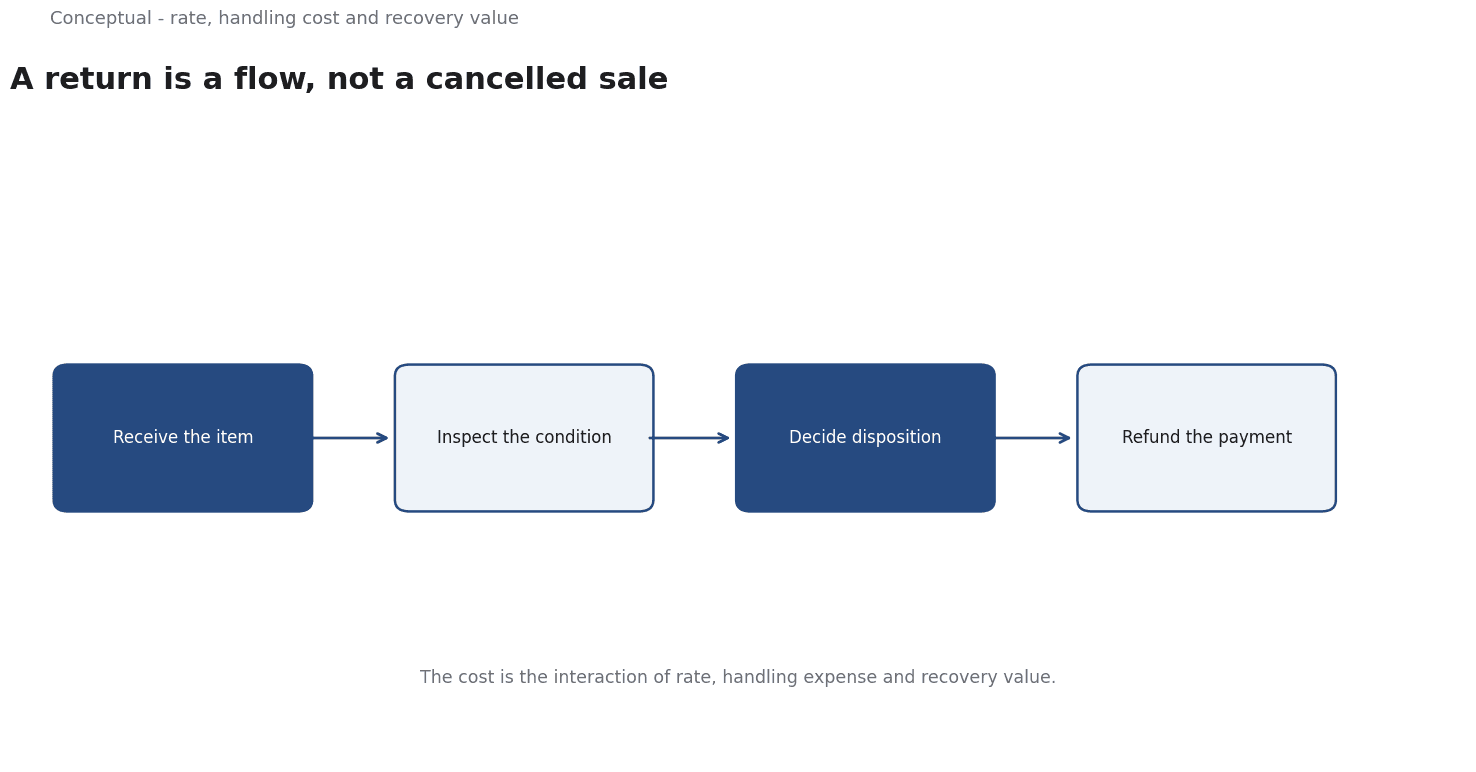
The chain behind a return
A return moves through five stages:
- Initiation. The customer requests a return. The friction here is a service decision: too much friction loses customers, too little invites abuse.
- Transport back. The item moves to a store, a collection point, or a warehouse. This is the most visible cost and the hardest to reverse once incurred.
- Inspection and grading. The item is checked: resellable, open-box, damaged, or unsellable. The accuracy of this step determines how much value is recovered.
- Disposition. The item is restocked, discounted, recycled, or discarded. Each route has a different recovery value and a different delay.
- Refund and accounting. The payment is reversed, and the original sale has to be restated in the period's numbers.
Wikipedia's reverse-logistics overview covers reuse, unsold goods, and packaging flows — a reminder that returns are one part of a larger set of reverse movements, not an isolated customer-service process.
A worked example of return cost
The following numbers are hypothetical and illustrative.
An online retailer sells 100,000 orders a month at an average value of 80, with a gross margin of 30% — 24 of contribution per order. The return rate is 20%.
- Returned orders: 20,000. Contribution lost on those sales at the point of return: 20,000 × 24 = 480,000 of the original margin is at risk.
- Direct return cost: assume 12 per return for outbound-and-return shipping, inspection, and handling — 20,000 × 12 = 240,000.
- Value recovered: if 70% are resold at full value, 20% at a 30% discount, and 10% are written off, the recovered margin is partial. Assume an average recovery of 18 per returned order against the original 24 — 360,000 recovered.
- Net effect: original contribution on all orders was 2,400,000. After returns, contribution is 2,400,000 − 480,000 − 240,000 + 360,000 = 2,040,000, a 15% reduction.
Three levers change the outcome:
- Reduce the rate by 5 points. Returns fall to 15,000. Holding other assumptions, the net loss shrinks by roughly 150,000 a month. But if the cause was a fit problem that better product data could fix, the cost of that fix is far less than the ongoing saving.
- Improve grading speed. An item that sits in a return bin for six weeks misses its selling season. Cutting that delay can raise the recovery rate more than cutting handling cost.
- Charge for returns selectively. A fee changes behaviour but also changes the customer's willingness to buy. The decision should be tested, not assumed.
The point is that the headline 20% rate is not the cost.
The cost is the interaction of rate, handling expense, and recovery value — and two of those are operational choices.
Why online returns differ
Three structural factors make returns a larger issue online:
No inspection before purchase. A customer cannot try on a garment or check a product's feel. The retailer pays for that uncertainty through higher return rates in fit-sensitive categories.
Cheap initiation. A prepaid label and a click make returning easy, which is good service and also removes the friction that once discouraged casual returns.
Longer chains. A return to a warehouse may travel further and be handled more times than a return to a nearby store, which is why some retailers allow in-store returns of online orders.
The Census channel context matters here: e-commerce was 17.1% of total retail sales in Q2 2026, so the operational model that generates these returns is a significant part of the sector, not a fringe case. The same release notes that the estimate is seasonally adjusted but not price-adjusted and that revisions follow — a reminder to check the vintage of any retail statistic used in a cost model.
The disposition decision
What happens to a returned item after grading often determines more value than the return shipping cost. Four routes are common:
Restock at full value — the fastest and most valuable outcome, available when the item is unused and packaging is intact. It depends on the grading step being quick, because a product that sits in a return bin misses its selling window.
Open-box or refurbished sale — the item is resold at a discount. The discount is a realised loss, but it recovers more than disposal. Accurate grading matters: an item graded too optimistically will simply be returned again.
Return to supplier — common when the retailer does not hold the risk, or when the item is unsellable in its current channel. The terms are contractual and often outside the retailer's control.
Recycle or dispose — the last resort, and the one where a reverse-logistics strategy for reusable packaging and materials can recover some value. Wikipedia's overview of the field includes reusable packaging and unsold-goods flows for this reason.
A practical rule is to measure the realised recovery value of each route and the average time to disposition. A retailer that improves its grading accuracy by a few points can recover more margin than one that negotiates a small reduction in shipping cost.
What the rate does not tell you
Three limits matter.
Rates differ by category. A 20% rate on apparel and a 2% rate on groceries are not comparable achievements. Aggregate rates hide the categories where the problem sits.
A low rate can be a bad sign. If customers find returns difficult, they may keep products they dislike and never buy again. The rate fell and the business got worse.
Fraud and abuse are not the same as ordinary returns.
NRF press releases are a useful source for what the industry reports about return volumes and fraud concerns, but they are industry statements and should be read as such.
The counterargument to investing heavily in returns — that a returned sale was never a profit — misses the operational point.
A return that is handled well can recover value and preserve a customer; one handled badly does neither.
A decision test
- Break the return rate down by product and reason, not just channel total.
- Measure the full cost — transport, handling, grading delay, and write-offs — not only the refund.
- Track recovery value and time-to-resale, since speed determines how much value survives.
- Test changes to return friction for effects on repeat purchase, not just on the rate.
- Separate ordinary returns from abuse before changing policy.
- Use dated channel data from a primary source such as Census, with revisions in mind.
- Treat the return flow as a service and a cost centre at the same time.
For the channel comparison, see E-commerce vs Brick and Mortar; for the inventory connection, see Inventory Management.
References & Further Reading
- Wikipedia contributors, 2026. Reverse logistics - Wikipedia — Overview of product returns, reusable packaging and unsold-goods flows; secondary reference used with NRF and Census data.
- National Retail Federation, 2026. NRF Press Releases | Latest Statements & Announcements | NRF — Primary retail-sales and channel data for sell-in versus sell-out definitions.
- U.S. Census Bureau, 2026. Quarterly Retail E-Commerce Sales — The official definition and estimates for retail e-commerce sales.