Retirement Planning for Small Teams
Small teams need retirement plans that fit their capacity. Read the options, a worked setup, and why admin cost decides what survives.
A retirement plan is a benefit with a long tail of administration. For a small team, the right question is not which plan has the most features but which one the organisation can operate correctly year after year. A plan that is set up once and then neglected is a liability, not a benefit.
Direct answer: Choose a plan by matching it to team size, budget, and administrative capacity, with the rules checked currently. Investor.gov's IRA guidance covers a common structure for small employers, and the cost article explains how fees compound over long horizons. The boundary: this is educational orientation, not legal or tax advice — eligibility, limits, and deadlines are jurisdiction-specific and change, as the copyright article treats current law generally.
The options
Individual arrangements. In the United States, an IRA or a simplified plan for small employers can be relatively light to administer, as the Investor.gov IRA guidance explains. The specific eligibility rules and limits must be checked for the current year, which the official source provides.
Group plans. A 401(k)-style plan can offer higher limits and employer matching but brings testing, filing, and fiduciary duties, which the administrative-capacity discussion addresses. A small team should price those duties in time, not only in fees, as the cost article requires for any workload.
Auto-enrolment. Where the rules permit, automatic enrolment with an opt-out raises participation, which the behavioural-finance article treats as a default effect. It also increases the employer's administrative obligation, which the operating-model article frames as the cost of a design choice.
Three consequences follow. The plan should fit the team's capacity, which the founder-led-sales article analogises to choosing a GTM motion that matches available time. The investment options should be low-cost and diversified, as the ETF article advises for any long-horizon portfolio. And the plan needs an owner, as the governance checklist requires for any maintained programme.
A worked setup
The following is hypothetical and illustrative. A ten-person company wants to offer a retirement benefit with minimal administration.
Three checks decide the structure. First, what is the budget and who does the paperwork, as the cost article requires? An owner who can handle annual contributions and notices is a prerequisite. Second, which arrangement fits the team's size and jurisdiction, as the Investor.gov guidance advises for US employers? Third, what default contribution and investment option are chosen, which the behavioural-finance article treats as a decision about participation rather than a neutral setting?
Three conclusions follow. A light structure that is maintained is better than a sophisticated one that is neglected, as the operating-model article argues for fitting capacity. Low-cost diversified options protect the benefit from fee drag, as the ETF article explains. And the plan should be reviewed when the team or rules change, as the monitoring article advises.
The administrative obligation
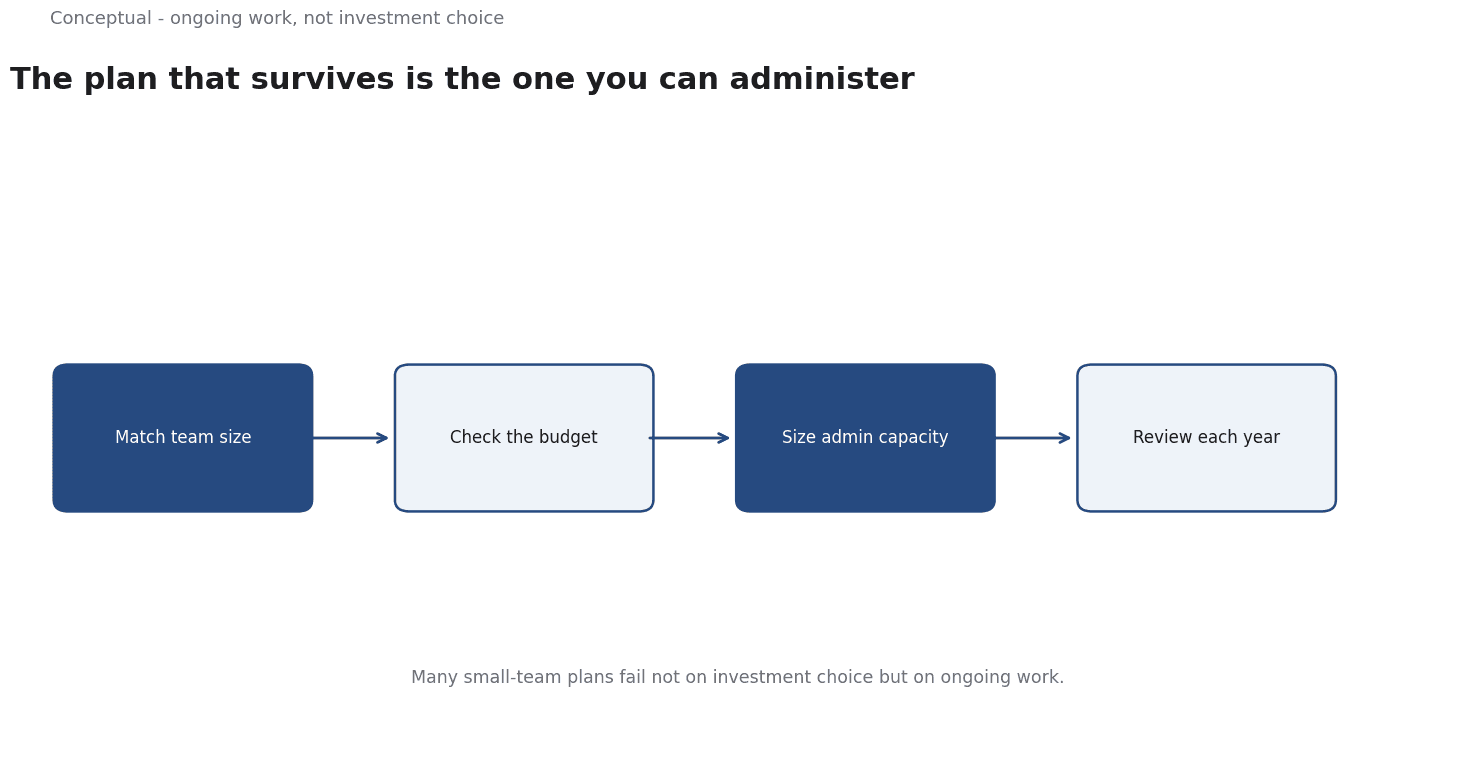
The reason many small-team retirement plans fail is not the investment choice but the ongoing work.
Contributions must be calculated and remitted on time, notices must reach employees, and filings must be accurate, as the official guidance for the chosen structure specifies. An employer that cannot do this reliably should choose a simpler arrangement, which the operating-model article frames as fitting the design to actual capacity.
This is why the cost of a plan should be measured in time as well as fees, which the cost article requires for any workload. A structure with low fees but monthly manual work may be more expensive for a small team than one with moderate fees and a provider that handles the administration, as the build-versus-buy article argues for software capabilities. The comparison should be made explicitly rather than assumed, as the decision-memo article requires for a recorded judgement.
The benefit to employees also depends on communication.
Explaining the contribution, the match, and where the money is invested in plain language is part of operating the plan, as the internal-communications article argues for decisions others can act on.
What a retirement plan cannot do
It cannot guarantee an outcome, which investor education states explicitly for all investments. It cannot replace adequate current savings, which the emergency-fund article treats as the first reserve. And it does not remove the employer's obligations, which the official rules define and a qualified adviser should confirm, as the legal article treats current law.
The counterargument that a benefit is too expensive for a small team is fair in cash terms and misses the administrative design question, as the worked setup shows that the right structure is the one the team can operate.
A decision test
- Check current eligibility, limits, and deadlines with the official source.
- Match the structure to team size and administrative capacity.
- Price fees and time, as the cost article requires.
- Choose diversified, low-cost options, as the ETF article advises.
- Consider a default where rules permit, as the behavioural-finance article explains.
- Assign an owner, as the governance checklist requires.
- Review on a change in team size or rules, as the monitoring article advises.
For the household view, see Personal Finance for Professionals; for the investment side, see Asset Allocation.
References & Further Reading
- U.S. Securities and Exchange Commission, 2026. Individual Retirement Account (IRA) | Investor.gov — Primary investor education on tax-advantaged retirement accounts.
- U.S. Securities and Exchange Commission (Investor.gov), 2026. Introduction to Investing — Primary regulator guidance on market mechanics and investor protection.