Revenue Recognition: What Investors Watch in the Notes
Revenue is recognised when earned, not when cash arrives. Read the IFRS 15 model, a worked contract example, and the notes that change the number.
Two companies can report the same revenue and mean different things by it. One sells software with immediate delivery; the other recognises revenue on a three-year contract before delivering most of the service. Both follow the rules, but the quality of their reported revenue differs. The notes to the statements are where that difference becomes visible.
Direct answer: Revenue recognition determines when a sale enters the income statement, which is not necessarily when cash is received. Wikipedia's overview states the principle that revenue is recognised when earned rather than when payment arrives, and IFRS 15 — Revenue from Contracts with Customers — supplies the primary standard with a structured model. The boundary: the standard constrains when revenue is recorded, but estimates of variable consideration and the passage of time still require judgement — which is exactly what an investor should examine in the notes.
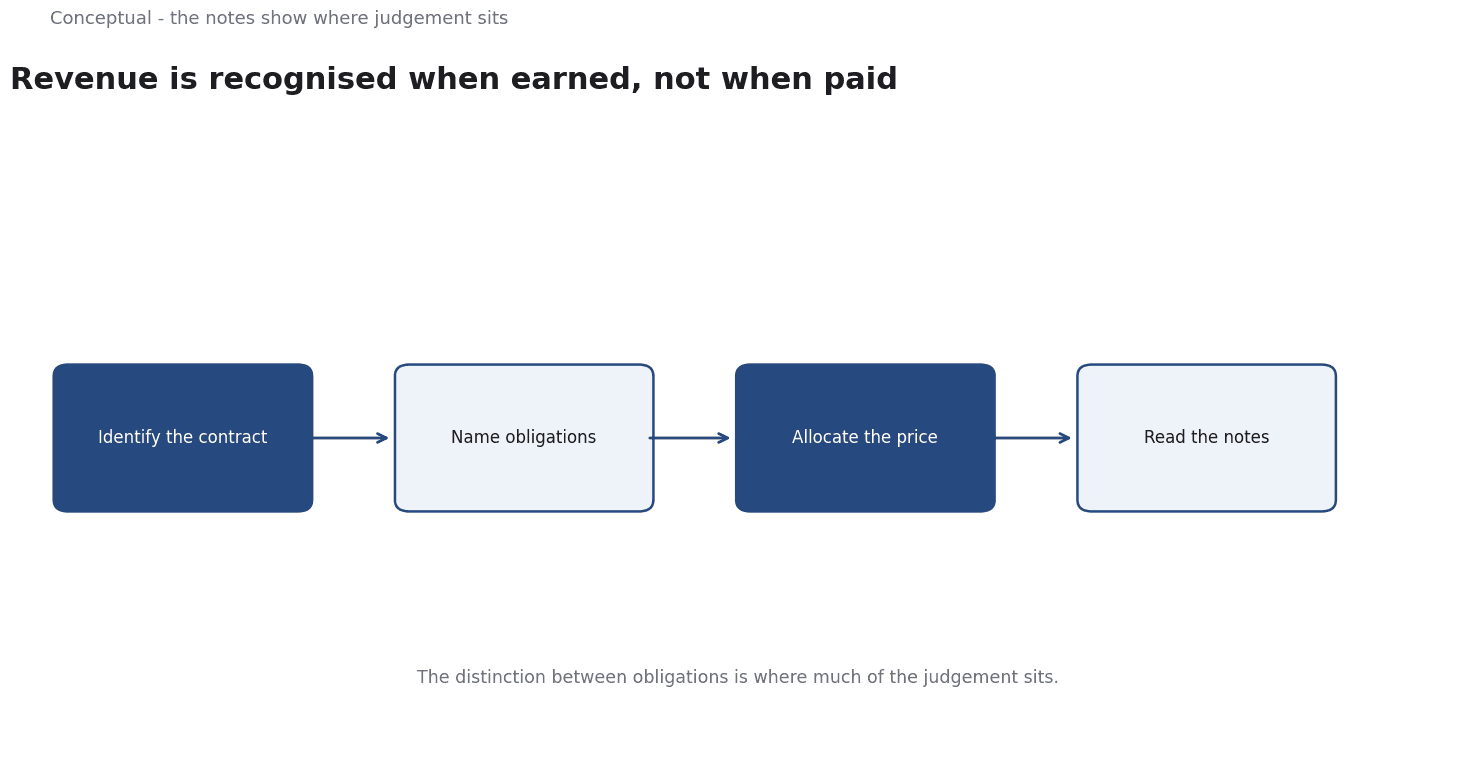
The IFRS 15 model
IFRS 15 applies to contracts with customers and is built around identifying what was promised and when it was delivered. The model is commonly described in five steps:
- Identify the contract with the customer.
- Identify the performance obligations — the distinct goods or services promised.
- Determine the transaction price, including variable amounts.
- Allocate the transaction price to the performance obligations.
- Recognise revenue when each obligation is satisfied — over time or at a point in time.
The distinction between obligations is where much of the judgement sits.
A contract that bundles a product, installation, and three years of support may contain several obligations, each recognised on a different schedule.
Why the timing matters
Cash and revenue diverge. An invoice issued in December for work to be performed next year is not December revenue. Conversely, work completed in December without an invoice may be revenue in December. A company's cash position and its income statement answer different questions, as the cash-flow discussion elsewhere shows.
Growth can be manufactured by timing. A company that recognises more revenue upfront on long contracts will show faster growth than one that spreads it, even if the underlying sales are identical. The growth rate is real in the accounts and different in economics.
Estimates enter the number. Variable consideration — rebates, discounts, performance bonuses — has to be estimated and constrained. The constraint exists precisely because an unconstrained estimate can be used to inflate revenue.
A worked example of a bundled contract
The following numbers are hypothetical and illustrative.
A company signs a three-year contract for 120,000, covering:
- A software licence delivered immediately.
- Implementation services delivered over three months.
- Three years of support.
Suppose the standalone selling prices are 60,000 for the licence, 30,000 for implementation, and 90,000 for support — a total of 180,000. The contract price of 120,000 is allocated proportionally:
- Licence: 120,000 × 60/180 = 40,000.
- Implementation: 120,000 × 30/180 = 20,000.
- Support: 120,000 × 90/180 = 60,000.
Recognition:
- Licence (point in time): 40,000 recognised on delivery.
- Implementation (over time): 20,000 spread over three months.
- Support (over time): 60,000 spread over 36 months — about 1,667 a month.
Year-one recognised revenue: 40,000 + 20,000 + (1,667 × 12 ≈ 20,000) = 80,000. Cash received might be 40,000 in year one under staged billing — or 120,000 upfront, depending on terms.
Three observations follow:
- The 120,000 cash is not 120,000 revenue. The support obligation is unsatisfied and cannot be recognised in full at signing.
- The allocation drives the answer. A different set of standalone prices changes how much is recognised upfront. Those prices are an estimate the investor should examine.
- Contract liabilities appear. Cash received before recognition sits as a liability — an obligation to deliver — and its movement is a useful signal of future revenue.
The notes worth reading
Four disclosures change how much confidence to place in a revenue number:
Disaggregation of revenue. Revenue split by product, geography, and timing shows whether growth is broad or concentrated in one line.
Contract balances. Contract liabilities (cash received before delivery) and receivables (delivery before cash) reveal the direction of the timing gap. A shrinking liability can mean revenue is being recognised from past billings rather than new sales.
Performance obligations and their timing. The note should say what is promised and whether it is recognised over time or at a point. This is where a bundled contract like the example becomes visible.
Judgements and estimates. Standalone selling prices, variable consideration, and the constraint on estimates are disclosed here. A company that changes an estimate and boosts revenue in the same period deserves a question.
The counterargument — that an investor cannot reconstruct every judgement from the notes — is fair.
The point of reading them is not to recalculate the accounts but to identify which numbers depend on estimates and whether those estimates have moved.
Red flags in the disclosures
Four patterns deserve a follow-up question, though none proves wrongdoing:
A change of estimate that improves revenue. If a company changes standalone selling prices or the estimate of variable consideration and revenue rises as a result, the notes should explain why the new estimate is better. "Better for the number" is not an explanation.
Contract liabilities falling while revenue rises. A shrinking liability means the company is recognising revenue from billings accumulated in earlier periods. If new billings are not replacing them, the growth may be temporary.
A growing gap between revenue and cash collection. Receivables expanding faster than revenue can signal collection problems — or aggressive recognition. The cash-flow statement and the receivables note together narrow the question.
Bundles introduced without clear allocation. A new multi-element contract with an unexplained allocation gives management more discretion over timing. Disclosure should let a reader see the components.
The point of a red flag is to focus attention, not to reach a verdict. Many have innocent explanations, and the notes are where those explanations should appear.
What recognition does not tell you
It is not cash generation. A company can recognise revenue for work performed and still fail to collect. Receivables and cash flow carry that story.
It is not customer satisfaction. Revenue recognised on a signed contract says nothing about whether the customer will renew. Retention and expansion are separate metrics.
It is not comparable across frameworks. IFRS 15 and the corresponding US standard are converged in structure, but reporting under different bases and with different judgements still limits comparison.
A decision test
- Ask when revenue is recognised — at a point or over time — for the main product lines.
- Read the performance-obligation note and check whether bundles are separated plausibly.
- Track contract liabilities alongside revenue to see whether new billings support the number.
- Check the estimates — standalone prices and variable consideration — for changes.
- Compare revenue growth with cash collection over several periods.
- Read disaggregation to find where growth actually sits.
- Treat a timing-driven jump as a question, not a verdict.
For the statement-level view, see Reading Financial Statements; for the cash side, see Working Capital.
References & Further Reading
- IFRS Foundation, 2026. IFRS - IFRS 15 Revenue from Contracts with Customers — The primary accounting standard for revenue from contracts with customers and its five-step model.
- Wikipedia contributors, 2026. Revenue recognition - Wikipedia — The principle of recognising revenue when earned rather than when cash is received; secondary reference.