Working Capital: The Cash Constraint Growth Companies Miss
A growing business can be profitable and still run out of cash. Read the cash conversion cycle, a worked growth example, and the levers that matter.
A company that doubles its sales can need more cash than one that stays flat. Growth ties up money in inventory and receivables before the revenue converts to cash, and the gap has to be funded somewhere. Working capital is the name for that gap, and it is one of the most common reasons a profitable business fails.
Direct answer: Working capital is current assets minus current liabilities; the cash conversion cycle measures how long cash is tied up in operations, using days of inventory, days of receivables and days of payables. Wikipedia's working-capital overview notes that a business can face cash constraints while growing, and the cash-conversion-cycle entry gives the component formula. The boundary: working capital is not free to optimise — cutting inventory too far loses sales, and stretching payables can damage supplier relationships.
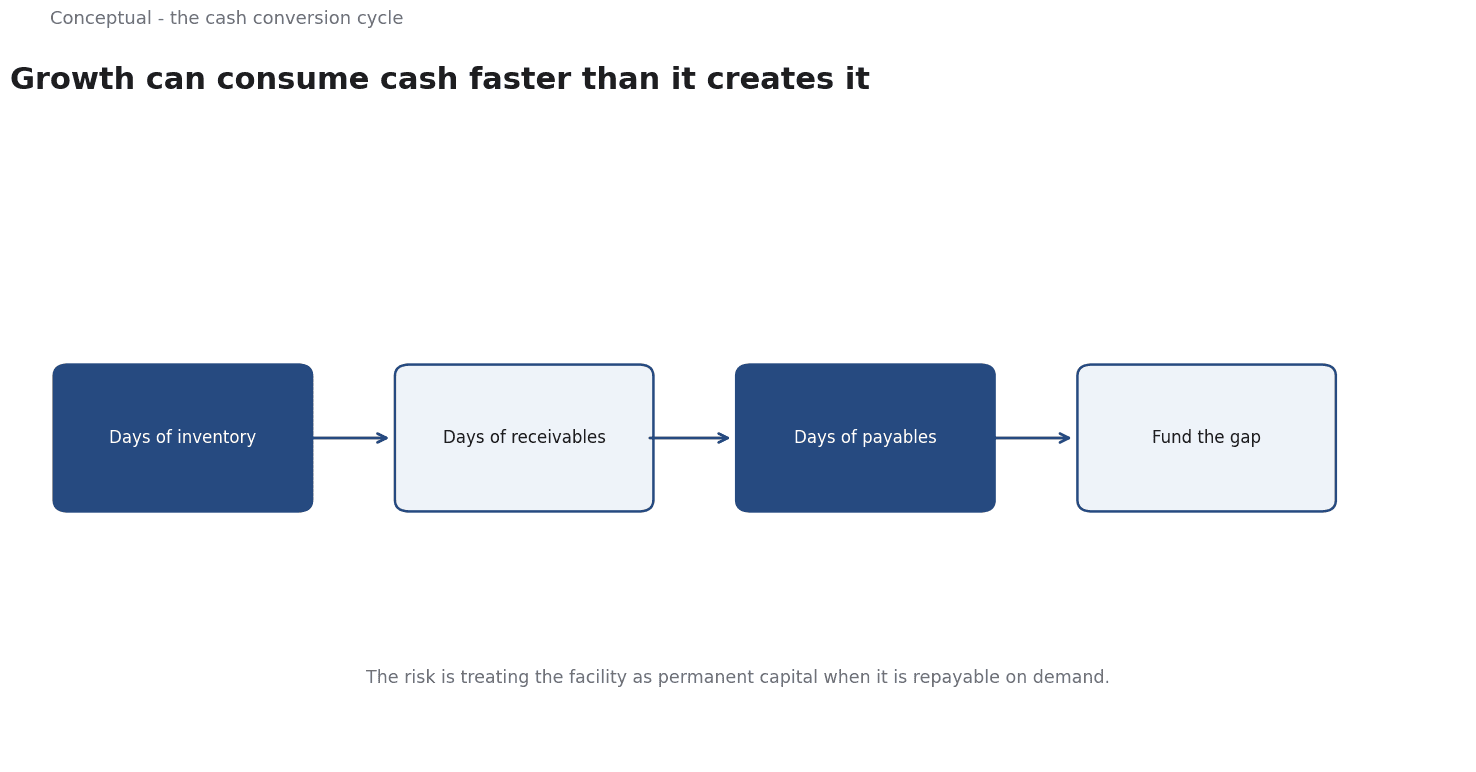
The three components
Working capital is often reduced to a single number, which hides where the problem sits.
Three accounts drive it:
Inventory. Cash paid for goods that have not yet sold. More inventory ties up more cash, and slow-moving stock can become a write-off.
Accounts receivable. Invoices issued but not yet paid. Revenue is recognised, but the cash has not arrived. Longer payment terms shift financing to the seller.
Accounts payable. Amounts owed to suppliers. These are a source of short-term financing — up to the point where late payment damages the relationship or triggers worse terms.
The cash conversion cycle combines them:
CCC = days inventory outstanding + days sales outstanding − days payable outstanding
A shorter cycle means the business recovers cash faster. A negative cycle — common in some retail and subscription models — means suppliers and customers finance the operation.
Why growth makes it worse
Suppose a business sells 1,000 units a month at 100 each, with 60 gross margin per unit. When sales grow to 1,500 units, it must buy and hold more inventory and finance more receivables before the extra revenue is collected. The cash outflow comes first; the inflow follows after the cycle.
Three patterns are common:
Fast growth with slow collection. The company ships more and invoices more, but customers pay in 60 days. The cash gap grows with every increment of sales.
Seasonal stocking. Inventory is bought ahead of a peak season. Working capital swells before the selling period and releases afterward — a timing problem, not a structural one, but it still needs financing.
Supplier terms mismatch. Payables are due in 30 days while receivables arrive in 60. The company finances 30 days of every sale from its own balance sheet.
A worked example of a funding gap
The following numbers are hypothetical and illustrative.
A distributor has 30 days of inventory, 45 days of receivables, and 20 days of payables.
CCC = 30 + 45 − 20 = 55 days
Monthly revenue is 2,000,000, with a gross margin of 25% — so cost of goods sold is 1,500,000 a month, or about 50,000 a day.
Cash tied up ≈ 55 × 50,000 = 2,750,000
Now revenue grows 50% to 3,000,000 a month. Cost of goods sold becomes 2,250,000, or 75,000 a day. If the cycle stays at 55 days:
Cash tied up ≈ 55 × 75,000 = 4,125,000
The growth consumed an additional 1,375,000 of cash before a single extra pound of profit was collected. Three levers change the result:
- Reduce receivables from 45 to 30 days. CCC falls to 40 days, and cash tied up becomes 3,000,000 — a 1,125,000 reduction at the higher volume. This is often cheaper than financing the gap.
- Negotiate payables from 20 to 35 days. CCC falls by 15 days, with a similar cash effect. The risk is supplier friction, which can cost more than the financing saved.
- Cut inventory days from 30 to 20. This releases roughly 750,000 but risks stockouts if demand is uncertain. The saving is only real if service levels hold.
The point is that the three levers are not interchangeable. Receivables improvement is usually the least damaging; payables and inventory trade cash for relationships and resilience.
Financing the gap without disguising it
When the levers are exhausted, the remaining gap has to be financed. Three options dominate:
A revolving credit facility. Sized to the peak seasonal need and drawn as required. The cost is interest on the drawn amount plus commitment fees; the benefit is flexibility.
Supplier financing. Extending payables with a supplier's agreement, sometimes through a platform that pays the supplier early and collects from you later. This converts a working-capital gap into a financing cost and should be priced accordingly.
Equity. The least dangerous option for liquidity and the most expensive in dilution. A company that funds recurring working-capital needs with equity is using permanent capital for a cyclical problem.
The discipline is to name which need is temporary and which is structural. A seasonal stocking gap is a good use of a revolver; a gap that grows with every sale is a business-model problem that financing only postpones.
What the ratio hides
Averages conceal distribution. 45 days of receivables may mean most customers pay in 20 and a few take 120. Aggregate days outstanding will not tell you which customer is starving you of cash.
Working capital is seasonal. A single balance-sheet date can flatter or penalise a business depending on where it sits in its cycle. Use several periods.
Not all inventory is equal. Fast-moving stock and obsolete stock both count as assets, but only one will convert to cash. The write-off risk belongs in the analysis.
The counterargument — that a business with profitable unit economics can always borrow against growth — is true only while credit is available and the borrowing cost is lower than the return.
A company whose working capital gap grows faster than its profit is building on financing it does not control.
A decision test
- Compute the cash conversion cycle from its three components, with a stated period.
- Estimate cash tied up as daily cost of goods sold times the cycle, as in the worked example.
- Project the gap under your growth plan before committing to the growth.
- Rank the levers by damage: receivables first, then payables and inventory with their trade-offs stated.
- Break receivables down by customer to find the real delay.
- Check seasonality across several periods, not one snapshot.
- Price the financing of the remaining gap and ask whether the return justifies it.
For the valuation link, see Corporate Finance Essentials; for the statement-level view, see Reading Financial Statements.
References & Further Reading
- Wikipedia contributors, 2026. Working capital - Wikipedia — Current assets minus current liabilities, and why a growing business can be cash-constrained; secondary reference.
- Wikipedia contributors, 2026. Cash conversion cycle - Wikipedia — The days-inventory, days-receivable and days-payable formula for the cash conversion cycle.
- Aswath Damodaran, 2026. Damodaran Online: Home Page for Aswath Damodaran — Publicly maintained datasets for industry averages, WACC, and valuation.