Shopper Marketing Checklist
A checklist is only useful if it is built on a real shopper insight and executed at the shelf. How to map the path to purchase, design a planogram, and check compliance.
Shopper marketing is often reduced to a set of in-store tactics: a display, a coupon, a brighter shelf edge. The real problem is that these tactics are frequently designed without a clear picture of who the shopper is or where the choice is actually made, so activity increases while the buying decision is unchanged. A checklist helps only when it is anchored to the trip the shopper takes, not to the campaign the brand happens to be running.
Direct answer: Shopper marketing focuses on the person doing the buying at the points where a choice is made, which is not always the person who consumes the product. The practical consequence is that a checklist should organise its checks around the path to purchase and the physical shelf, with the planogram as the tool that turns insight into placement. Its value is bounded by the quality of the shopper insight and by execution in store, not by the length of the checklist.
Delta: This article adds an execution discipline beyond the sources: it maps shopper insight and planogram design to the specific decision of where to intervene on the path to purchase, with claim status made explicit.
The mechanism
The Wikipedia entry on shopper marketing describes a discipline centred on the shopper and the path to purchase rather than on the consumer in the abstract. That distinction is the foundation of a useful checklist. The shopper may be buying for someone else, may be in a different mindset from the person who uses the product, and makes a series of choices from entering the store to leaving it. Organising the checklist around that trip means the first questions are about the shopper and the mission, not about which promotional mechanic is available.
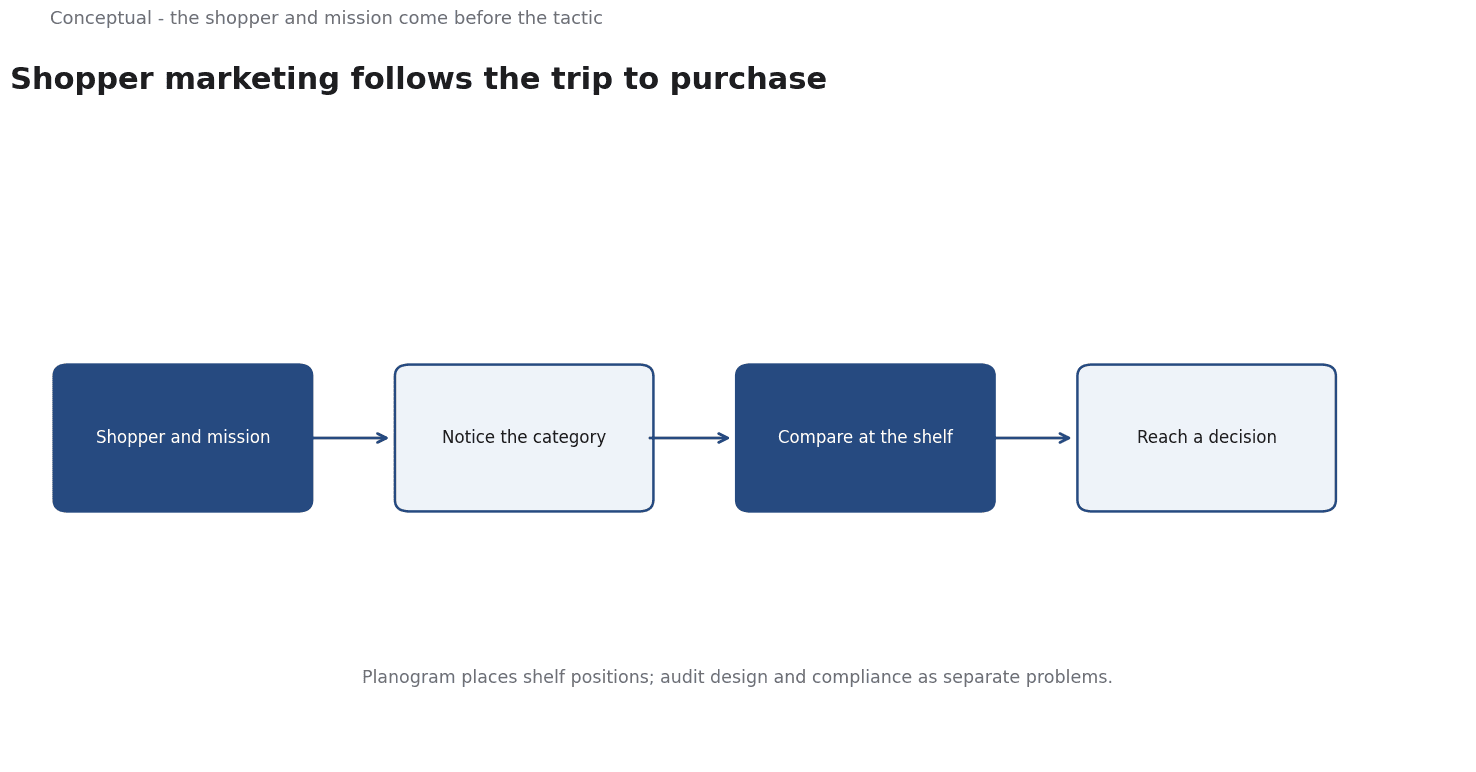
The path-to-purchase idea gives the checklist its structure. The relevant moments are the ones where a choice can still be influenced: noticing a category, comparing options at the shelf, and reaching a decision. Marketing communications thinking adds that a message competes with noise and is decoded by the receiver, so the in-store signal must be legible in a crowded environment. A practical checklist therefore maps each touchpoint and asks what the shopper needs at that point, rather than placing tactics wherever there is space.
The planogram is where insight becomes physical. Wikipedia defines a planogram as a diagram that indicates the placement of retail products on shelves, with the aim of maximising sales. It turns a decision about category role, facings, eye-level position, and adjacency into a specification that a store can follow. The practical consequence is that the shelf should be treated as a designed decision environment: products that the shopper compares should sit together, and high-value positions should follow from the insight rather than from habit.
A planogram is also a measurement instrument. Because it specifies exactly what should be where, it creates a standard against which execution can be checked. This separates two different problems: a design problem, where the shelf layout does not reflect shopper behaviour, and a compliance problem, where the correct design is simply not implemented in a given store. A checklist that only audits design will miss the stores where the plan was never executed, and a checklist that only audits compliance will keep reproducing a weak design.
A worked example
The following is hypothetical and illustrative. A brand in a packaged category wants to increase the share of shoppers who choose its product at the shelf. Three checks are run before any spend is committed. First, the team defines the shopper and mission: who buys this category, whether the purchase is planned or prompted, and which attributes drive the choice. Second, the path to purchase is mapped to locate the decision point, revealing that the comparison happens at the shelf rather than earlier in the trip, so the intervention belongs on the shelf rather than in an upstream message. Third, the planogram is specified and a compliance sample of stores is scheduled. The outcome is that the design is sound but the main constraint turns out to be execution: several stores do not match the planned layout, so the first action is a compliance fix rather than a new campaign.
Evidence status
| Claim | Status | Source | Verified | Recheck when |
|---|---|---|---|---|
| Shopper marketing focuses on the shopper and the path to purchase | source-reported | Wikipedia contributors, "Shopper marketing" | 2026-11-18 | The Wikipedia article is substantially revised |
| A planogram specifies product placement on shelves with the aim of maximising sales | source-reported | Wikipedia contributors, "Planogram" | 2026-11-18 | The definition of a planogram changes |
| Executional compliance is a distinct failure mode from planogram design | inferred | Derived from the sources | 2026-11-18 | Store-level compliance data becomes available |
The table keeps the two source-backed definitions separate from the reasoning built on them. The focus on the shopper and the role of the planogram are reported directly. The distinction between design and compliance is an inference: it follows from treating a planogram as a standard that can be compared with what a store actually does, and it should be tested against store-level data before it is used to allocate effort.
What it cannot do
A checklist cannot replace shopper insight. It is a structure for asking questions, and if the answers are guesses, the structure only makes the guesses look organised. Knowing who the shopper is, what mission they are on, and what drives the choice requires observation and data, not a form. Without that foundation, the checklist produces a tidy plan that reflects the team's assumptions about shopping rather than the behaviour it is meant to influence. The form is a reminder of what to ask, not a source of the answers.
There is a hidden cost in execution. A planogram that exists on paper but is not realised in stores delivers nothing, and achieving compliance across many stores is a logistical problem involving staff, time, and competing priorities for shelf space. Retail environments vary, and a layout that works in one format may be impossible in another. The cost of maintaining compliance is recurring, not a one-off, and it should be counted when the intervention is justified. A design that assumes perfect execution is a design that has not been costed.
The path to purchase often begins before the shopper enters the store: with a brand impression, a price expectation, or a shopping list. If the checklist ignores those earlier influences, it will over-attribute the decision to the shelf and miss the moments where the choice was already narrowed. The shelf matters, but it is one part of a longer sequence, and a fix applied too late in that sequence cannot recover ground lost earlier.
There are boundaries where this approach should not be applied unchanged. Habitual, low-involvement purchases may be driven by availability and routine rather than by deliberate comparison, so a detailed shelf design may have little effect. Online shopping replaces the physical shelf with a digital one governed by different rules of visibility and ranking. Different categories and channels require the checklist to be adapted, not copied, and some contexts call for research rather than a standard set of checks. Applying the same form everywhere is a way of avoiding the question of whether it fits.
Finally, shopper behaviour and the retail environment change, so the checklist needs review. Assortment shifts, seasonality, competitor moves, and new store formats all alter what a good plan looks like. A compliance standard that is never refreshed becomes a ritual that protects an outdated design. The checklist should carry an owner and a recheck condition, and its results should be read alongside sales and availability data rather than as a score in itself. Without that review, the organisation becomes skilled at following a plan that no longer describes its shoppers.
The counterargument that a checklist standardises execution is fair for reducing omissions across many stores and teams, and incomplete for capturing the local judgment that a particular store or shopper context requires; standardisation should set a floor, not replace observation.
A decision test
- Define the shopper and the purchase mission, distinguishing buyer from consumer.
- Map the path to purchase and locate the point where the choice is made.
- Identify what the shopper needs at that point, not which tactic is available.
- Specify the planogram: category role, facings, position, and adjacency.
- Trace each placement decision to the insight that justifies it.
- Check compliance in a sample of stores before attributing any result to the design.
- Assign an owner and a recheck condition, and review against sales and availability data.
Shopper marketing works when the shelf is designed from a real understanding of the trip and when that design is actually executed.
The discipline is less about finding more tactics than about connecting insight, placement, and measurement into one chain. When any link is missing, the checklist produces activity without a decision, and the first task is to find the broken link rather than add another box to the form.
For further reading, see Voice of Customer: Turning Feedback into Decisions.
References & Further Reading
- Wikipedia contributors, 2026. Shopper marketing - Wikipedia — Marketing aimed at the point of purchase.
- Wikipedia contributors, 2026. Planogram - Wikipedia — The placement of products on shelves.