Site Migrations Pitfalls
A site migration changes where pages live, and the risk sits in the old addresses. Read how redirects and canonicals work, a worked audit, and where the guidance stops.
A site migration changes where pages live, and the risk is not the move itself but what happens to the old addresses. Two mechanisms decide whether existing signals survive: URL redirection and the canonical tag. The real problem is that teams treat a migration as a file transfer, when it is actually a set of address-level decisions that each need an owner.
Direct answer: Map each retired URL to its new destination with a permanent redirect, and mark the preferred version of any duplicated content with a rel=canonical. The sources define redirection types and canonical methods; the rule that every mapping needs an owner is a synthesis. Neither source specifies a migration schedule or guarantees a ranking outcome.
Delta: This article adds a claim-status table and a per-URL mapping decision test beyond the sources: it maps redirect and canonical choices to a migration review decision, with claim status explicit.
The mechanism
The Wikipedia entry on URL redirection distinguishes a permanent redirect from a temporary one. A 301 response signals that a resource has moved permanently, so a crawler or a returning visitor is pointed at the new location and the old address can be retired. A temporary redirect signals a short-term move and asks the client to keep using the original address. The practical consequence is that the redirect type is a claim about intent: choosing the wrong one tells consumers something false about whether the old address still matters.
Google's guidance on consolidating duplicate URLs describes the rel=canonical method. When the same content is reachable at more than one address, a canonical link marks the preferred version so that signals can be consolidated rather than split. The guidance presents this as a way to specify a canonical among duplicates. The practical consequence is that canonicals handle the cases a redirect cannot: tracking parameters, protocol variants, and trailing-slash differences that are not really separate pages.
The two tools are complementary, not interchangeable.
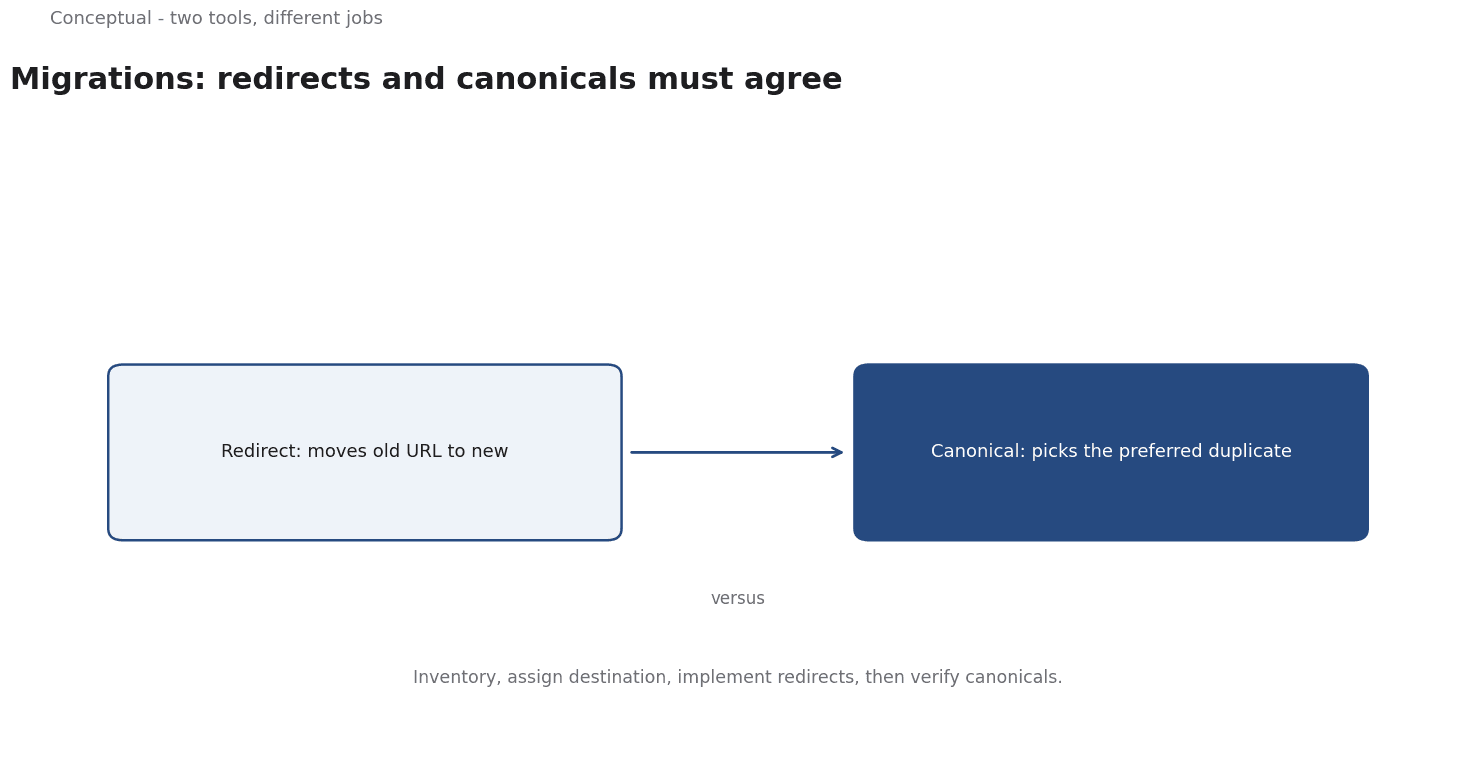
A redirect moves a user and a crawler from an old address to a new one; a canonical chooses a preferred version among addresses that still exist. Applying both to the same URL in conflicting ways sends mixed signals, such as redirecting to one destination while pointing the canonical at another. The sources describe each mechanism on its own; the rule that they must agree is an inference drawn from how the mechanisms interact.
The output of a migration is therefore a mapping table: old URL, new URL, redirect type, canonical target, and an owner for each row. The discipline is a sequence, inventory the old addresses, assign a destination, implement the redirects, then verify the canonicals. Each row is a local decision, and the sources do not supply the destinations.
A worked example
The following is hypothetical and illustrative. A storefront moves from an old path structure to a new one during a replatform. Three checks decide the review. First, does every retired product URL carry a permanent redirect to the single new product page rather than to the homepage? Second, do duplicate versions created by tracking parameters point to one canonical product URL? Third, do any old URLs receive both a redirect and a conflicting canonical? The audit finds one category page redirected to the homepage, which is corrected to the matching new category. It also finds parameter variants with no canonical, which are fixed. The outcome is a cleaner signal path, not a new ranking guarantee. The numbers are hypothetical; the verification method is the contribution.
Evidence status
| Claim | Status | Source | Verified | Recheck when |
|---|---|---|---|---|
| A permanent redirect signals a moved resource | source-reported | Wikipedia, URL redirection | 2026-11-18 | Redirect semantics revised |
| rel=canonical consolidates duplicate URLs | source-reported | Google, Canonical | 2026-11-18 | Google guidance updated |
| Every retired URL needs an owner and a mapping | inferred | Derived from the sources | 2026-11-18 | Site structure changes |
The first two rows are factual claims drawn from the sources. The third is an inference about ownership, because neither source assigns responsibility for a mapping. Recheck the definitions when the source entries change, and the inferred claim whenever the site structure changes.
What it cannot do
A redirect and canonical audit does not guarantee that rankings survive a migration. The sources define how the mechanisms work; they do not promise that link signals transfer completely or that search visibility is preserved. A correct redirect removes one source of loss, but ranking depends on many other factors outside these two documents. Treating a clean mapping as a guarantee of unchanged traffic is a category error, and a reviewer should resist reading the absence of a warning as a promise.
The hidden cost is inventory and maintenance. Every retired URL needs to be found, classified, and assigned a destination before the move, and the mapping must survive later edits to the site structure. Teams often discover orphaned URLs only after traffic has fallen. The labor is recurring rather than one-time, paid in attention and coordination between the people who own content and the people who own the server configuration. A mapping that is correct on launch day decays as soon as the site changes.
A redirect can send a visitor to the new page while a stale canonical points somewhere else, or a chain of redirects can accumulate so that one old address passes through several hops before settling. Each extra hop weakens the signal and slows the client. A clean-looking migration can still contain dozens of these conflicts if no one checks the interactions rather than the individual rules, which is why a row-by-row review matters more than a spot check.
There is a boundary around what these sources cover. The redirection entry describes response types, and Google's guidance describes canonical methods; neither prescribes a migration timeline, a testing procedure, or a rule for when to prefer a redirect over a canonical in a specific case. Those are local judgments. A reader who expects a step-by-step migration plan will not find one here, and should not treat the absence as a defect in the mechanisms themselves. Each design choice still has to be made by someone who knows the site.
Because site structure changes, the mapping needs review whenever pages are added, removed, or renamed. Each row should carry a recheck condition, and the canonical target should be confirmed after each deployment. Without that record, a future reviewer cannot tell which mappings were deliberate and which were carried forward by habit, and a small edit can quietly reintroduce the duplicate or redirect problem the migration was meant to solve.
The counterargument that a redirect-and-canonical audit is fair for preserving existing addresses is incomplete when the new site changes the content itself.
A decision test
- Inventory every old URL before the move.
- Assign one new destination to each retired URL.
- Choose a permanent redirect for moves that are not temporary.
- Mark a canonical for pages reachable at multiple addresses.
- Check that no URL has a redirect and a conflicting canonical.
- Verify the redirect resolves to the intended destination in one hop.
- Record an owner and a recheck date for each mapping row.
The audit is useful only when each mapping is owned and revisited. The test turns a vague sense that a migration went well into a set of checkable address-level decisions, so a reviewer can see which rule was applied and when it must be rechecked. For further reading, see What AI Search Actually Measures.
References & Further Reading
- Wikipedia contributors, 2026. URL redirection - Wikipedia — Forwarding one URL to another.
- Google, 2026. How to Specify a Canonical with rel="canonical" and Other Methods — What Google says about redirects, canonicals, and duplicate handling.