Skill Development Examples
Skill growth is a change in what someone can do, not hours spent. Read concrete examples, a worked practice plan, and why credentials are a weak proxy.
Skill development is often measured by inputs — courses completed, hours logged, certificates earned — which are easy to count and weakly related to what a person can do. The learning-science literature is clearer: durable skill comes from retrieval, practice, and feedback, which the Learning Scientists resource explains for effective learning strategies. A useful example therefore describes a change in performance, not a record of activity.
Direct answer:
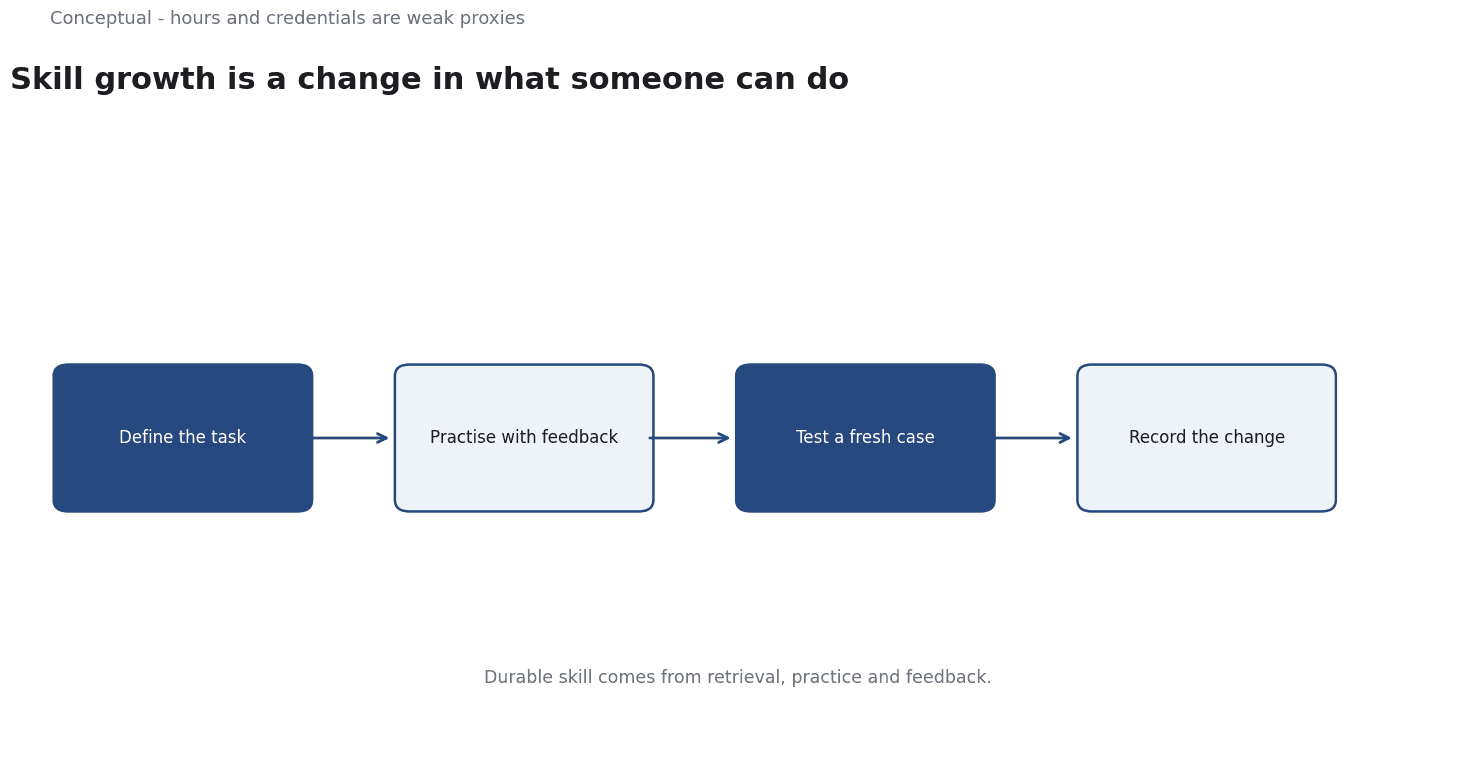
Develop a skill by defining a observable task, practising it with feedback, and testing whether performance improved on a fresh case.
O*NET's task descriptions help define what a role actually requires, and the learning-strategies resource covers the method.
Examples of real skill development
A developer learns debugging. Instead of reading about a framework, they work through five real failures, writing down the symptom, the hypothesis, and the fix, which the systematic-debugging method recommends. The measure is whether they diagnose a sixth failure faster, as the evaluation-rubric article requires for a fresh case.
An analyst learns SQL. Rather than completing a course, they answer thirty questions from a real dataset and check each result against a known answer, which the data-analysis article advises for verification. The measure is accuracy on new questions, not course completion, as the feature-engineering article treats context as the test of a skill.
A manager learns feedback. They conduct five difficult conversations with a written plan and ask for honest reactions, which the engineering-management article treats as a practice of the role, as the voice-of-customer article recommends for feedback. The measure is whether the conversations change behaviour, not how many were held.
Three consequences follow. Each example has a task, feedback, and a test, which the learning-strategies resource identifies as the mechanism. Each produces evidence that can be shown, as How to Build a Technical Portfolio That Demonstrates Real Skills recommends for demonstrating real skills. And each is tied to a role's actual work, which O*NET's descriptions support, as the future-of-work article argues for skill-based framing.
A worked practice plan
The following is hypothetical and illustrative. A professional wants to improve at writing decision memos.
Three steps follow. First, define the task: produce a one-page memo with a decision, evidence, and a reversal condition, as the decision-memo article specifies. Second, write four memos on real decisions and ask a reviewer to score them against a rubric, which the evaluation-rubric article requires for concrete feedback. Third, rewrite one and test whether a new reviewer can state the decision without asking, as the five-minute-update article treats comprehension as the point.
Three checks decide whether the skill developed. Did the memos improve against the rubric, as the evaluation article requires? Did the reviewer's understanding change, as the communication article advises for a shared frame? Can the person do it without the template, which the learning-strategies resource treats as the goal of practice?
What skill development examples cannot do
They cannot prove competence in a different context, which the causal-inference article treats as a generalisation question. They do not replace experience, which the publication standard forbids fabricating, as How to Build a Technical Portfolio That Demonstrates Real Skills argues for honest provenance. And they are not a substitute for a clear goal, which the value-proposition article analogises to stating what changes for the reader.
The counterargument that credentials are the practical signal is partly true in hiring and weak as a measure of capability, which the technical-interviews article argues for tests that reveal systems thinking.
A decision test
- Define the task in observable terms, as O*NET's task descriptions support.
- Practise on real or realistic cases, as the learning-strategies resource recommends.
- Get feedback against a rubric, as the evaluation-rubric article requires.
- Test on a fresh case, as the debugging method advises.
- Record evidence of the change, as How to Build a Technical Portfolio That Demonstrates Real Skills recommends.
- Avoid counting hours as outcomes, as the future-of-work article warns.
- Re-test after a material change in the role, as the monitoring article advises.
For the method, see Why Learning How to Learn Is a Competitive Advantage; for the evidence, see Technical Portfolio.
References & Further Reading
- U.S. Department of Labor, 2026. O*NET OnLine — The standard occupational taxonomy used to compare roles across industries.
- Learning Scientists, 2026. The Learning Scientists — Research summaries on retrieval practice, spacing, and durable learning.