Social Media Marketing: Platform Strategies, Content, and Community
Social is a set of different distribution systems, not one channel. Read how to choose platforms and measure outcomes that matter.
Social media marketing is often treated as a publishing problem: create content, distribute it on several platforms, measure engagement. The platforms are not interchangeable, and treating them as such is why a programme can be busy for a year and leave no clear evidence that it changed anything.
Direct answer: Each social platform is a distinct distribution system with its own discovery mechanism, audience expectations, and measurement limits. Choose platforms by where your buyers make decisions in your category, not by where your team likes to spend time; build content for the platform's native format; and treat engagement as a diagnostic, not an outcome. The outcome is a change in decision — a qualified enquiry, a retained customer, a purchase — measured with a holdout where possible.
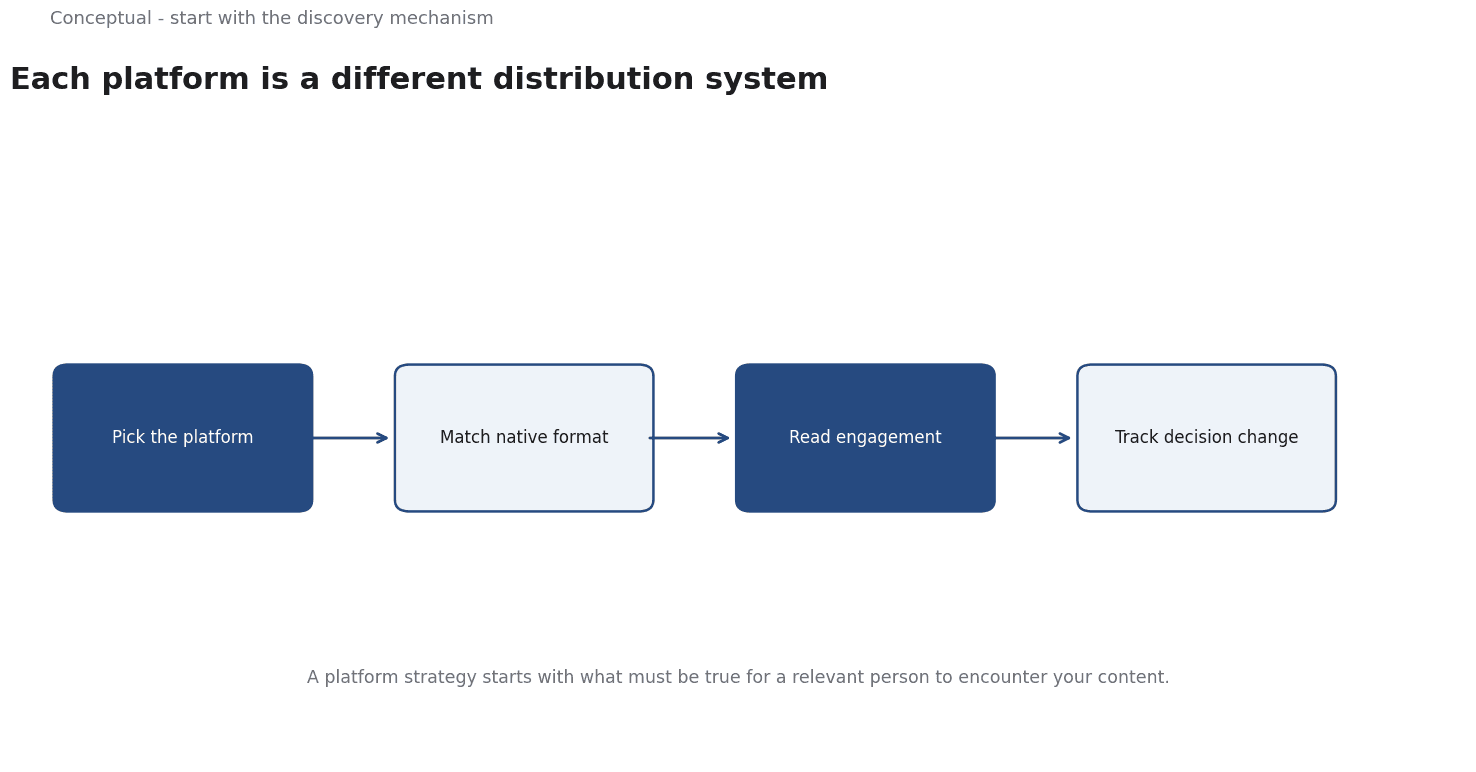
The platforms are different systems
It is efficient and it fails, because discovery works differently in each place.
On some platforms distribution is driven by the social graph — who you know and what they share. On others it is driven by a recommendation system that surfaces content to people with no prior connection to you. In one case an existing audience is the asset; in the other the content's performance with a cold audience is the asset. The same post cannot be optimised for both.
This is why a platform strategy has to start with the discovery mechanism: what has to be true for a relevant person to encounter your content here?
The answer determines the format, the cadence, and whether an existing following matters.
Stack Overflow's developer survey is useful context for technical audiences because it reports which platforms developers actually use and trust, and how that changes over time. It is a self-reported survey with the usual limits — the sample is people who chose to answer — and it is still better evidence than an internal guess about where your buyers are.
Relevance beats volume
The reason most social content fails is not quality; it is that it was written for the brand rather than for the person who would encounter it. A post that describes what your company shipped is only interesting to people who already care. A post that addresses a question the audience is actively trying to answer can travel to strangers.
The discipline is the same one that makes content marketing work: start with the decision the buyer is making and the questions that precede it. The format changes by platform — a short video, a thread, a long-form post — but the underlying question does not.
Porter's trade-off logic applies to platform choice exactly as it does elsewhere. "A strategic position is not sustainable unless there are trade-offs with other positions."
A brand that tries to be present and distinctive on six platforms will be generic on all six.
Choosing two and being unmistakably useful there is a position; choosing six is a budget.
Engagement is a diagnostic
Likes, shares, and comments are signals about content, not about business outcomes. They are useful for learning which formats and subjects resonate, and useless as a measure of whether the programme created customers.
The metric problem is the same one that affects marketing measurement more broadly. Google Ads states that "attribution models let you choose how much credit each ad interaction gets for your conversions" — a rule, not a measurement of causation. If a social interaction received credit in a model, that does not establish the interaction caused the purchase, and a last-click model will systematically under-credit channels that create awareness early.
For decisions about budget, use the incrementality instrument that fits the intervention: a randomised holdout for a directly attributable campaign, or a geo experiment for market-level brand activity. Google's published work describes geo experiments as "one approach that Google has successfully employed to measure advertising effectiveness" with a systematic design process.
Community is a different job
Community building is not content distribution with a friendlier tone. Its job is to make customers and prospects useful to one another, and its measure is whether questions get answered without the brand intervening.
That means the organisation has to give up some control — a community where only favourable posts survive is not a community and generates little trust. It also means staffing it: an unmoderated community decays quickly, and a heavily moderated one loses the property that made it valuable.
The commercial value is indirect and real: better support deflection, stronger retention, a source of product evidence, and a place where the language customers use is visible. Those outcomes take longer than a campaign and are usually under-measured, which is why community programmes often look worse than they are in a quarterly report.
A working sequence
- Choose two platforms by discovery mechanism, and name what has to be true for a buyer to encounter your content there.
- Write for the decision, not the announcement. Start with the question the reader is asking.
- Accept the trade-off. Refusing the other platforms is what makes the chosen ones work.
- Use engagement to improve content, never as the business objective.
- Instrument the outcome — enquiry, trial, retained customer — and connect it to the social activity where possible.
- Use holdouts or geo experiments for budget decisions, not attribution models.
- Treat community as a separate programme with its own measures and its own staffing.
For the distribution logic, see Why Distribution Is Often More Important Than Product Quality; for the measurement framework, see Marketing Attribution.
A worked example
The following is hypothetical and illustrative. A company selling developer tools is choosing where to spend its social effort for the next quarter, with capacity to do two platforms properly. Check one identifies the discovery mechanism on each candidate: whether content reaches people through a social graph or a recommendation system that surfaces it to strangers, cross-referenced against the Stack Overflow developer survey for where developers pay attention, noting its self-reported limits. Check two applies the trade-off: the company commits to two platforms and accepts being absent elsewhere, on the logic that presence on six makes the brand generic on all six. Check three separates measurement: engagement is used only to improve format and subject, while a randomised holdout on a directly attributable campaign and a geo experiment for market-level brand activity decide the budget, rather than a last-click attribution model that under-credits awareness. The outcome is bounded: if the holdout shows no change in qualified enquiries, the engagement numbers are left as a content diagnostic and the budget is not renewed on the strength of likes alone.
A counterargument
The framework assumes a stable discovery mechanism and solid evidence about where buyers are, and a critic would question both. The Stack Overflow developer survey, offered as the audience-location source, is self-reported by people who chose to answer, which the article concedes is thin evidence for a specific category's buyers; recommendation-driven platforms can also change how content surfaces faster than a two-platform position can be retooled. The measurement advice has a similar scale problem: the holdouts and geo experiments cited from Vaver and Koehler and Google's attribution documentation need volume, while a small programme may have nothing to measure except the engagement signals demoted to diagnostics. Focus is a real trade-off, but a narrow audience may dictate presence over distinctiveness.
References & Further Reading
- Google Ads Help, 2026. About attribution models - Google Ads Help — First-party documentation of attribution models and their limits.
- Brian Vaver and Koehler, 2011. Measuring Ad Effectiveness Using Geo Experiments — Geo experiments for incrementality, the cleanest way to attribute marketing spend.
- Stack Overflow, 2026. Developer Survey — The recurring cross-stack developer survey used for adoption and tooling claims.