Store Labor Explained
How direct labor cost and point-of-sale data connect store staffing to margin. Read the mechanism, a worked example, and the limits of the model.
Store managers often treat labor as a fixed overhead and sales as an independent variable, then wonder why a busy shift still loses money. The real problem is that staffing cost and sales data are recorded in separate systems and rarely reconciled at the level of a single shift. Connecting them is what turns labor from an accounting line into a controllable decision.
Direct answer: Direct labor cost is the wage expense that can be traced to a specific unit of work, and point-of-sale data records the transactions that work produces. Read together, they let a manager test whether a shift's staffing level paid for itself. The sources describe each concept separately; the link between them is a synthesis, not a documented fact.
Delta: This article adds a decision frame beyond the sources: it maps labor cost and point-of-sale records to a staffing decision, with claim status explicit.
The mechanism
The Wikipedia entry on labor cost defines direct labor as the cost of employees whose work can be traced directly to producing a good or delivering a service. In a store, that is the hours on the floor that touch a sale. Indirect labor, such as a manager doing payroll or a cleaner, cannot be assigned to a single transaction. The practical consequence is that only part of the wage bill moves with sales, and treating the whole bill as variable leads to poor staffing calls.
The point-of-sale entry describes the moment and the system where a retail transaction is completed: the register, the card reader, the scanner, and the software that records the sale. The practical consequence is that point-of-sale data captures the revenue side at a fine grain, including time of day, basket, and transaction count. That grain is what makes it possible to compare against labor hours in the same window.
Once both sides exist at the same grain, a manager can compute a ratio, such as labor hours or labor cost per transaction, and watch it across shifts. The useful comparison is not a single number but the change in that number as staffing changes. A shift with more hours should move more units; if it does not, the extra hours did not pay for themselves.
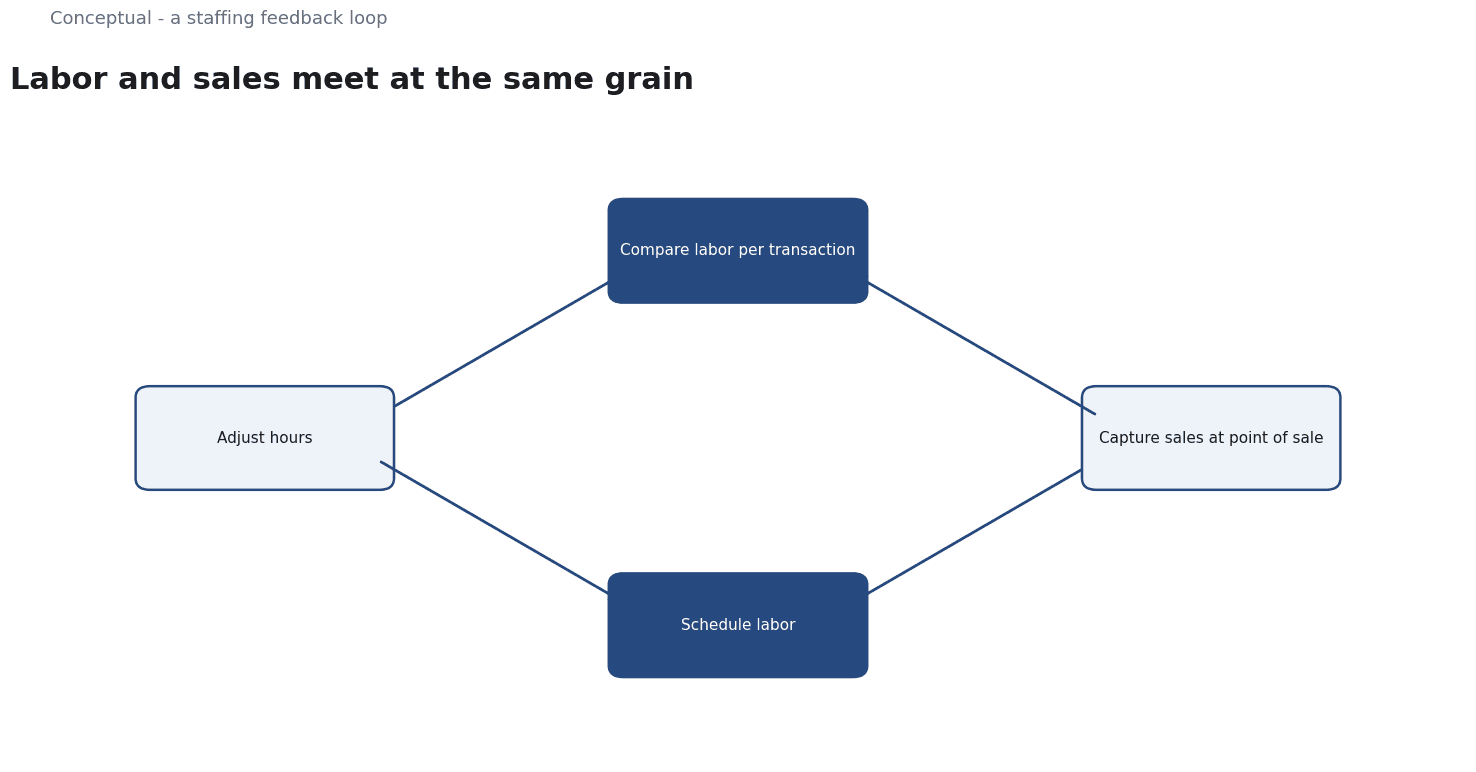
The mechanism is a feedback loop: schedule labor, capture sales at the point of sale, compare, adjust. Its reliability depends on both systems measuring the same window and the same definition of a transaction. Mismatched time windows, unrecorded voids, or labor booked to the wrong department break the comparison. The decision the loop supports is narrow but valuable: how many hours to schedule for a given expected demand.
A worked example
The following is hypothetical and illustrative. A store manager is deciding whether to add two hours to a Saturday afternoon shift.
Three checks decide. First, does the extra labor qualify as direct, meaning those hours will be on the floor touching customers rather than absorbed into tasks that cannot be tied to sales? Second, does the point-of-sale data for that window show a pattern the extra hours could plausibly change, such as a queue that peaks at a predictable time? Third, is the comparison fair, with the same window and the same transaction definition on both sides?
The outcome is a written decision with a review condition: add the hours for four Saturdays, then compare labor cost per transaction against the baseline. If the ratio does not improve, the hours come out. The scenario is hypothetical; the method is the contribution.
Evidence status
| Claim | Status | Source | Verified | Recheck when |
|---|---|---|---|---|
| Direct labor cost is traced to specific work | source-reported | Wikipedia, Labor cost | 2026-11-18 | Definition changes |
| Point of sale records the retail transaction | source-reported | Wikipedia, Point of sale | 2026-11-18 | System scope changes |
| Compare labor and sales at matched grain | inferred | Derived from the sources | 2026-11-18 | Definitions diverge |
The first two rows are documented in the source entries. The third row is a synthesis: the sources define the concepts but do not prescribe the comparison. Recheck it whenever the store changes how it defines a transaction or assigns labor, because then the comparison no longer measures what it claims.
What it cannot do
The frame cannot tell a manager what demand will be. It compares labor to sales that already happened, so it is diagnostic, not predictive. A ratio that looked healthy last Saturday says nothing about next Saturday if a holiday, a competitor opening, or a change in local traffic shifts demand. The manager still needs a demand forecast from somewhere else, and the labor-to-sales comparison cannot supply it.
The hidden cost is measurement. Capturing labor at the right grain means timesheets or scheduling systems that record which hours were actually worked, and point-of-sale data that records clean transactions. Those systems cost money and attention to maintain. If managers round hours or void sales informally, the comparison degrades quietly, and a manager may make confident decisions from numbers that no longer describe the floor.
A shift with high sales and high labor may look inefficient because the ratio is high, when in fact the labor caused the sales by keeping queues short. Without an experiment, such as adding hours for a trial window and then removing them, the comparison cannot separate the two directions. The worked example's trial is the antidote, but it requires discipline to run and to read honestly.
The boundary is direct labor. The frame deliberately excludes indirect labor and such costs as benefits, training, and turnover, all of which are real. A store that minimizes direct hours by cutting training may raise turnover and incur costs that never appear in the labor-per-transaction ratio. The frame is a tool for one slice of cost, not a complete model of store economics.
Finally, the comparison needs a scheduled review. Policies change, transaction definitions drift, and new channels such as online pickup blur where a sale occurs. A ratio that is not re-examined becomes a ritual. Setting a review date and naming an owner keeps the decision honest, and it forces someone to restate what the numbers mean before the next staffing call.
The counterargument that labor is a fixed cost is fair for a small store with a stable schedule and incomplete where demand varies by hour.
The frame earns its keep only when hours can be flexed and sales measured at the same grain.
A decision test
- Define the window and the shift you are deciding about.
- Classify the proposed hours as direct or indirect labor.
- Confirm the point-of-sale data covers the same window and transaction definition.
- Compute the labor-cost-per-transaction baseline for comparable periods.
- Set a trial with a clear change and a review condition.
- Name the owner and the date the decision will be revisited.
- Decide whether to keep, extend, or reverse the change.
A staffing decision is only as good as the grain of the data behind it.
When the labor measure and the sales measure describe the same window, the comparison is a useful constraint on a manager's judgement. When they do not, the ratio is decoration. The decision test exists to catch that mismatch before hours are committed.
For further reading, see Decision Memos That Survive Review.
References & Further Reading
- Wikipedia contributors, 2026. Direct labor cost - Wikipedia — Cost of labour in operations.
- Wikipedia contributors, 2026. Point of sale - Wikipedia — Systems for recording transactions at the point of sale.