The Difference Between Knowing a Tool and Understanding a System
Knowing a tool means operating its interface. Understanding a system means predicting its behavior, diagnosing failures, and choosing between alternatives. The difference matters
Job descriptions list tools. Incidents reveal systems. The gap between the two is where careers stall and production outages happen.
Direct answer: Knowing a tool means you can operate its interface — click the right buttons, write the correct syntax, follow the documented recipe. Understanding a system means you can predict its behavior, diagnose why it failed, and choose between alternatives when the tool is the wrong fit. Tool knowledge is about how to use; system understanding is about why it works and what happens when it does not.
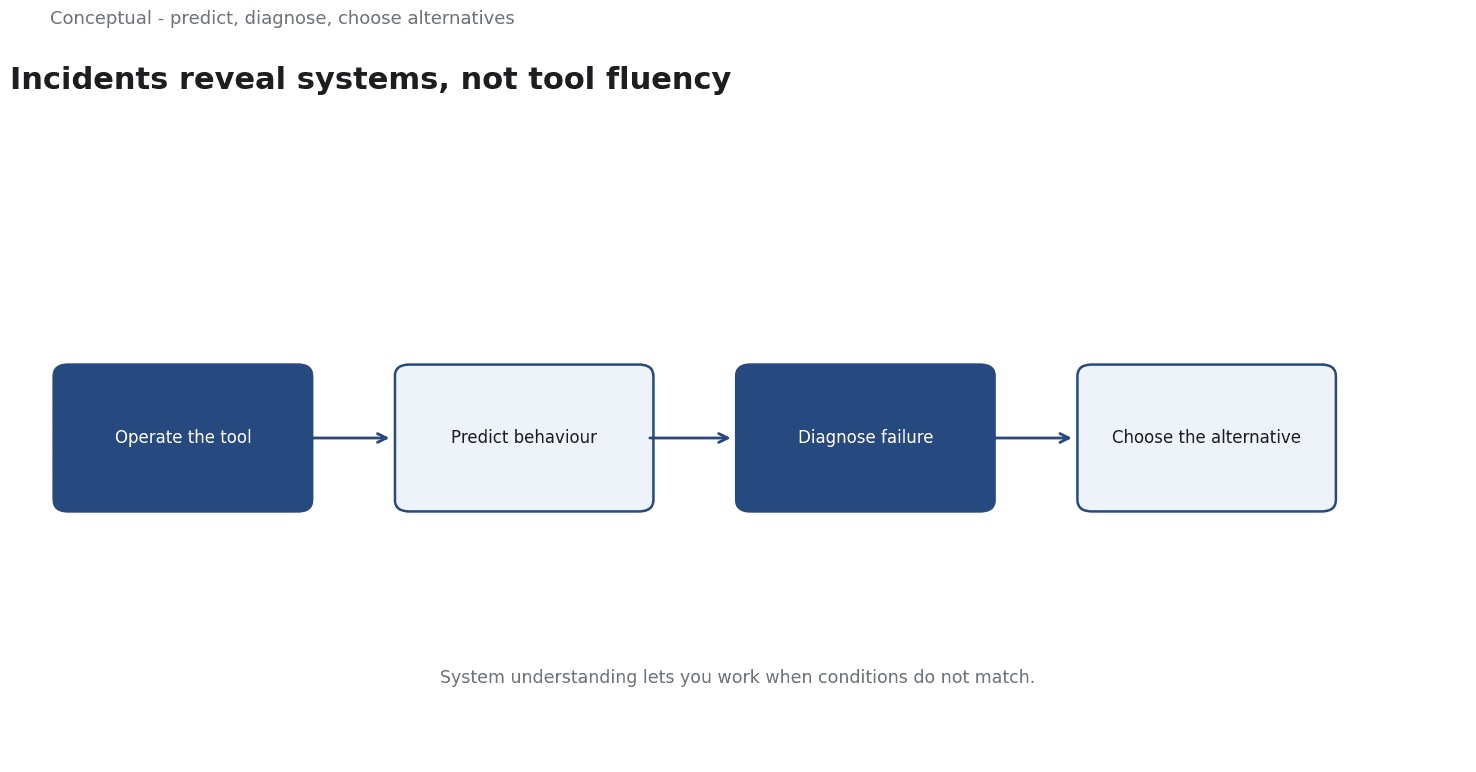
The distinction with examples
| Situation | Tool knowledge | System understanding |
|---|---|---|
| Writing a SQL query | Knows SELECT, JOIN, WHERE syntax | Knows how the database executes the query, what indexes do, and why a full table scan slows down as data grows |
| Deploying with a CI/CD platform | Can push code and trigger a pipeline | Knows what happens between commit and production: build, test, artifact, rollback, and where failure can hide |
| Building a React component | Can write JSX, props, and state | Knows how the browser renders HTML, how JavaScript blocks parsing, and why hydration matters for crawlers |
| Configuring a CDN | Can set cache rules in a dashboard | Knows what a cache key is, how Vary creates separate entries, and why a cold edge misses origin |
Tool knowledge lets you do the task when conditions match the tutorial.
System understanding lets you do the task when conditions do not match — when the query is slow, the pipeline fails, or the vendor changes its API.
Why the gap shows up under pressure
A tool usually works in the happy path. It fails at the edges: timeouts, partial failures, version mismatches, unexpected input. When a SQL dashboard stops refreshing, tool knowledge says "re-run the query." System understanding asks "is the connection pool exhausted, is a lock blocking the table, or did the replica lag?" The first response restarts the symptom; the second addresses the cause.
The same gap appears in hiring and promotion. A candidate who lists ten tools may be less valuable than one who understands two systems deeply, because the latter can learn the third tool quickly and diagnose the first when it breaks.
How to build system understanding
Tool knowledge accumulates by using tools. System understanding accumulates by asking "what is underneath?" for each tool you use:
- Trace one request end to end. Pick a user action in a system you work with and follow it from browser or API call to database and back. Name each hop: DNS, TLS, load balancer, application, cache, query, response. Identify where each hop can fail.
- Break it in a safe environment. Stop a service, fill a disk, kill a process, introduce latency. Watch what the monitoring shows and what it does not show. The gap between what you expected to see and what you saw is your learning.
- Read the source or documentation of the layer below. If you use an ORM, read how it translates to SQL. If you use a framework, read its request lifecycle. You do not need to memorize it; you need to know where to look when something goes wrong.
- Compare alternatives. If you know one CI/CD platform, learn how another handles the same problem differently. The differences reveal what is platform-specific and what is universal.
The honest boundary
Understanding a system does not mean knowing everything. Distributed systems, in particular, are too complex for any one person to hold fully. The goal is not omniscience; it is knowing which layer to investigate, what question to ask next, and when you are outside your depth.
For the related question of how to present proven skills honestly, see How to Build a Technical Portfolio That Demonstrates Real Skills.
A worked example
The following is hypothetical and illustrative. A SQL dashboard that refreshed instantly last quarter now takes minutes as data grows. Tool knowledge says to re-run the query. System understanding asks what changed underneath: whether an index is missing, whether a full table scan now dominates, or whether a lock or lagging replica is involved. The same symptom has several causes, and only one of them is fixed by restarting.
A useful response is to trace one request end to end and then break the system in a safe environment. Stop a service, fill a disk, add latency, and watch what monitoring shows versus what it misses. The distance between what you expected to see and what actually appeared is the learning; a dashboard that glows green while users wait teaches more than a passing tutorial.
The same distinction shows up in modeling. In the Feature Engineering and Selection material, Kuhn and Johnson treat feature construction, resampling, and selection as the substance of predictive work. Calling a library's fit method is tool knowledge. Knowing that a resampling scheme can hide overfitting, or that a feature leaks information from the future, is system understanding of a different layer.
A decision test
Porter's differentiation-versus-cost argument is a reminder that tools are chosen, not merely used. When the tool is the wrong fit, the question is not how to drive it harder but which alternative fits the constraint. A practitioner who understands two systems deeply can learn a third tool quickly; one who lists ten tools but cannot diagnose the first is fragile under pressure.
The honest boundary matters here. Distributed systems are too large for any one person to hold fully, so expertise means knowing which layer to investigate, what question to ask next, and when you are outside your depth. The valuation datasets Damodaran maintains are a good analogy: the value is not memorizing figures but knowing where to look when the number is needed.
So the test is behavioral. Can you predict how the system behaves when conditions change, diagnose a failure below the interface, and choose a different tool when this one is wrong? If you can only follow the documented recipe, you know the tool. If you can answer those three questions, you understand the system well enough to be trusted with it when it breaks.
A counterargument
A reasonable critic would push back on the clean line the article draws between the two kinds of knowledge. Its own sources blur it. Porter's differentiation-versus-cost argument is about choosing a position among trade-offs, a strategic judgment that does not follow automatically from tracing a request end to end. Kuhn and Johnson treat feature construction, resampling, and selection as craft built through practice, which sits awkwardly with a definition of tool knowledge as merely following a documented recipe. Even the Damodaran analogy the article uses concedes that no one holds all the numbers, so the value is knowing where to look. If distributed systems are too large for any one person, the decisive skill may be knowing whom to ask and when to defer - a capability the predict/diagnose/choose test does not score.
The distinction is useful as a direction of travel, but thinner as a binary.
References & Further Reading
- Michael E. Porter, 1996. What Is Strategy? — The differentiation-versus-cost argument behind competitive-advantage analysis.
- Max Kuhn and Kjell Johnson, 2019. Feature Engineering and Selection: A Practical Approach for Predictive Models — The closest thing to a reference text on feature construction, resampling, and selection.
- Aswath Damodaran, 2026. Damodaran Online: Home Page for Aswath Damodaran — Publicly maintained datasets for industry averages, WACC, and valuation.